
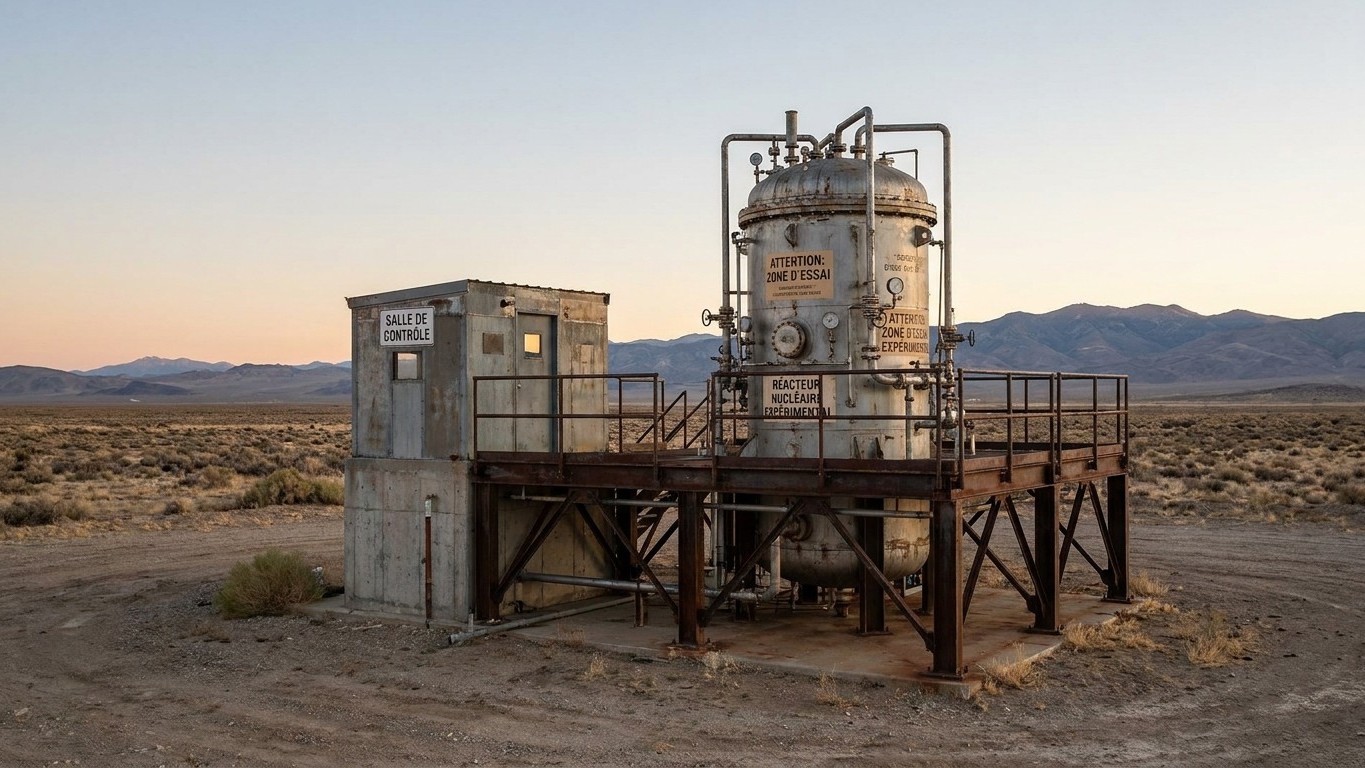
On May 20, 1964, in a remote corner of the Nevada desert, American engineers fired up a nuclear reactor with no shielding for five minutes at full power. The device, named Tory II-C, was not a standalone laboratory experiment: it was the heart of a cruise missile designed to fly at very low altitude, scattering radioactive fallout along its path. A few weeks later, the Pentagon shut the program down. The reason was summed up in one chilling sentence: the weapon was judged too dangerous for the Americans themselves, before ever considering using it against an enemy.
To Remember
- A nuclear-armed missile with no shielding that would have left a trail of contamination in its wake
- A successful test followed by surreal celebration and the next-morning radiation checks
- A weapon so terrifying that even its creators were relieved it was canceled
A Nuclear Ramjet Designed as a Flying Scourge
It all began in 1957, when the United States Air Force tasked the Lawrence Radiation Laboratory with studying a ramjet powered by the heat of a nuclear reactor rather than by conventional fuel. The ramjet concept was straightforward: the vehicle’s motion compressed high-pressure air at the front (the ram effect), a nuclear reactor heated the air, and the heated air was then expelled to produce thrust. The hoped-for result was essentially unlimited range, since there would be no fuel tank to deplete.
The missile that would emerge from this was called SLAM, for Supersonic Low Altitude Missile. It was designed to fly at Mach 3 with an unshielded nuclear reactor and to carry more than a dozen hydrogen bombs. Its own director gave it a nickname that hit home: the “flying crowbar.” The name stuck because it fit: this was not an elegant weapon but a cudgel. Without an interceptor able to stop it, the device would skim the ground at a few hundred meters altitude, invisible to the radars of the era, before dropping its nuclear warheads one by one on several cities in a single mission.
But the true macabre stroke of the project lay in a technical detail. To save weight and boost performance, the designers abandoned all shielding around the reactor core. The SLAM’s reactor sat naked, so to speak, to save weight, leaving the missile to shed a radioactive exhaust trail wherever it flew. And that wasn’t the only hazard: its low-altitude passage generated a shock wave and a noise so violent that they could injure people on the ground. A weapon that didn’t even need to detonate its payload to kill.
Five Minutes That Proved the Improbable
The audacious technical gamble paid off. A first prototype, Tory II-A, roared to life for the first time on May 14, 1961, mounted on a railroad car because no one dared imagine it taking to the air. Three years later, the full-scale version was ready. On May 20, 1964, Tory II-C operated for five minutes at full power, reaching roughly 500 megawatts by the published measurements, with figures ranging from 461 to 513 MW, producing about 35,000 pounds of thrust, in the sight of dozens of Air Force officials and Atomic Energy Commission observers who watched from a safe distance.
The mood that day bordered on the surreal. Livermore engineers celebrated their success by loading a borrowed piano onto a truck and racing to the nearest bar, in Mercury, Nevada, where the program director took his seat at the keys. The celebration was quintessential Livermore: a borrowed piano on a flatbed truck rolled to the nearest bar in Mercury, Nevada… The next morning, the revelers queued at the medical tent for radioactivity checks. An anecdote that reveals a lot: even those who had made the machine run were not entirely sure what, exactly, they had just celebrated.
A Weapon Considered Too Dangerous for Its Own Side
The problem was not just the enemy. It was the impossibility of testing the missile under real conditions without irradiating territory, friend or foe. Serious questions about viability were raised, including how to test a device that would eject large quantities of radioactive exhaust from its unshielded reactor in flight. No one inside the program had a convincing answer.
The strategic context sealed its fate. By mid-1964, the landscape had shifted: intercontinental ballistic missiles had arrived, capable of delivering warheads faster and cheaper than any low-altitude nuclear cruise missile. Why bother with a noisy, radioactive cudgel when a silent rocket could do the job in minutes instead of hours? Some officials even feared the weapon would be “too provocative,” and believed it would spur the USSR to develop a similar device, for which no defense existed.
On July 1, 1964, after seven years and six months of work, the decision fell. In the darkest years of the Cold War, American engineers had designed a weapon so terrifying that many who built it were relieved at its cancellation. The missile never left the ground. Not a single time.
Nor does the story end entirely there. Sixty years later, Russia presented the Burevestnik, a nuclear-powered cruise missile that claims near-unlimited range. Western experts remain skeptical: according to researchers cited by several outlets, there is no credible evidence that Russia has achieved sustained nuclear flight, and a 2019 test allegedly cost several Russian scientists their lives, according to a CSIS analysis. The flying crowbar of Nevada has slept since 1964 in declassified archives, preserved as proof that a technology can work perfectly and yet remain, unimplementable.
Sources: large.stanford.edu | projectblackecho.com | csis.org
