
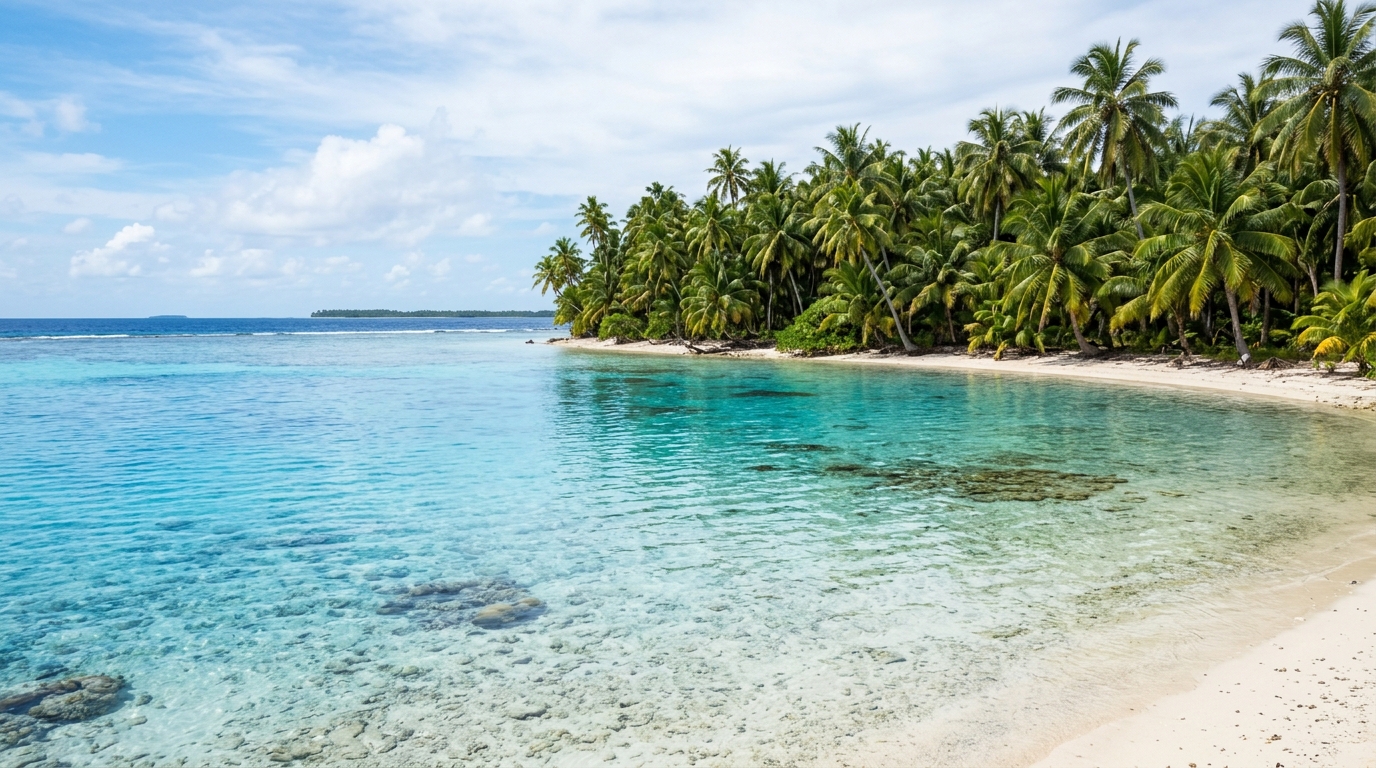
On Palmyra Atoll, a turquoise lagoon no longer hosts a single manta ray. Yet no fishing, no traffic of fins, and no chemical pollution explain this absence. The cause dates back to 1957, when thousands of rows of coconut trees were planted on the island, and quietly, without anyone noticing, ended up drying out an entire marine food chain.
This little speck of land lost in the middle of the central Pacific, roughly 1,600 kilometers south of Hawaii, looks like an exaggerated postcard of tropical paradise. Managed today by The Nature Conservancy and the United States Fish and Wildlife Service (USFWS), Palmyra Atoll conceals an ecological story as discreet as it is fascinating: a human decision made nearly seventy years ago whose consequences are still visible today in the absence of certain emblematic marine species.
A Crystal-Clear Lagoon, Yet Strangely Empty of Life
Anyone diving into Palmyra’s waters would expect to encounter the majestic silhouette of a giant manta gliding between schools of fish. That is precisely the kind of encounter people associate with isolated Pacific atolls, spared from mass tourism and overfishing. Yet here, these ocean giants have deserted some parts of the lagoon, leaving an underwater silence that long puzzled the scientists stationed on site.
What makes the puzzle particularly troubling is the absence of any obvious cause. No abandoned nets, no industrial discharges, no poaching. The water remains clear, the coral reef appears healthy from a distance. It is this apparent normality that led researchers from the University of California, Santa Barbara, to probe not what happened in the water, but what happened on land a few meters away.
The Invisible Thread Linking Birds, Guano, and Plankton
The answer to this disappearance hinges on a word rarely associated with marine biodiversity: guano. On Pacific atolls, seabirds nest by the thousands in the canopies of native trees, particularly in the Pisonia grandis, a dense-leaved tree with many branches perfectly suited for nesting. By digesting fish caught offshore, these birds produce droppings extraordinarily rich in nitrogen and phosphorus, which fall to the ground, seep into the soil, and then slowly wash into the lagoon.
This process, as quiet as it is consequential, plays a truly decisive role. Once in the water, these nutrients trigger real blooms of plankton, the invisible foundation of the entire marine food chain. The plankton feeds small fish, which in turn feed larger species, all the way up to manta rays, which feed by filtering vast volumes of water rich in plankton. In other words, the terrestrial birds were unknowingly nourishing an entire underwater ecosystem located only tens of meters from their nests.
When Planting a Tree Is Enough to Drive Away a Marine Species
That is where the coconuts come into play. Introduced to the atoll in 1957, most likely for agricultural purposes, these coconuts gradually overran large portions of the island, replacing the native forests. The problem is that the coconut tree has a smooth trunk, devoid of accessible branches, utterly unsuited to the nesting needs of seabirds. Where a Pisonia grandis can host dozens of nests, a coconut palm typically harbors none.
Following the manta rays equipped with acoustic tags, researchers observed a strikingly consistent pattern: the animals consistently congregated near the remaining native forest areas, and never approached the sections covered with coconuts. Additional tests conducted at sea confirmed this observation, revealing a markedly higher fish abundance near native forests than near palm plantations. The conclusion was self-evident: by driving away the nesting birds, the coconuts had severed the guano input that fertilized the reef, gradually depriving the lagoon of the plankton upon which manta rays depended.
Palmyra, the Real-Life Demonstration of an Equilibrium You Only See Once It Is Broken
In response to this finding, a vast ecological restoration program was launched on the atoll by The Nature Conservancy, the USFWS, and Island Conservation. The first phase, completed in 2011, involved eradicating the black rats introduced by past human activity, predators that directly attacked eggs and chicks of seabirds. It was necessary to secure the nesting habitat before tackling the tree problem itself.
Since then, more than a million invading coconuts have already been removed from the island, as part of an ambitious project aiming to ultimately replace about two million palm trees with native species. The objective is straightforward on paper: restore suitable nesting sites for seabirds so that the virtuous circle of guano can once again fertilize the lagoon. Palmyra Atoll has thus become a true living laboratory, watched on an international scale, to understand how the climate resilience of atolls depends on a delicate and unsuspected link between forest and coral reef.
This story, in its almost disarming simplicity, reminds us how ecosystems function as networks of invisible balances, where the disappearance of a seemingly minor link—here, a replaced tree—can cause an entire chain to collapse, reaching even into the ocean’s depths. At a time when many Pacific atolls face increasing climatic pressures, Palmyra’s example invites us to wonder how many other equally discreet connections between land and sea remain to be discovered before it is too late to protect them.
