
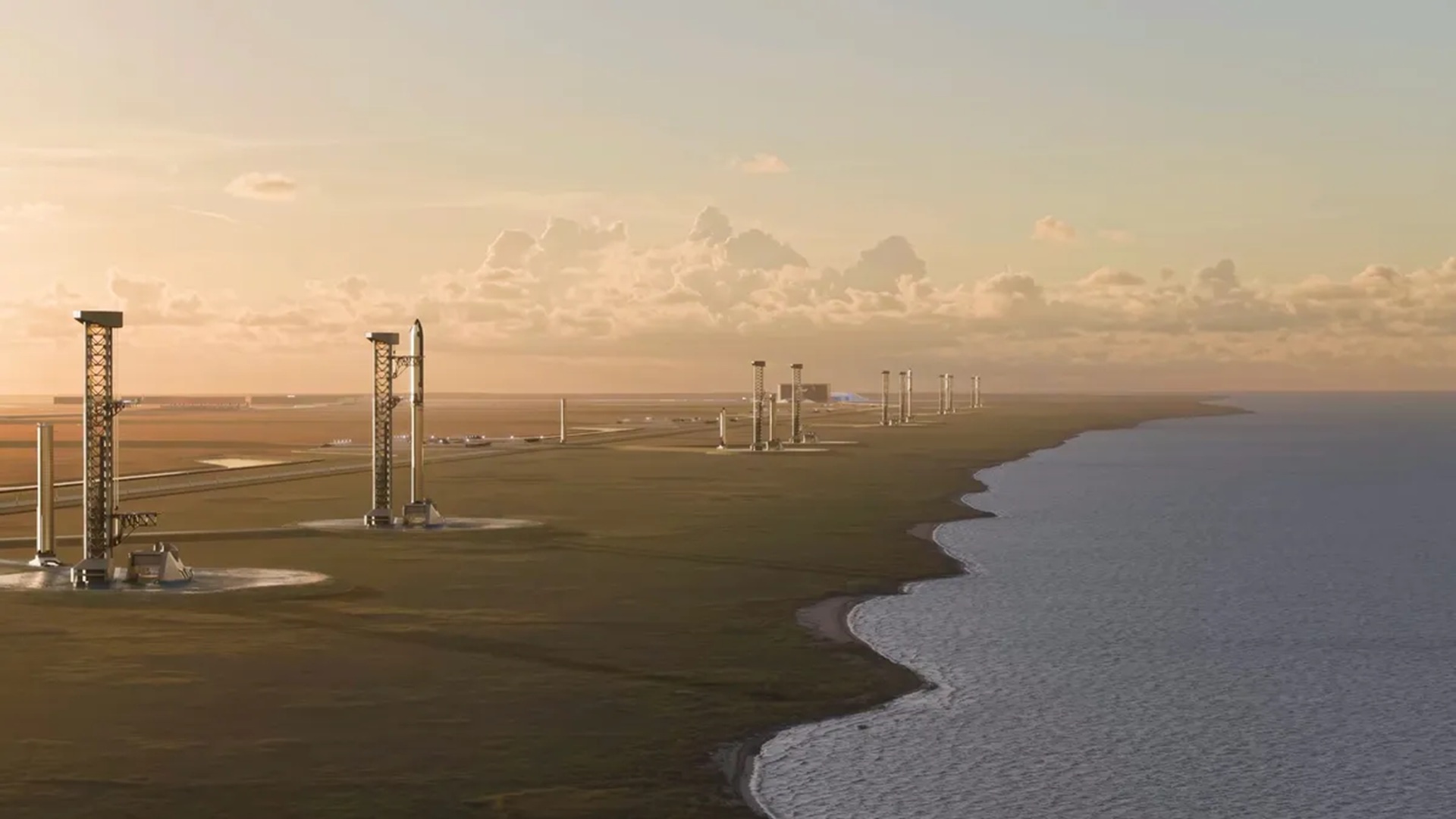
What if the next great leap for humanity into space didn’t start in a barren desert, but in a humid, mosquito-infested swamp somewhere south of Louisiana? The notion may be surprising, even disconcerting. Yet it is precisely on terrain like this, amid stagnant waters and reeds, that SpaceX chose to lay the foundations for what will likely become the largest launch complex ever built by a private company. A project valued at $100 billion, announced this week, that disrupts both the norms of the space industry and the tranquil landscape of Vermilion Parish.
An extraordinary industrial bet in the Louisiana wetlands
SpaceX isn’t simply adding another launch ramp. Elon Musk’s company announced the creation of Starbase Louisiana, a colossal industrial complex erected on a former Exxon property on Pecan Island, in Vermilion Parish. The stated objective is dizzying: to manufacture and launch Starship rockets at a cadence that no space agency or private actor has ever achieved to date, with the declared aim of surpassing thirty flights per day once the site is fully operational.
This site will become SpaceX’s fourth launch site on American soil, and by far the largest. In the long term, it is expected to host five distinct launch complexes, each equipped with two launch towers, for a total of ten launch pads spread across roughly 125,000 to 130,000 acres, or about 50,600 hectares of coastal land. A colossal project, set on swampy ground that is already reshaping the local economy and landscape even before the first shovel is turned.
Why Louisiana and not a Texan or Floridian desert
The choice of site naturally raises questions. SpaceX could have favored an arid, familiar terrain, like its historic Boca Chica site in Texas, or leaned more on Cap Canaveral’s existing infrastructure in Florida. Instead, the company bets on an old industrial site in a wetland area, a ground that at first glance seems ill-suited for aerospace.
Yet this terrain is not incidental. It offers direct access to navigable waterways, a crucial asset for transporting the massive Starship segments, far too bulky to travel on ordinary roads. The project even envisages constructing a true deep-water port integrated into the complex. The immediate proximity to the Gulf of Mexico also enables landing trajectories that are well clear of densely populated zones, a strategic advantage that few other American sites can offer with such established river infrastructure in place.
A production cadence that challenges the space industry
SpaceX aims for a production and launch cadence never before approached in the history of spaceflight. We’re talking about multiple giant rockets being assembled and tested in parallel at a single site, in an almost industrial logic that stands in stark contrast to traditional spacecraft craftsmanship. The company’s president, Gwynne Shotwell, spoke of the prospect of “thousands of launches per year” from this single complex.
This ambition rests on a model already proven at Starbase in Texas, but amplified to an unprecedented scale in Louisiana. The goal is to drastically reduce the time between two Starship launches, by assembling the rockets almost as vehicles along a production line. If this pace proves sustainable, it would redefine industry standards: traditional space agencies still operate on cycles of several months, or even years, between major launches.
Technical challenges of swampy, unstable ground
Building a launch base on a swamp presents unique technical constraints, almost unheard of at this scale. Ground stability, continuous water management, and the natural erosion of the Louisiana coast complicate every stage of the project, which is slated to begin in 2027 with a first launch planned for 2029. Engineers will almost certainly need to deepen the foundations, a cost overrun SpaceX seems prepared to shoulder in order to capitalize on the site’s unparalleled logistical advantages.
The local climate, marked by regular hurricanes at this time of year, adds another variable to the equation. No major space facility has ever been designed to withstand this kind of environment on such a scale. To mitigate these risks, SpaceX plans to incorporate into the complex its own fuel production facilities, a power plant, housing for workers, and even an airport, with the aim of making the base fully self-sufficient, capable of operating in near-autonomy even in the event of climate-induced disruptions.
What impact for Vermilion Parish and its residents
SpaceX’s arrival would upend a modestly endowed region, where the average salary remains well below the national average. The company promises the creation of 3,000 direct jobs over the next decade, with an average annual pay of $92,600, which is nearly 192% higher than Vermilion Parish’s current average. Louisiana Economic Development also estimates the project will generate more than 8,100 indirect jobs, while Elon Musk himself mentioned in a video the possibility of bringing “probably 10,000 really exciting jobs” to the state.
But residents are divided. The wetlands involved host a sensitive biodiversity, including dozens of migratory bird species for whom Pecan Island is a protected habitat. Local associations are already worried about the ecological and fishing impacts, a traditional activity in the region. In response to these tensions, SpaceX says it will offset ecological impact with broad coastal restoration measures, promising “thousands of acres of marsh creation through the beneficial deposition of dredged materials.” The company has also committed to paying $25 million per year for twenty-five years to the parish, plus an initial $20 million, as well as a $25 million donation to a local community foundation. A state law enacted shortly before the announcement could, however, limit residents’ legal recourse against certain aerospace projects, which already fuels criticism from environmental advocates.
Ultimately, this project crystallizes the same tensions seen elsewhere when a global industrial giant moves in: the promise of spectacular economic development on one side, ecological and social risks on the other, in a region that had never imagined hosting the space industry on its soil. It remains to be seen whether Vermilion Parish will be able to harness this windfall without sacrificing what still gives its marshes their fragile charm today.
