
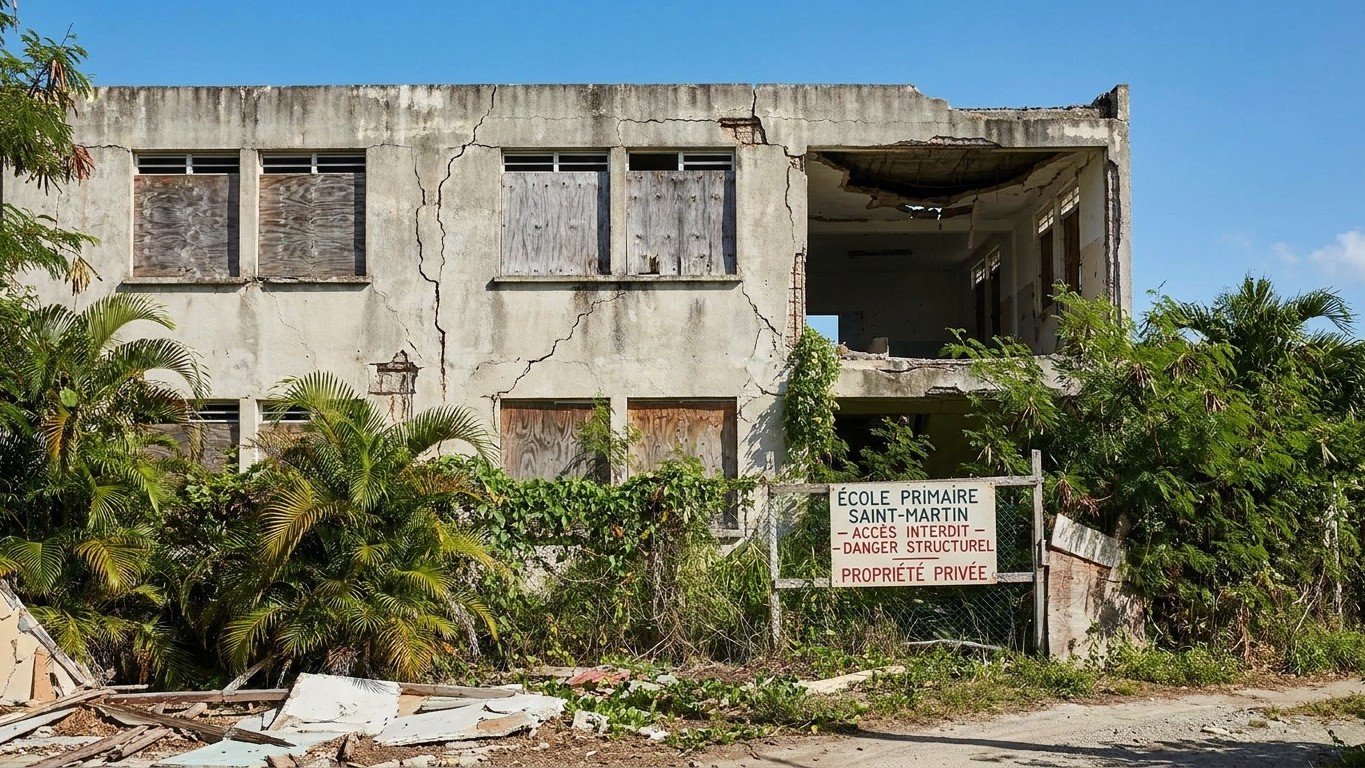
Fifty-two point seven million euros have been spent out of the 230 million programmed. The rest? Still sitting in the State’s coffers, eight years after Irma erased half of Saint-Martin’s built environment. Of the 230 M€ available for post-Irma reconstruction, only 52.7 M€ has been spent, due to the failure to equip themselves with the necessary engineering capabilities to carry out these operations. This figure, revealed by the territorial chamber of accounts in a report of definitive observations published in 2025, sums up the Saint-Martinois paradox: the money was there, ready to be spent, and no one knew how to use it.
Back in time. In the night from September 5 to 6, 2017, a climatic behemoth struck the island. Hurricane Irma ravaged the islands of Saint-Martin and Saint-Barthélemy, with wind gusts exceeding 300 km/h and torrential rains. The human toll was heavy: on the French side of Saint-Martin, officially eleven dead, seven missing, and more than 250 injured. On the infrastructure side, the assessment was equally brutal: across the territory, 56% of infrastructure was moderately to severely damaged or destroyed. The material damages, insured, exceeded one billion euros for the French part.
À retenir
- 177 millions d’euros dorment toujours dans les caisses de l’État huit ans après la catastrophe
- Saint-Martin dispose de tous les financements mais manque des équipes d’ingénierie pour les utiliser
- Saint-Barthélemy, touchée par le même ouragan, a presque terminé sa reconstruction : la différence réside dans l’administration, pas dans l’argent
Un plan de 230 millions, une collectivité sans les outils pour le piloter
Facing the scale of the disaster, the State pledged a massive effort. A reconstruction protocol was signed, and a development plan valued at 230 million euros was approved by the collectivity in 2018. On paper, everything needed to rebuild quickly was in place: schools, water networks, sea-dike protections against submersion, public buildings. In practice, little moved, or next to nothing. The territorial chamber of accounts, in its report on the 2019 and subsequent exercises, is unequivocal: affected by the consequences of the 2017 Irma cyclone and the 2020 health crisis, the Saint-Martin territorial collectivity did not complete its reconstruction and still does not fully master the competencies assigned by the 2007 institutional reform.
The crux of the matter was therefore not financial. That is where the report challenges received wisdom. One might have imagined files stuck in Paris, endless budgetary arbitrations, and construction firms unable to keep pace on an isolated island. The reality is more prosaic, and more disconcerting: the collectivity itself never had the necessary technical services to assemble the files, estimate the works, launch calls for bids, and monitor the projects. Credits opened, available, earmarked for specific projects, remained dormant for lack of personnel capable of processing them. Meanwhile, damaged schools continued to host students year-round in rotating schedules, and dikes intended to protect neighborhoods exposed to marine submersion never left the file drawers.
This lack of engineering also proved costly elsewhere. On the European stage, the collectivity hoped to receive 46 million euros from the European Union Solidarity Fund. It obtained only half. The weakness of the collectivity’s management prevented it from obtaining 25 million euros of the 46 million planned by the European Solidarity Fund, notably due to a failing public procurement process. The same logic, the same symptom: it is not the amount of aid that was missing, it is the ability to seize it.
Des écoles reconstruites, mais un parc de bâtiments toujours à moitié en ruine
Not everything is frozen, however. The schools benefited from priority treatment, and the results show it. A prior report from the Court of Auditors already noted this: despite the adoption of an ambitious 230-million-euro development plan approved by the collectivity in 2018, the rebuilding of the buildings destroyed in Saint-Martin remains very partial: less than half of the building stock and equipment has been reconstructed, with the exception of schools and high schools, which are now almost all upgraded. In practical terms: children have returned to classrooms that are fit for purpose, but gymnasiums, sports facilities, administrative buildings, or protective dikes remain, for a large part, in the state Irma left them.
The contrast with Saint-Barthélemy, its neighbor hit by the same hurricane the same night, drives the point home: only 18% of its infrastructures were damaged, compared with 56% on the French side of Saint-Martin, but more importantly, the Barthélean collectivity had an administration skilled in project management. Result: its reconstruction is now almost complete, while Saint-Martin is still floundering. Same catastrophe, same theoretical funding, two radically different trajectories. The difference is not the State’s check. It is the engineering behind the check.
Une situation financière qui s’aggrave pendant que les chanti
The most worrying aspect is that this delay is not a mere setback that will fade over time. The territorial chamber of accounts highlights a continued deterioration of local finances: between 2019 and 2023, expenses rose by 41 M€, mainly due to a larger workforce, while revenues fell by 19 M€. The collectivity hires more while collecting less in taxes and fees, a budgetary squeeze that does little to ease, even partially, the financing of projects that the State does not cover.
One question remains largely open: who, the State or the collectivity, should now take back the reins of project engineering? Strengthening a local technical team requires years of recruitment and training, a luxury Saint-Martin can hardly afford before the next major hurricane season. In the meantime, the 177 million euros that have not been spent continue to await somewhere in a Treasury account, while residents pass each year in front of public buildings that are walled up, eight years after the storm.
Sources : vie-publique.fr | senat.fr | assemblee-nationale.fr
