
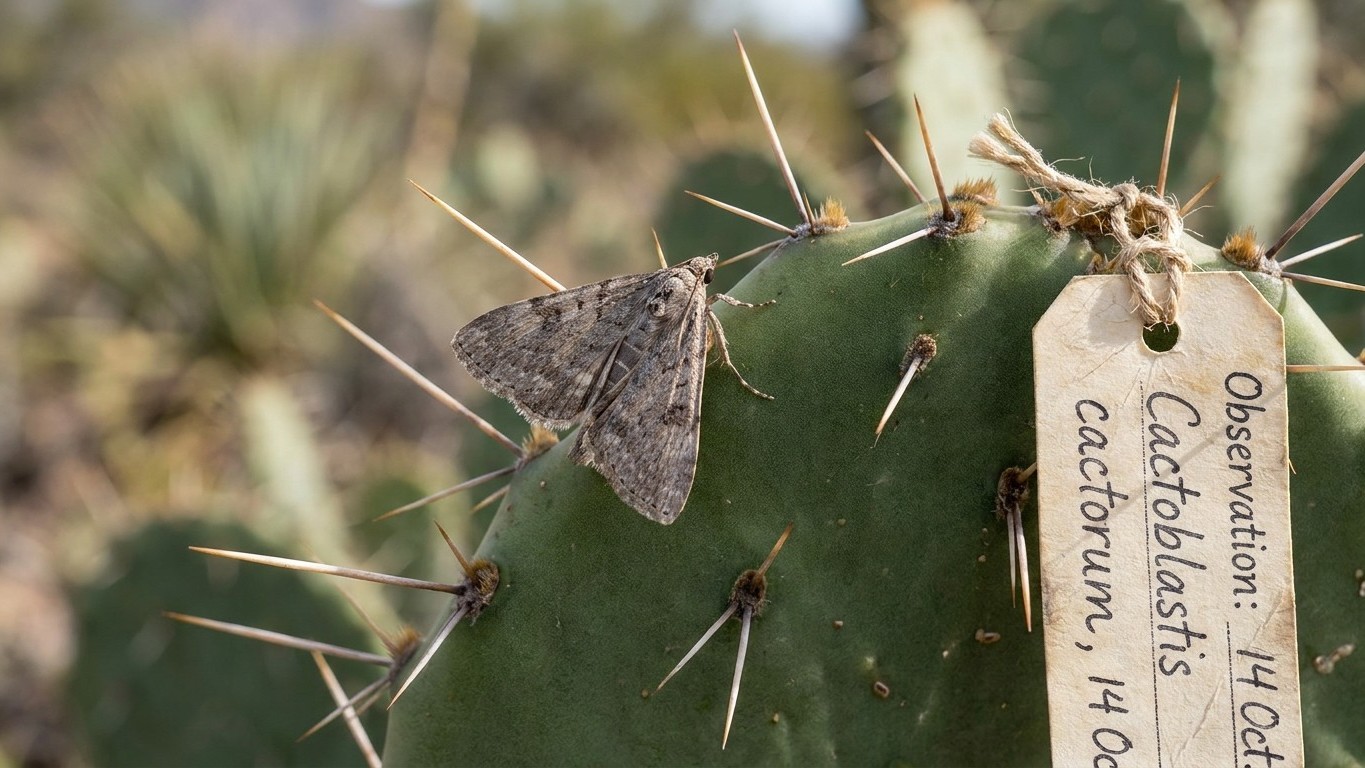
In 1926, Australians literally wiped out 25 million hectares of cactus by releasing a few hundred Argentine butterflies into the Queensland bush. Not a figure rounded for effect: it was indeed 25 million hectares in Queensland and New South Wales that were infested as early as 1925. A surface area comparable to the United Kingdom, swallowed by an entanglement of green spines. And the solution that ended this agricultural nightmare lay in a box of lepidopteran eggs.
Key takeaways
- A small gray-brown butterfly becomes the secret weapon against an invasive plant that paralyzed an entire continent
- From 527 females to 3 billion eggs distributed by trucks: an exponential multiplication that changes everything
- This spectacular success masks a more nuanced lesson about the unintended consequences of biological solutions
A Mexican cactus turned into a national nightmare
It all begins with a well-meaning colonial impulse. The prickly pear cactus, a succulent plant native to Mexico recognizable by its spiny paddles, was introduced into Australia as early as the late eighteenth century. It could have arrived with the First Fleet, but it is especially from the 1840s that many farmers deliberately plant it, as a hedge to keep cattle at bay and as a fodder reserve during drought. A utilitarian crop, planted to serve a purpose. It would eventually serve another purpose, that of devouring agricultural lands.
The cactus knows no bounds. At the start of the twentieth century, large tracts of agricultural and pastoral land are already infested, the plant advancing at roughly 404,686 hectares per year. A dizzying pace: each passing year corresponds to a small European country disappearing beneath the thorns. The invasion is described as a “dangerous enemy” advancing inexorably in contemporary accounts, a warlike image that is hardly exaggerated given how uncontrollable the phenomenon has become. Entire farms become unworkable, lands lose all value, and rural families have no choice but to abandon their operations.
Authorities try harsh measures first. Manual clearing, uprooting, chemicals: nothing works. The early attempts at mowing and poisoning prove ineffective, because the prickly paddles of the cactus easily reestablish themselves. Cut one stem and it regrows elsewhere. The plant seems immune to any straightforward destruction. Faced with this impasse, Australian scientists switch strategies radically: if the plant cannot be killed by hand, then find it a natural predator.
The arrival of the butterfly that would change everything
As early as 1912, Australian researchers embark on a methodical hunt for biological control agents—organisms capable of limiting the spread of another organism. The work is monumental: they must identify an insect that attacks the prickly pear without threatening neighboring crops. After testing 52 species, 18 insect species, and one mite, they finally release into Queensland a total of 18 candidates, including the moth and several other agents.
Among all contenders, one clearly stands out: the moth Cactoblastis cactorum, accompanied by five varieties of cochineal insects. Originating from South America, this small gray-brown lepidopteran is unimpressive to the naked eye. But its caterpillar has a formidable appetite. The caterpillars consume the interior of the prickly pear, leaving only empty shells, and they multiply at a phenomenal rate.
Laboratory breeding approaches near industrial scale. After two unsuccessful attempts in the early 1920s, 3,000 eggs of Cactoblastis cactorum are imported from Argentina, half sent to the Chinchilla experimental station and the other half kept in Brisbane. From a population of 527 females, 100,605 eggs hatch: the butterfly proves extraordinarily productive, and the second generation yields more than 2.5 million eggs. The multiplication rate is dizzying, nearly matching the scale of the invasion it is poised to combat.
The rapid reconquest of Australian lands
The first release takes place in 1926, amid a blend of skepticism and cautious hope. Once the initial butterflies are released, the Chinchilla station eventually ships up to 14 million Cactoblastis eggs per day across Queensland and New South Wales, at the height of the operation. Trucks traverse the countryside, loaded with egg-filled boxes destined for landowners in distress. The first 10 million eggs are distributed between 1926 and 1927, and nearly 3 billion eggs are delivered to farmers by 1930, carried by a fleet of seven trucks.
The results exceed all expectations, including those of the most optimistic scientists. In just a few years, the landscape undergoes a radical transformation: where there were vast seas of impassable cactus, there are now workable pastures and sugarcane fields. By 1933, it was estimated that 80% of infested lands in Queensland had been cleared, with 50–60% cleared in New South Wales.
This success, still cited today, remains a global benchmark. The initial release of Cactoblastis cactorum into the Australian environment in 1926 is regarded as one of the most spectacular examples of biological weed control in the world. Two towns in Queensland, Dalby and Boonarga, even erected monuments in honor of this small insect from Argentina, a rare gesture recognizing a region’s debt to a lepidopteran.
The story, however, does not conclude with a total and permanent victory. In the 1930s, the plants were brought under control but not completely eradicated, and the prickly pear continues to reappear in certain pockets of Australia. The flip side of this success story traveled well beyond Queensland: later introductions to the Caribbean and then to the southern United States were intended to replicate the feat, and today the same butterfly threatens several endemic cactus species in Florida, reminding us that a biological remedy, as effective as it may be in its own domain, is never entirely without consequences once released elsewhere.
Sources: environmentandsociety.org | les-jardins-de-koantiz.fr
