
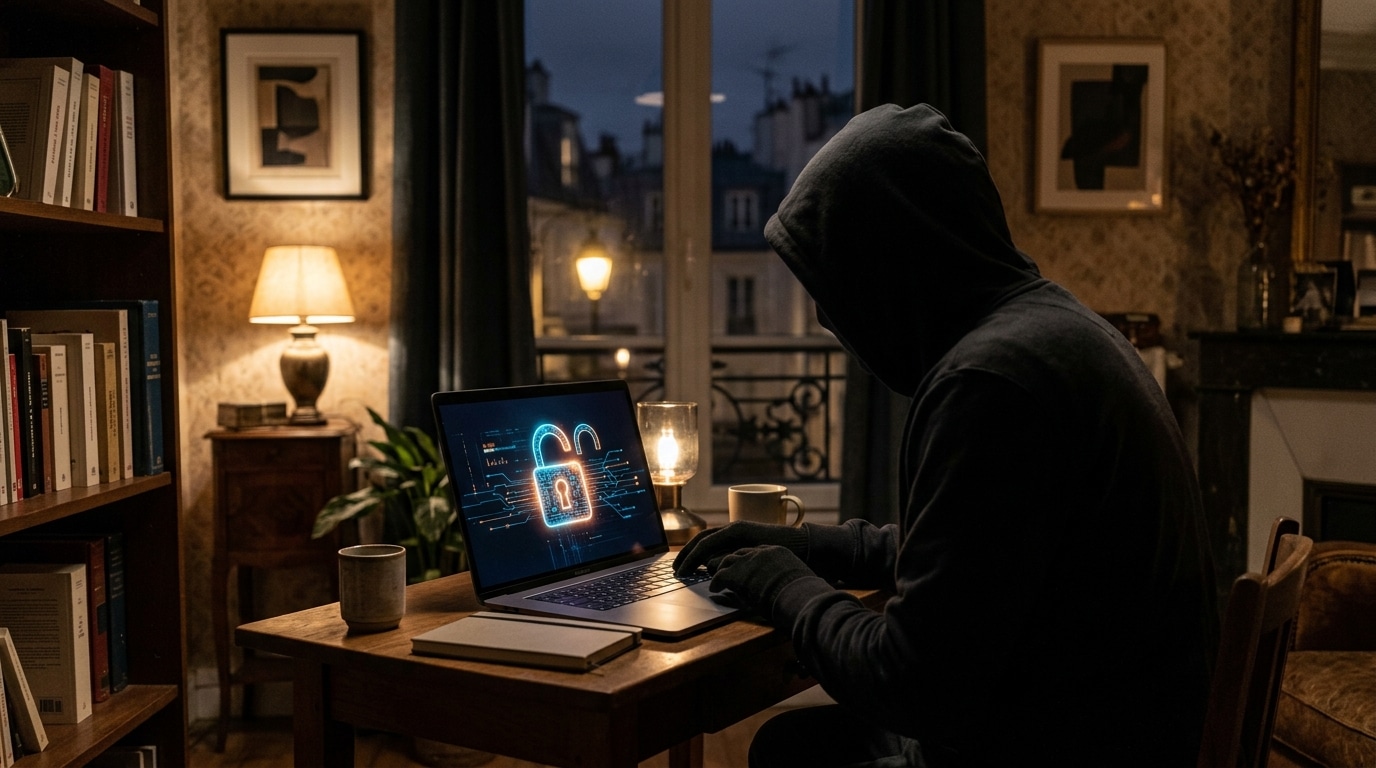
You have enabled two‑factor authentication on your most valuable accounts, and you finally feel at ease. This extra step, the code you receive by SMS or one generated by an app, was presented as the ultimate lock, the door that cannot be picked. Yet, a troubling reality has been pressing through the cybersecurity world for some time: hackers no longer need your password, not even that famous code. A small, discreet file, tucked away in the depths of your browser, is enough to fling the door wide open. They enter your home without forcing entry, without an alarm, and above all without ever asking for a key. Understanding this mechanism is already a first step toward protecting yourself.
The token that is worth more than a password
When you log in to a site, after you’ve entered your password and validated your two‑factor code, the service won’t ask you for all of that again at every click. That would be intolerable. Instead, it hands you a small digital pass: the session cookie. Think of a festival wristband. Once the bouncer has checked your ticket and your ID at the entrance, he slips this bracelet onto your wrist. You can then move in and out freely: no one will ask for your papers again, the bracelet speaks for you.
The problem is that this session cookie already contains an invisible marker indicating that two‑factor authentication has indeed been completed. In other words, it doesn’t just prove that you’re logged in: it certifies that you have passed all security steps. For a hacker, grabbing this file is like stealing the already‑validated festival bracelet. He no longer needs to know your password or intercept your code: the key itself carries the proof of your legitimacy.
How the pirates recover this invisible sesame
These cookies don’t float in the air: they are safely stored on your computer inside SQLite database files. These files hold key–value pairs, with session tokens and their expiration dates. And here lies the entire difficulty: attackers know exactly where to look. On Chrome, on Firefox, on the major browsers across different operating systems, the location of these files is well known. The attack can therefore be fully automated.
Two major methods stand out. The first relies on information‑stealing malware, which specifically targets users of Google Chrome, the world’s most widely used browser. Once installed on your machine, this malware makes no noise. Its sole mission is to plunder your data: passwords, autofill information, and, above all, active session cookies. It aims at high‑value targets: your bank, your email, your cryptocurrency platforms, your corporate portals. The second method rests on so‑called man‑in‑the‑middle attacks. Specialized tools like EvilGinx2 slip in as a proxy between you and the legitimate site, capturing your password and your two‑factor token on the fly while you log in with confidence.
Why the second factor becomes useless in the face of this attack
This is where the real revelation lies, and it is chilling. Once a hacker possesses your session cookie, they merely need to import it into their own browser. The site then recognizes you as if you were at your keyboard. This is what is known as a “Pass‑the‑Cookie” attack: the authorized session is simply replayed, again and again, without ever triggering any code request. The attacker never sees your password, never needs your one‑time code. He obtains full and instant access.
Even more troubling: this bypass remains possible even after the browser is closed. So the theft is not merely a fleeting event tied to an open session. And the scale of the phenomenon is staggering. There have been reports of the theft of 17 billion cookies exploited in attacks. So many doors potentially left ajar, with two‑factor authentication powerless to stop it, since the flag attesting its validation travels directly in the stolen file.
The habits that close the door before it opens
In light of this assessment, it’s best not to panic, but to adopt a few prudent habits. The first line of defense remains preventing malware from installing in the first place: be wary of suspicious attachments, software downloaded from unofficial channels, and questionable browser extensions. These information thieves need to invite themselves into your house before they can rummage through your files.
- actively sign out of sensitive services rather than leaving sessions open indefinitely.
- regularly review active sessions in your account settings and revoke those you do not recognize.
- keep your browser and operating system up to date, as patches often seal the vulnerabilities that are exploited.
- monitor unusual logins reported by your email or banking services.
Staying vigilant against phishing attempts is also a decisive defense, since proxy attacks rely precisely on baited pages that mimic legitimate sites with perfect accuracy. A link received in an unexpected message should always be met with a moment of hesitation.
Two‑factor authentication is not obsolete, far from it: it still blocks the vast majority of traditional attempts. But it is not the impregnable fortress we were told. The Achilles’ heel is no longer the password, nor the code, but this small discreet file that proves your identity once and for all. At a time when our digital lives are concentrated on a few essential accounts, shouldn’t we rethink our blind faith in these invisible locks, and rediscover the value of simple but constant vigilance?
