
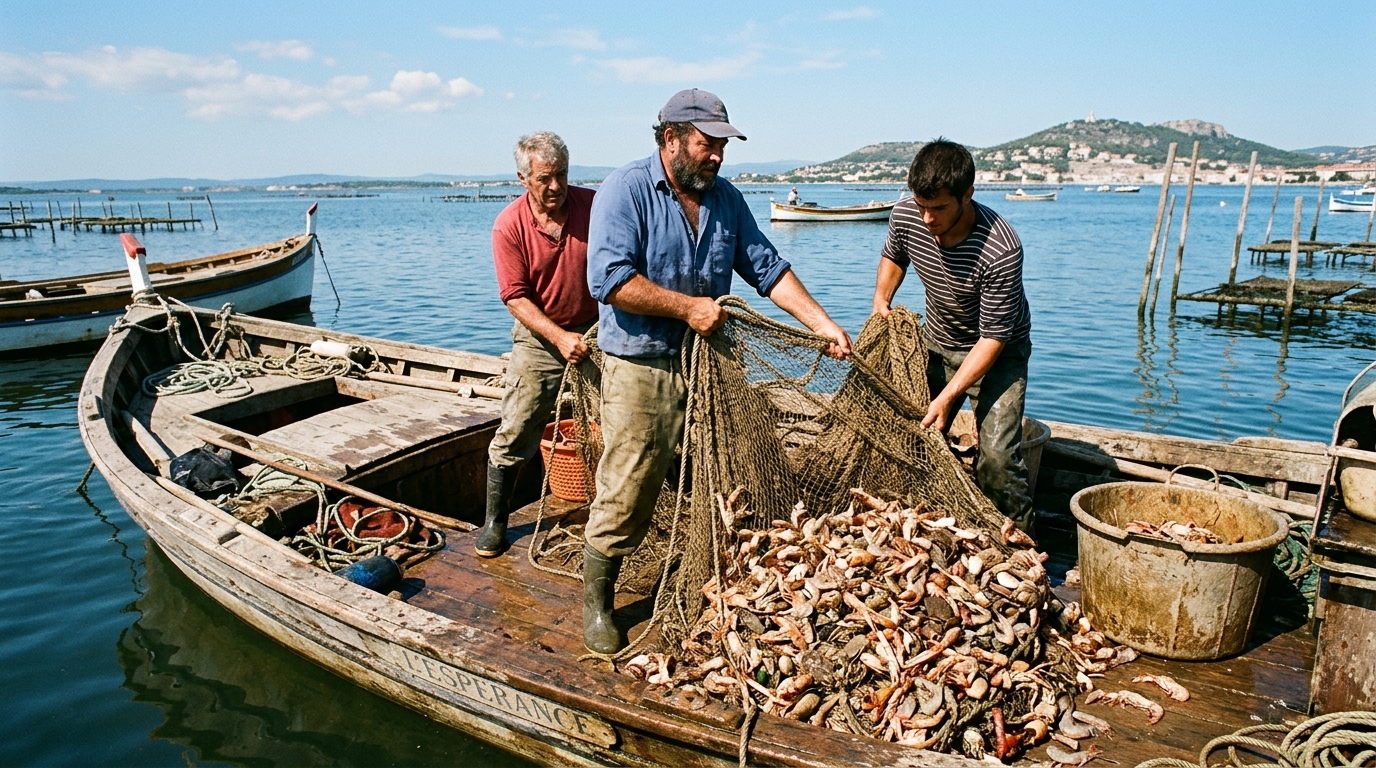
A crustacean with vivid blue pincers, capable of devouring anything that crosses its path, has settled in the lagoons of the Hyères Saltworks without warning anyone. In 2023, the nets set in these calm waters yielded only three isolated specimens, almost a curiosity for local naturalists. Today, hundreds of individuals pile up each week in the site managers’ traps. This rapid rise worries scientists as well as maritime professionals, who see in this silent invasion a troubling signal for the already fragile balance of these protected lagoon ecosystems. Because behind this demographic explosion lies a creature from very far away, as fascinating as it is unsettling.
A Predator From America That Fears Nothing
Its scientific name, Callinectes sapidus, literally means “delicious good swimmer.” A name almost prophetic for this species native to the Atlantic coasts of America, ranging from Nova Scotia to Argentina. Easily recognizable among a thousand by its claws in an intense ultramarine blue and a span that can reach 15 centimeters across, and up to 23 centimeters and nearly 800 grams for the largest individuals, this crab is far from a discreet visitor. It is a true opportunistic predator, omnivorous and even cannibalistic on occasion, capable of swallowing as many as 15 clams per day. Mollusks, shells, small fish: nothing seems to escape its voracious appetite.
What makes its establishment all the more problematic is that it has no natural predators in the Mediterranean. Left to its own devices in an environment that doesn’t know its rules, it thrives without constraint. Its presence in French waters is believed to date back five or six years, probably transported by ballast water from commercial ships, a mode of introduction now well known for many marine invasive species.
Why Hyères’ Lagoons Have Become Its Ideal Playground
If the blue crab has acclimated so well to the Hyères Saltworks, it is because this area offers exactly the conditions it needs to flourish. It tolerates a very wide range of salinity, from the freshwater waters of rivers to the open sea, allowing it to colonize extremely varied environments without any adaptation effort. The lagoons, with their shallow, warm waters and abundant food, provide it with an open pantry.
Another formidable advantage: its mobility. This crustacean can travel about 15 kilometers per day, enabling it to quickly colonize new territories and to spread along the coastline far faster than one might imagine for an animal of its size. Add to that an extraordinary reproductive capacity, with a female capable of producing hundreds of thousands of eggs per spawning, and you get a species that ticks all the boxes to become a formidable invader. The Hyères Saltworks, classified as a Natura 2000 site and serving as a nursery for many local species, thus becomes a particularly exposed area, where monitoring has intensified in recent months around the Pesquiers Saltworks and the Old Saltworks.
Fishermen Between Worry and Unexpected Economic Opportunity
On the ground, opinions are divided. On one hand, concern dominates in the face of a creature that directly threatens resources traditionally exploited in these lagoons: scallops, shellfish, and small fish form a significant portion of the local ecosystem and of artisanal fishing activity. On the other hand, a path is slowly emerging: exploitation. The blue crab is already eaten in the United States, where it is even considered a delicacy, as well as in some Mediterranean countries facing the same phenomenon.
Given the impossibility of eradicating the species entirely, the most serious option today is to turn this invader into an exploitable resource. Intensive fishing, rather than a mere environmental management measure, could thus become a real economic outlet for local professionals, provided that marketing channels rapidly organize around this new addition to people’s plates.
An Invader That Could Rebalance the Cards of an Entire Mediterranean Ecosystem
What is unfolding in Hyères goes far beyond the local scene. Elsewhere in the Mediterranean, notably in Italy, the presence of the blue crab has already caused substantial damage to certain conchery sectors, with dramatic drops in production observed in several lagoons. These worrying precedents show how much this species can durably disrupt lagoon ecosystems by directly attacking the bases of the local food chain.
To better understand its behavior and anticipate its spread, specimens are now being collected across the entire Mediterranean arc to study more closely its reproductive behavior and population dynamics. This scientific approach aims to better grasp an animal that we already know will not leave on its own. The question is therefore no longer whether the blue crab will remain permanently installed in the French lagoons, but rather how to learn to coexist, or even to capitalize on, this invasion from another continent.
From three discreet individuals in 2023 to several hundred regular captures today, the story of the Hyères Saltworks blue crab illustrates how quickly a species from elsewhere can establish itself in an ecosystem that was not prepared to welcome it. Between an evident ecological threat and a still-embryonic gastronomic opportunity, this small crustacean with blue claws reminds us that in biological invasions, nature often has the upper hand on our ability to anticipate. The question remains: tomorrow, will it really be the one that ends up on our plates, or will our marine balance continue to pay the price?
