
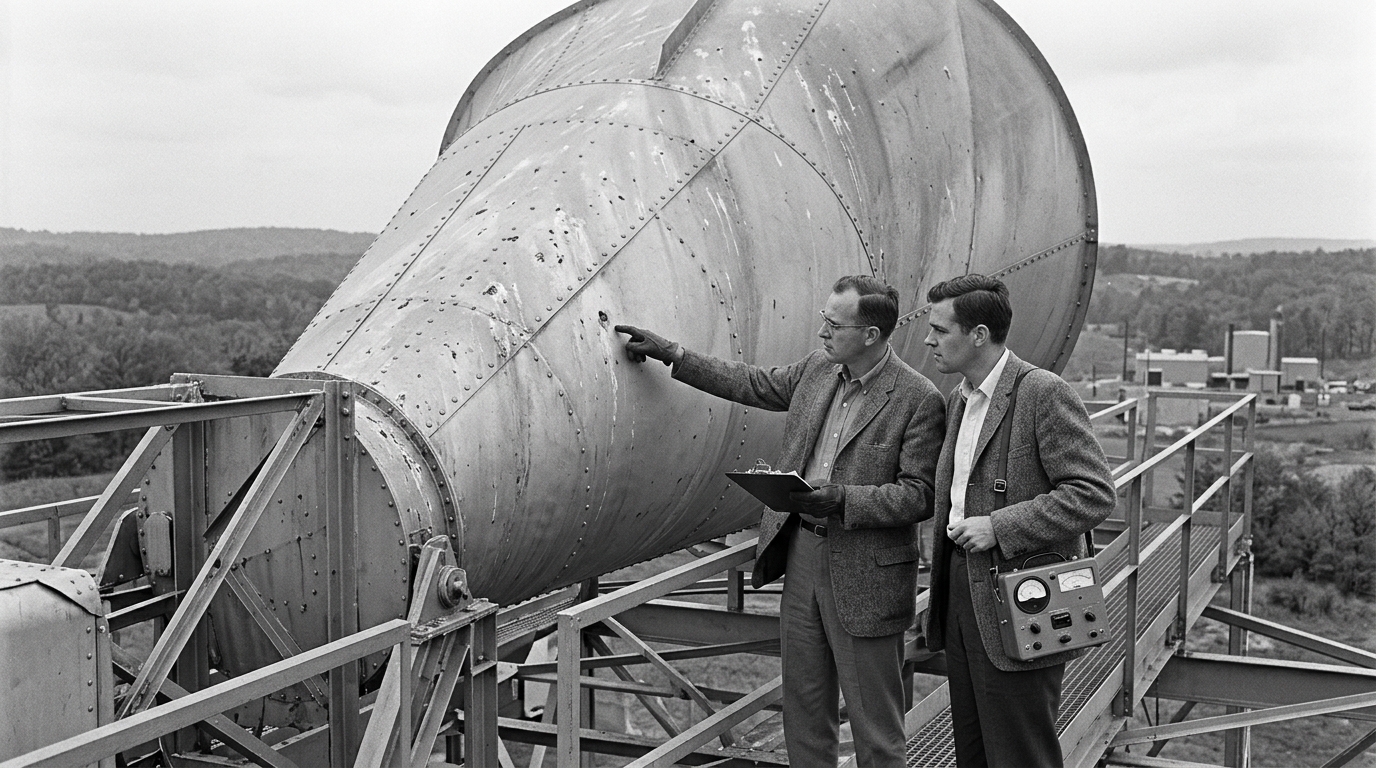
A mere background murmur. A vexing electronic whisper that refuses to disappear, no matter which direction you point the antenna. That, in its most stripped-down essence, is the story of one of the greatest discoveries in modern astronomy. Two American engineers, convinced they were dealing with a plumbing problem or with pigeon droppings crusting their equipment, actually laid hands on the oldest trace of our universe. This anecdote, almost comically trivial at first, deserves attention because it beautifully illustrates how science sometimes advances through pure accident, at a moment when years of theory had managed to prove nothing.
A horn-shaped, giant antenna and a mystery that resists all logic
It all begins in New Jersey in 1964, with an instrument of impressive scale: a colossal radio telescope shaped like a horn, which two scientists, Arno Penzias and Robert Wilson, were about to use for precision measurements. Their goal was far more down-to-earth than unraveling the secrets of the universe. Yet very quickly a problem emerges: a persistent background noise, a kind of radio hiss that refuses to fade away, whatever way they orient their instrument.
What makes the situation particularly frustrating is that this signal seems to come from everywhere at once. Not from a specific source in the sky, not from a identifiable cardinal point, but from the entire vault of the heavens, as if the entire universe were whispering the same note continuously. For two engineers accustomed to tracking highly localized interferences, such behavior defies conventional instrumental logic.
Pigeons wrongly accused: the technical investigation spirals into obsession
Faced with this mystery, Penzias and Wilson threw themselves into the most down-to-earth hypotheses. Among the suspects, an unexpected culprit quickly emerged: pigeons, whose presence had disrupted the equipment. The idea seemed plausible: after all, organic residue could easily perturb the reception of such a delicate signal. The two men embarked on a meticulous cleaning campaign, chasing down the slightest suspicious trace, convinced they had finally pinpointed the source of the trouble.
Yet the stray noise stubbornly refused to vanish. Despite repeated unsuccessful tests and data that continued to confound them, the signal persisted, identical to itself, day after day. It was at this moment that the technical investigation tipped into a form of obsession: what if this wasn’t a hardware defect, but something far more fundamental?
A few miles away, another team was seeking the same thing
What makes this tale especially delightful is that, at roughly the same time, a totally independent research team was pursuing a precise theoretical hypothesis: if the Big Bang indeed happened, its residual ripples should still be detectable today, distributed across the universe as a fossil radiation. This team actively sought to measure that signal, though they did not yet possess the technical means to prove it conclusively.
The meeting between these two groups—Penzias and Wilson on one side, and the other team on the other—was transformative. By comparing their separate observations, the missing piece of the puzzle suddenly snapped into place. The background noise that haunted the New Jersey engineers was neither an antenna flaw nor a consequence of pigeons: it was the cosmic microwave background radiation, this residual imprint of the Big Bang that theory had predicted but could not yet demonstrate.
What this accidental discovery changed forever about our view of the cosmos
Looking back, it is difficult to gauge how profoundly this fortuitous finding reshaped cosmology. Until then, the Big Bang theory remained a compelling hypothesis, lacking robust observational proof. The detection of this residual radiation turned the origin of the universe from a mathematical conjecture into a measurable reality, present in the sky for anyone equipped with the proper instruments to observe it.
Today the discovery is regarded as one of the most significant milestones in the history of astronomy. It permanently transformed how scientists approach the study of the cosmos, opening the door to decades of research into the origins and evolution of the universe. And all of this, it is worth remembering, was sparked by a stray nuisance that two engineers merely wanted to silence, unaware that they held in their hands the echo of an event billions of years old.
There is something deeply heartening about this scientific anecdote: a universal truth hiding in the noise of background static, patiently waiting for someone to stop treating it as a nuisance. So the next time an unexplained crackle disturbs your own devices, perhaps it is worth pondering, for a moment, whether the universe itself is not trying to whisper something to you.
