
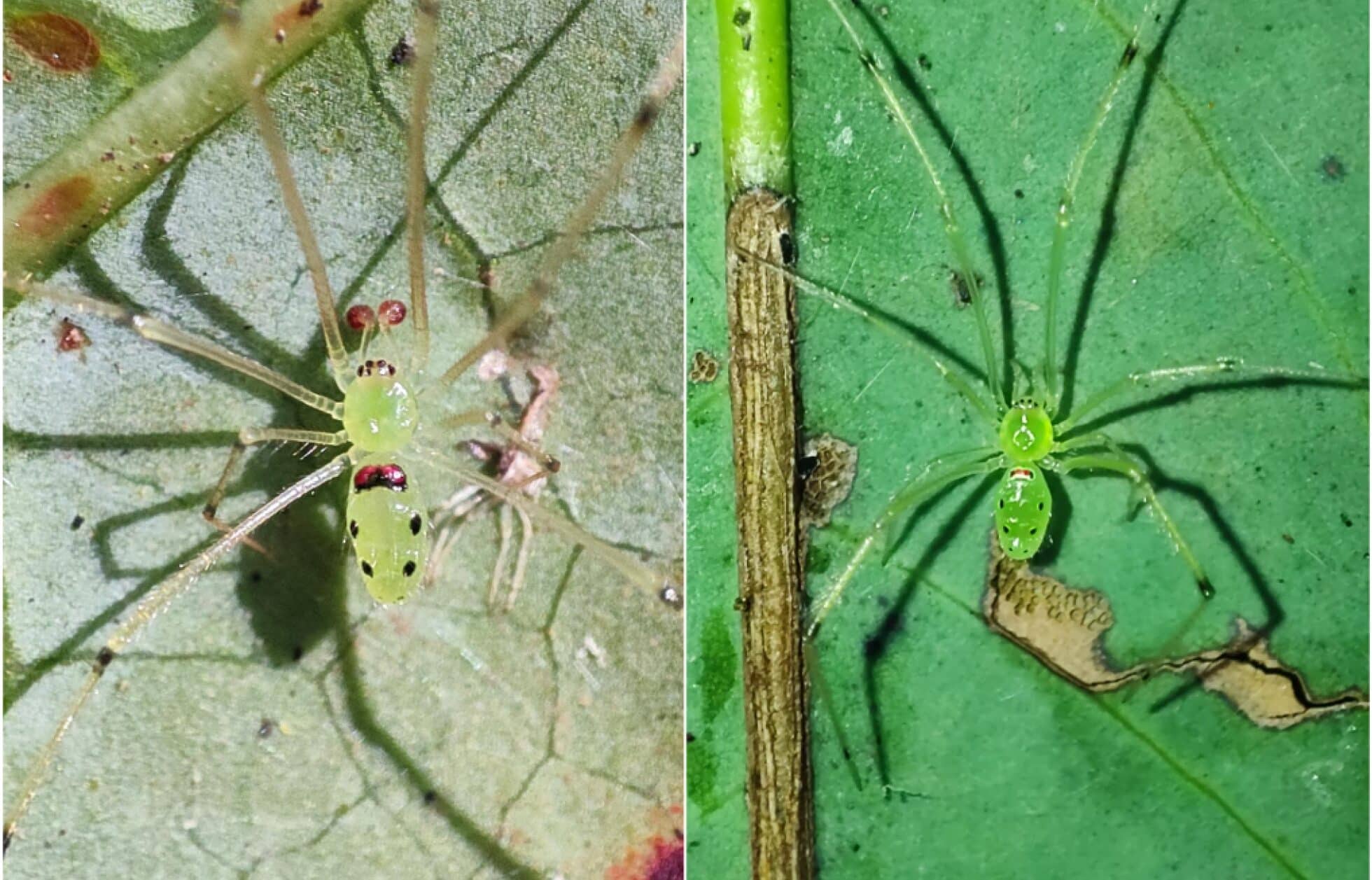
A few months ago, researchers discovered a very special spider in the Indian Himalayas. This specimen, however, bore an uncanny likeness to another spider long thought endemic to the Hawaiian archipelago. In fact, scientists have uncovered a doppelgänger—a completely different species that, despite its close resemblance, upends previously established certainties.
A ‘smiling species’ displaying an 8.5% genetic difference
The Himalayan smiling-faced spider (Theridion himalayana) is a new spider species, as reported in the journal Evolutionary Systematics in April 2026. Discovered in the Uttarakhand mountains (Indian Himalayas) by the Forest Research Institute of Dehradun (India), the spider features a predominantly green coloration and, above all, a smiling-face motif that to this day remains a genetic mystery.
The fact is that this Himalayan spider bears a striking resemblance to the smiling-faced spider (Theridion grallator), known for more than a century and living exclusively on the Hawaiian archipelago. The Indian researchers therefore wondered whether the two spiders belonged to the same species and, consequently, questioned the endemism of the Hawaiian specimen.
As the study authors note, DNA analysis of the Himalayan spider revealed an 8.5% genetic difference with its Hawaiian cousin. Thus, it is clearly a distinct species. Since then, scientists estimate that the two organisms developed their smiling motif completely independently and this, thousands of kilometers apart—about 12,000 km. This rare phenomenon is indeed called convergent evolution.
32 variations of patterns and colors
The “smile” that characterizes the two species likely serves an evolutionary function, but the fact remains that scientists know little more. They think that, potentially, this smiling-face motif helps these creatures survive better in the wild, in addition to their green coloration which greatly aids camouflage. Nevertheless, the authors of the study do not know the precise reason for such a pattern, especially since they observed no fewer than 32 variations of patterns and colors (morphs). In any case, this characteristic undoubtedly points to a deeper genetic mystery that remains to be solved.
“This confirms its distinctive character within the genus and raises broader questions concerning the dispersion of lineages, the parallel evolution of color polymorphism, and the independent evolution of species in montane forests. A dichotomous key of Theridion species described in India is also presented,” the study notes.
The two species enjoy ginger plants
Beyond their striking similarity, the two spiders share another trait. Indeed, each one tends to cling to ginger plants. Since this invasive plant is not native to Hawaii, the existence of an evolutionary link between the two species leaves little room for doubt. One of the next steps for researchers will be to understand why each of them, in their own life, has chosen the same plant in their daily routines.
In the meantime, one should underscore a fact: science until now held that Hawaii’s Theridion grallator was a unique biological curiosity. Thus, the discovery of Theridion himalayana, which, as a reminder, lives at elevations above 2,000 meters in Asia, has completely unsettled these certainties.
