
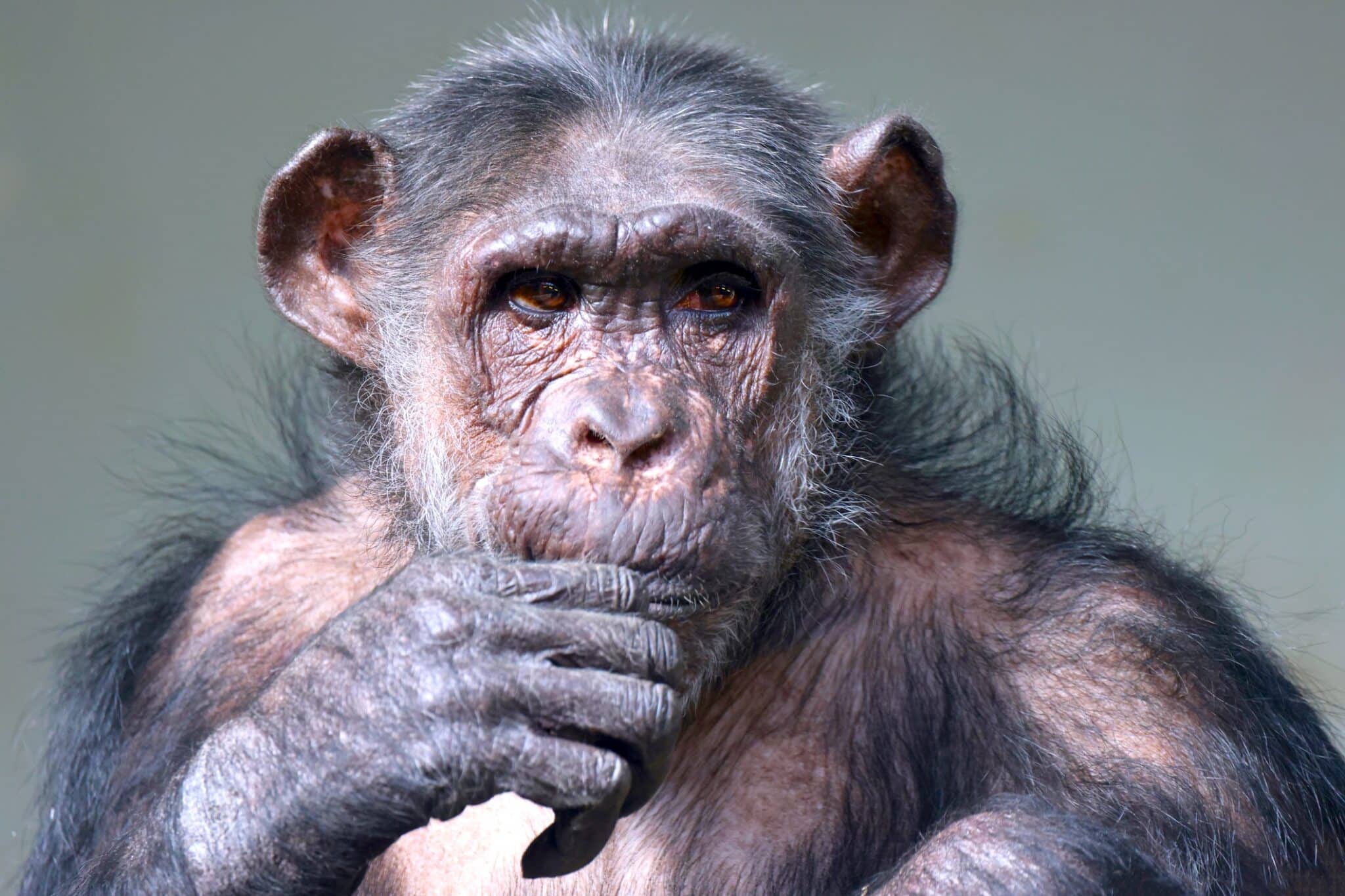
For a long time, rationality was considered a strictly human privilege. The ability to analyze evidence, revise beliefs, and adapt decisions seemed to definitively set us apart from the rest of the animal kingdom. Yet, recent research conducted on chimpanzees by psychologist Hanna Schleihauf and her team at Utrecht University shows that these primates share with us fundamental reasoning mechanisms. These discoveries, reported in the journal Science, upend our understanding of animal intelligence and suggest that certain cognitive processes are deeply rooted in primate evolution.
Simple Experiments to Test Chimpanzee Rationality
To understand how chimpanzees evaluate and revise evidence, Schleihauf’s team designed five experiments at the Ngamba Island Sanctuary in Uganda. The apes had to choose among several boxes containing food, basing their decisions on cues ranging from direct evidence to subtle sounds.
The initial experiments already showed that the order and strength of the evidence influenced their choices. If weak evidence was followed by stronger evidence, the chimpanzees changed their minds, but they remained faithful to their initial choice when the strongest evidence was presented first. These results indicate that the apes weighed the information rather than reacting purely on instinct.
Cognitive Abilities That Go Further
In the following experiments, the level of complexity increased: several boxes, redundant or new evidence, and sometimes misleading cues. The chimpanzees showed a preference for new evidence, suggesting that they know how to distinguish what genuinely adds information from what merely repeats what they already know.
The fifth experiment tested the animals’ ability to revise their beliefs in the face of deceptive cues, such as images or sounds simulating the presence of food. The chimpanzees adjusted their decision based on the most reliable evidence, showing that they actively evaluate the credibility of information and do not simply follow blindly their initial impressions.
What This Reveals About Animal and Human Intelligence
These results highlight a form of metacognition rare in animals: the ability to reflect on one’s own knowledge and adjust it in light of new information. In other words, chimpanzees can not only solve problems but also revise their judgments based on evidence, a process akin to human critical thinking.
This discovery has profound implications for our understanding of cognitive evolution. It suggests that some reasoning mechanisms are inherited from a common primate ancestor, and that rationality would therefore not be exclusively human. Of course, traits like complex language or advanced culture remain specific to our species, but it is fascinating to note that our primate cousins share essential reflective abilities.
