
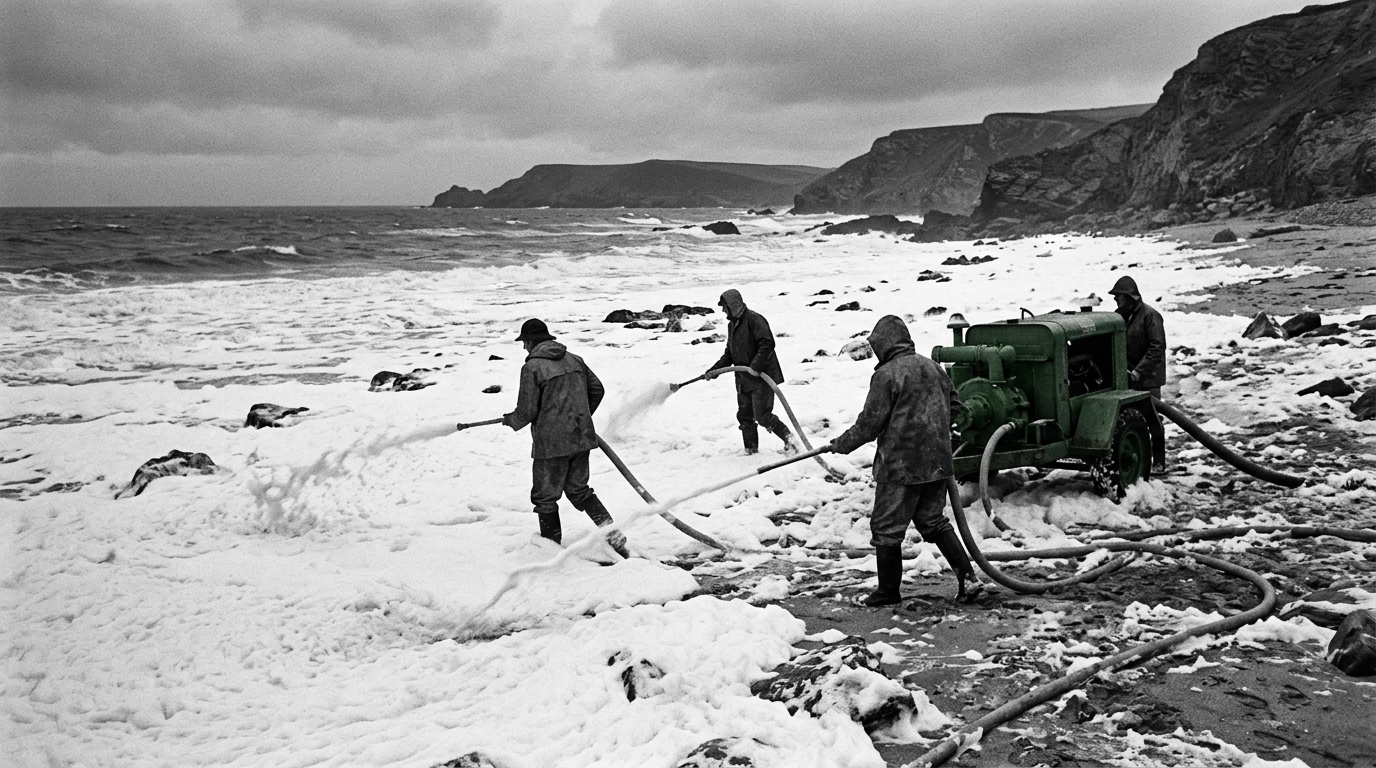
Imagine a Cornwall beach, pale sand and rocks cloaked in foam, where nothing moves for years. No barnacle, no seaweed, no crab scurrying beneath the pebbles. This silence is not the sound of a pristine nature, but the product of a biotic desert crafted by human hands, who believed they were acting rightly. In this late summer, as many holidaymakers still tread the sands along the Atlantic coastlines without a second thought, it is worth recalling that a seemingly clean beach can conceal a catastrophe far deeper than the mere oil slick that preceded it.
A grounded tanker, an improvised remedy in the urgent rush
It all began in March 1967 when the tanker Torrey Canyon struck the Seven Stones reef near Land’s End, at Cornwall’s western tip. For twelve days, its entire cargo—about 119,000 tonnes of crude oil from Kuwait—spilled into the English Channel. The image is striking: a black slick spreading inexorably, threatening the English coast and later the north of France.
Faced with the scale of the disaster, the British authorities reacted with the tools of the time, i.e., in a war-footing against oil. The Royal Navy was mobilized to transport large quantities of chemical products to the wreck site, while more than forty additional ships were chartered to spray detergents over the floating slicks and the shores already polluted. In total, about 10,000 tonnes of detergents were released, in the hope of dissolving the oil and saving the beaches. The intention was commendable, the method, however, would prove catastrophic.
When the remedy kills more surely than the poison
As early as 1967, the scientific journal Nature noted that the effects of these detergents on intertidal marine life deserved close scrutiny, particularly in two specific zones along the Cornwall coastline. The observations that followed would confirm the darkest fears. Several landmark scientific studies conducted in the late 1960s showed that the dispersant used had caused more damage than the oil itself on the western Cornish shores. A paradox, for a product meant to save the coastline.
The mechanism is actually simple to grasp, once you translate it into a familiar image. A detergent, whether designed to degrease a pan or to disperse oil, works by attacking fatty membranes and living tissues. On a beach, it does not distinguish between an hydrocarbon film and the delicate shell of a barnacle or the tissues of a seaweed. In short, by trying to clean the surface, it poisoned everything living beneath. Marine pollution specialists, such as the ITOPF, would later emphasize that a large portion of the harmful impacts of this oil spill were directly attributable to the volume, concentration, and toxicity of the dispersants used, far more than the oil that had spilled from the Torrey Canyon.
Ten years of silence: what the sterilized shorelines reveal
What makes this story especially valuable to science is that it did not unfold in a vacuum. A network of coastal sites in southwest England had already been studied for more than a decade before the catastrophe, notably to track the evolution of barnacle populations in relation to climate. This database, built independently of any forthcoming pollution, provided an invaluable scientific reference against which to measure, afterward, the true extent of the damage.
The monitoring continued for decades, particularly at Porthleven, one of the shores most severely affected by the episode. This long-term work allowed a finding as simple as it was troubling: the shores treated with detergents took more than ten years to recover a life comparable to the areas spared from the sprays. Where the oil alone would probably have let nature reclaim itself within a few seasons, the widespread chemical use had frozen the shores in a state of biological desert for more than a decade. The so-called miracle cure proved, in fact, to be the principal cause of the lasting sterilization of these beaches.
From Cornwall to today: the forgotten lesson of oil spills
Beyond the local ecological tragedy, with about 140 miles of Cornwall’s beaches polluted and more than 15,000 birds killed, the Torrey Canyon affair had an impact that stretched far beyond the British shores. The glaring absence of international agreements on responsibility and compensation in the event of hydrocarbon pollution led, in the following years, to the creation of the International Oil Pollution Compensation Funds, better known by the acronym FIPOL. A local catastrophe thus ended up reshaping, in part, international maritime law.
But perhaps the most useful lesson remains the one about how to manage environmental crises itself. In the face of dramatic and highly publicized pollution, the temptation is strong to act quickly and forcefully, prioritizing the immediate appearance of cleanliness over the real health of ecosystems. The Cornwall episode permanently etched itself in the minds of scientists working on subsequent oil spills, reminding them that an ill-calibrated dispersant can turn a visible pollution into an invisible disaster, silent and far harder to reverse.
This story, nearly sixty years on, retains a troubling relevance every time a new oil spill threatens a coastline. It reminds us that a beach that appears clean on the surface says nothing about what is happening beneath the pebbles and in the sand. So, the next time you walk barefoot on a seemingly intact beach, perhaps you’ll think, for a moment, of those Cornish tidal shores that took more than a decade to regain a semblance of life, and of the fine line that sometimes separates an emergency fix from a lasting error.
