
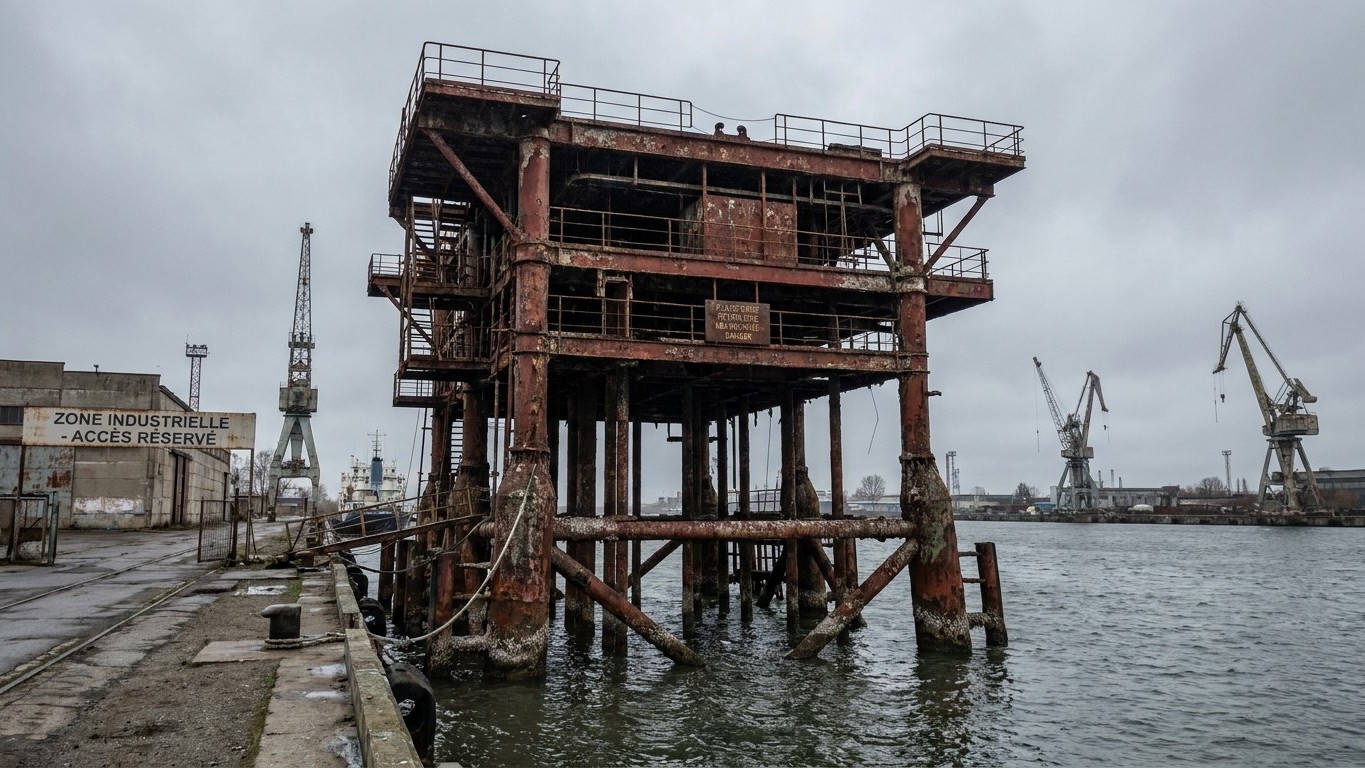
A 36,000-tonne hull sits rusting away in Slavianka port, about a hundred kilometers from Vladivostok. Its name, Odyssey, may not resonate with the general public, but this metal structure long embodied one of spaceflight’s boldest ideas: launching rockets from a mobile sea platform, right on the equator. Since May 2020, Odyssey, the mobile launch platform, along with the command ship Sea Launch Commander, have been moored at the quay of Slavianka port. Stationary. Silent. Far, far from their Californian glory days.
Key takeaways
- An 1980s oil platform was transformed into a revolutionary spaceport capable of launching rockets from the equator
- Between 1999 and 2014, Odyssey achieved 32 successful commercial launches before geopolitical tensions froze the project
- Bought by Russia in 2018, the platform has rusted for six years in a shipyard with no prospect of reactivation
From an Oil Platform to a Floating Spaceport
The story begins in the 1980s, thousands of miles away from any space project. The Ocean Odyssey, a decommissioned semi-submersible drilling platform, later launched rockets from the equator for the Sea Launch consortium. Before its conversion, the craft had a far less glorious fate: after years spent as a rusting wreck in Dundee docks, Scotland, aerospace advances came to the aid of the self-propelled platform, measuring 436 feet in length and about 220 feet in width.
What attracted Boeing and its Norwegian, Russian, and Ukrainian partners was not the platform itself, but its ability to move. The advantages of space launches from the equator, combined with the availability of the Ocean Odyssey, prompted Boeing to convert the platform into a launch pad. The calculation was simple, almost elementary: the closer you launch to the equator, the more you benefit from the Earth’s rotation, about 465 meters per second at that precise location. A free nudge that lets more payload reach geostationary orbit without consuming an extra gram of propellant.
Thus the platform was towed to an extremely precise point in the Pacific. On March 27, 1999, a Russian Zenit-3SL rocket, fueled by kerosene and liquid oxygen, placed a demonstration satellite into geostationary orbit from the Ocean Odyssey launch site, located at 0°N, 154°W. A swath of ocean with no land or borders, chosen for its equatorial position and low maritime traffic.
Thirty-six Rockets, Three Failures, and a Decade of Commercial Success
Between its first and last launch, Odyssey witnessed a full generation of telecommunications satellites. Launched for the first time in 1999, the Zenit-3SL flew 36 times, with three outright failures and one partial failure. An honorable record for its era, when space competition was far less crowded. Clients included Hughes, DirecTV, Eutelsat, and XM Satellite Radio, all drawn by a service capable of placing heavy payloads into geostationary transfer orbit at a competitive price.
The business model rested on a delicate balance between technical performance and the costs of maritime logistics. Keeping a reconverted oil platform navigated to the mid-Pacific, assembling it, re-supplying it, and then evacuating all crew before each automated launch—the operation was almost a ballet of industry. A feat that eventually proved costly, literally.
Bankruptcy, a Russian Buyout, Then Abandonment
The turning point came in 2014. Geopolitical tensions between Russia and Ukraine, on which the Zenit rockets depended for manufacture, precipitated the halt of operations. The Sea Launch consortium, already financially fragile, ceased its launches. Four years later, ownership changed hands: in April 2018, the Russian group S7 completed the purchase of Sea Launch for $109 million, renaming the company SL Aerospace.
The new owner then set lofty ambitions. But even before Odyssey left California, U.S. authorities ensured the removal of sensitive equipment. Americans dismantled part of the hardware, mainly positioning gear based on GPS technology, replaceable by GLONASS solutions, a Russian official would explain later. In February 2020, the S7 group transported the 46,000-ton Odyssey to the shipyard of Slavianka near Vladivostok, aboard a Chinese-flagged cargo ship.
On site, ambitions collided quickly with economic reality. S7 Group confirmed that no launches were planned in the near future, but announced a reconstruction and modernization program for the platform valued at $470 million, starting in November 2020. The figure was dizzying, almost as much as the inaction that followed. Vladislav Filev, head of S7, summed up the situation with disarming candor, saying the program was “frozen until better days.” He even expressed regret at the move to Russia, where costs proved “twice as bad” as in California.
An Industrial Phantom, a Symbol of a Resurfacing Idea
Six years after arriving in Slavianka, Odyssey has still not returned to service. The launch hardware remains dismantled, the hull continues to age in the salt and humidity of Primorye. A Russian official, during a visit, had praised the structure as unique in the world, noting that nothing comparable existed elsewhere on the planet.
What makes this story almost ironical is that the very concept Odyssey embodied is now reemerging on the scene. Players like Firefly Aerospace or the startup Seagate Space are working on new maritime launch variants, while China is already testing its own launches from barges at sea. The idea of a mobile launch pad, free from geographic constraints and the saturation of land bases, has not lost its relevance. The question remains whether these new projects will avoid the pitfall that felled Odyssey: a brilliant technical model sacrificed to cost and geopolitics.
Sources: alamy.com | planet4589.org
