
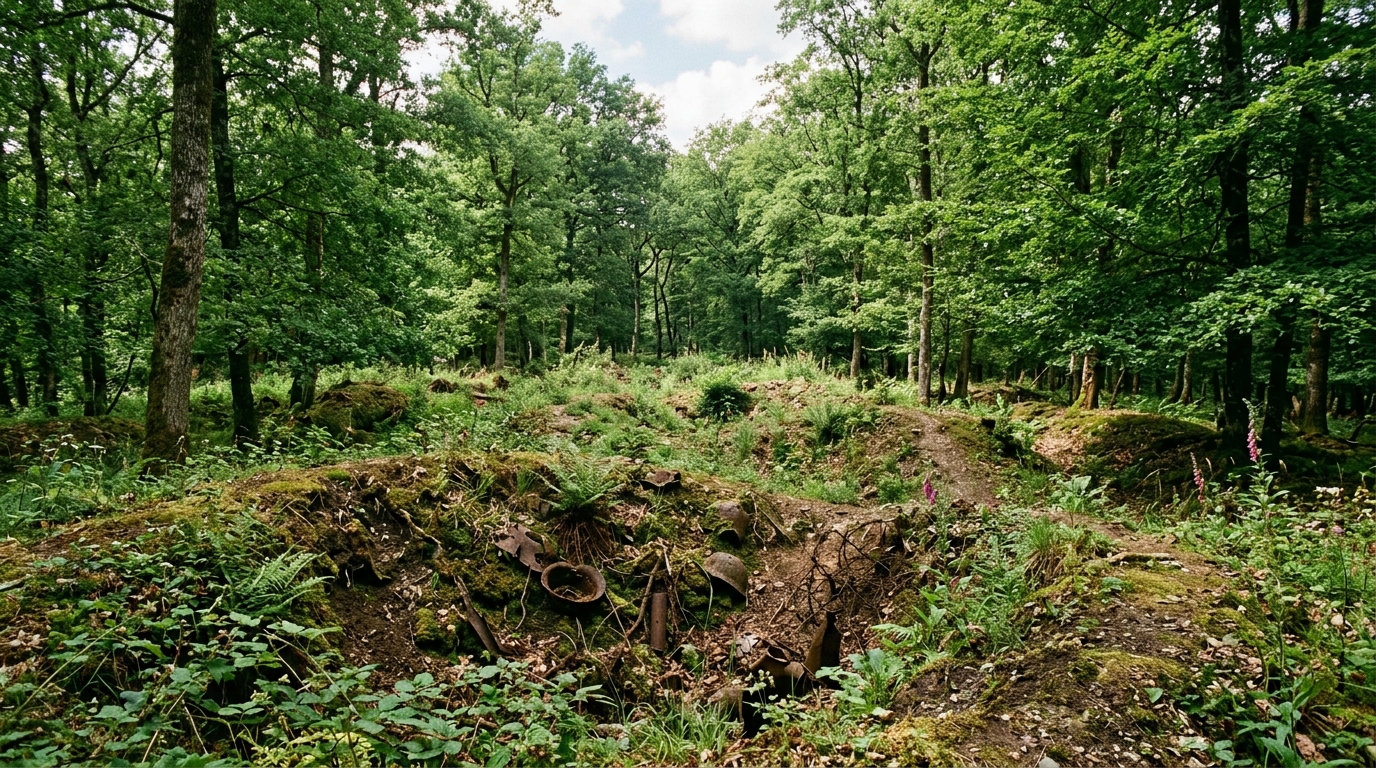
And what if the peace signed on a certain November morning had never truly concerned the ground itself? Men put away their rifles, borders were redrawn, and the war memorials bloomed in every village in France. But beneath the Meuse soil, something continued its quiet work, indifferent to treaties and commemorations. In the heart of the Spincourt forest, a clearing of barely a thousand square meters remains today completely sterile. Nothing grows there, nothing lives there, and no one is allowed to set foot on it. They call it the Place à Gaz, and its history tells of a war that, somewhere, never ended.
A zone where France laid down its arms before its own soil
Between 1926 and 1928, a British industrialist chose this remote corner of the Meuse to destroy more than 200,000 chemical shells abandoned by the German army. Among them, the formidable shells known as “blue cross,” filled with arsenic agents specifically designed to pierce the gas mask filters of soldiers. The operation, carried out in haste and without the precautions we would impose today, left an imprint that no one had measured at the time.
For decades, the forest reclaimed its space around, and almost everyone forgot what lay beneath the ferns. It wasn’t until 2007 that two German researchers, Tobias Bausinger and Johannes Preuß, from the University of Mainz, revealed the existence of this still-contaminated zone. Their discovery reopened a file that France had thought closed for a long time, and reminded us that some battlefields never truly close.
An underground empire of decontamination, forgotten for nearly a century
Investigations conducted by the BRGM, commissioned by the Meuse prefecture after access to the site was banned in 2012, revealed something far larger than a single poisoned clearing. Three other polluted sites were located in the surrounding area, outlining the contours of a gigantic complex of “désobusage” activities that were already underway in the post-war era. A private company, named Clere & Schwander, would have processed no less than one and a half million chemical shells and 300,000 explosive shells, transported as early as 1919 from the Meuse, the Somme, and even Belgium.
This monumental and dangerous work relied on a workforce with little training for such risk: a company of prisoners of war stationed at Spincourt, tasked with dismantling unstable, chemical or explosive munitions by hand. It is hard to imagine today the conditions under which this operation took place, carried out without real protective equipment, in a country still stunned by four years of conflict.
The arsenic that will poison this land for another three hundred years
Analyses conducted on the soils of the Place à Gaz are dizzying. Some samples revealed up to 17% pure arsenic, accompanied by extremely high levels of cadmium, lead, and mercury. These heavy metals do not evaporate and do not dilute with time, unlike what one might expect from ordinary pollution: they embed themselves in the soil, seep into the aquifers, and continue to circulate within the local ecosystem, season after season.
Moreover, the threat is not limited to this single clearing. In 2015, the discovery of toxic residues on neighboring agricultural plots forced several farmers to simply cease their activity. Forests were then planted on the most contaminated zones, not out of ecological concern but simply because no other human presence was considered feasible there. BRGM engineers themselves consider this site literally dead, and they estimate that it will take several centuries before such land can again be deemed safe for use.
Deminers still risk their lives, a century after the armistice
The clearing was fenced off in the early 2010s to ban access to walkers, and a security dome is now planned by state services to permanently contain this extraordinary pollution. But the Meuse is not limited to this Place à Gaz alone: across the region, shells continue to surface naturally after frost, plowing, or erosion, a phenomenon residents have long called the iron harvest.
The French ordnance disposal service still operates each year in this area, at a pace that has hardly diminished since the 1990s. This Meuse territory, where several villages erased from the map were never rebuilt, illustrates a reality rarely taught in schools: some wars never fully end. The ground keeps the memory of battles long after people have forgotten, turning a quiet forest into an active, silent, and ever-present threat for future generations.
As late summer invites strolling along the forest edge, it is unsettling to recall that, a few hundred kilometers from Paris, a patch of earth remains as hostile as it was the day of its contamination. The Great War may belong to history books, but it continues, somewhere beneath our feet, to write its own pages. And if the real question is not when that war ended, but how long it will take for it to truly fade away.
