
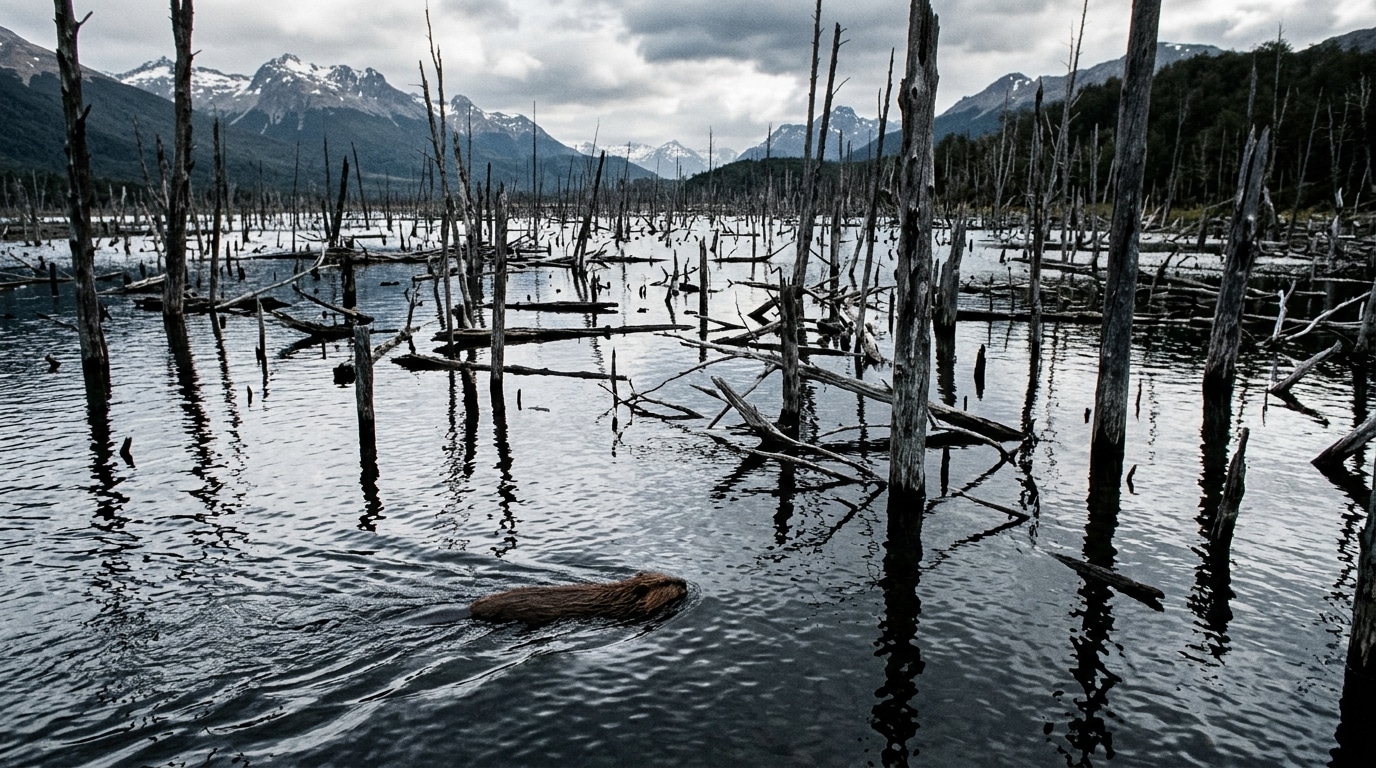
Can a handful of rodents really devastate millions of hectares of forest? In Tierra del Fuego, at the southern tip of South America, the answer lies in a tale as improbable as it is fascinating. It all began with a paper-thinly reasonable idea: to introduce a few beavers to build a thriving fur industry. No one imagined that this seemingly harmless act would give rise to one of the most spectacular biological invasions in the southern hemisphere. Today, what was meant to be an economic opportunity has turned into an ecological nightmare, transforming millennia-old landscapes into desolate wetlands. Here is how a small band of beavers from Canada’s far north rewrote, in its own way, a stretch of the continent.
Thirteen Four-Pawed Settlers for a Fur Dream
We are in the middle of the 20th century. The Argentine government, enticed by the promise of a lucrative trade, decides to import a handful of North American beavers (Castor canadensis) from Canada. The objective is clear: to launch a fur industry in this remote southern region, where economic activities struggled to take root. About twenty individuals were released into the wild in 1946, with the hope that they would thrive enough to feed a future market.
The trade, in fact, never truly took off. The beavers, however, took their colonization mission very seriously. In the absence of predators to hinder their expansion, these initial pioneers multiplied at a dizzying pace. There are now more than 100,000, a multiplication by thousands since their arrival. Not content with simply colonizing Tierra del Fuego, they crossed sea lanes to conquer the neighboring islands of Navarino, Dawson, and Hoste. A fur dream turned into an uncontrolled invasion.
Why the Southern Forest Never Learned to Defend Itself
To grasp the scale of the disaster, one must understand a crucial biological reality: the Tierra del Fuego forest had never encountered a beaver. These ecosystems developed for millennia without ever crossing paths with this builder. As a result, there was no natural defense, no preexisting balance, no predator capable of regulating these newcomers. The beaver arrived as if on a vast playground, untouched by competition.
The forest’s Achilles heel lies mainly in its slow regeneration. The local trees, belonging to the genus Nothofagus — the famed southern beeches — grow at an incredibly slow pace compared with northern species. Where a Canadian birch might rebound quickly after being gnawed, a Nothofagus takes decades, if not longer. It is precisely this difference that makes the damage almost irreversible: once felled, this forest simply does not reconstitute itself within a human lifetime.
Dams Everywhere, a Forest That Rots While Standing
The beaver is a born engineer. He gnaws the tree methodically until it falls, then halves it to feed himself and build his lodge. But his most destructive work remains the dam. By blocking waterways, he transforms a peaceful mountain stream into a chain of stagnant water basins. What once flowed freely becomes a muddy marsh, and the riparian forest, now flooded, ends up dying standing.
The consequences go beyond the simple loss of trees. The peat bogs, these precious natural reservoirs that regulate water and store immense amounts of carbon, are also disturbed. Many aquatic beings adapted to flowing waters can no longer move or survive in these still expanses. Tierra del Fuego National Park, once a postcard image of pristine nature, now literally looks dynamited: gnawed trees and fallen trunks stretch as far as the eye can see, composing a landscape of desolation.
Eradicating 100,000 Beavers: The Colossal Bet of Two Nations
The authorities did not wait for the disaster to peak before acting. As early as 1977, Argentina launched field surveys in Tierra del Fuego and Santa Cruz to measure the extent of the damage to ecosystems. These studies highlighted the gravity of the invasion and the urgency to act quickly. Yet the gap between finding and acting proved substantial.
Since then, Argentina and Chile have joined forces in joint eradication programs, an ambition that borders on the titanic. Eliminating more than 100,000 rodents dispersed across such a remote and rugged territory is a logistical puzzle. Teams must advance through near-impossible terrain, tracking elusive and prolific animals, all while fighting against a nature that seems to resist them. It is a colossal gamble, commensurate with the scale of the original misstep.
The story of Tierra del Fuego’s beavers sounds like a powerful warning: introducing an species far from its native habitat, even with the best intentions, can trigger irreversible upheavals. Thirteen small rodents from Canada proved sufficient to rewrite the ecology of a large swath of the continent. And might this lesson, more broadly, invite us to temper our ambition with humility before the intricacies of life and before attempting to alter its delicate balances?
