
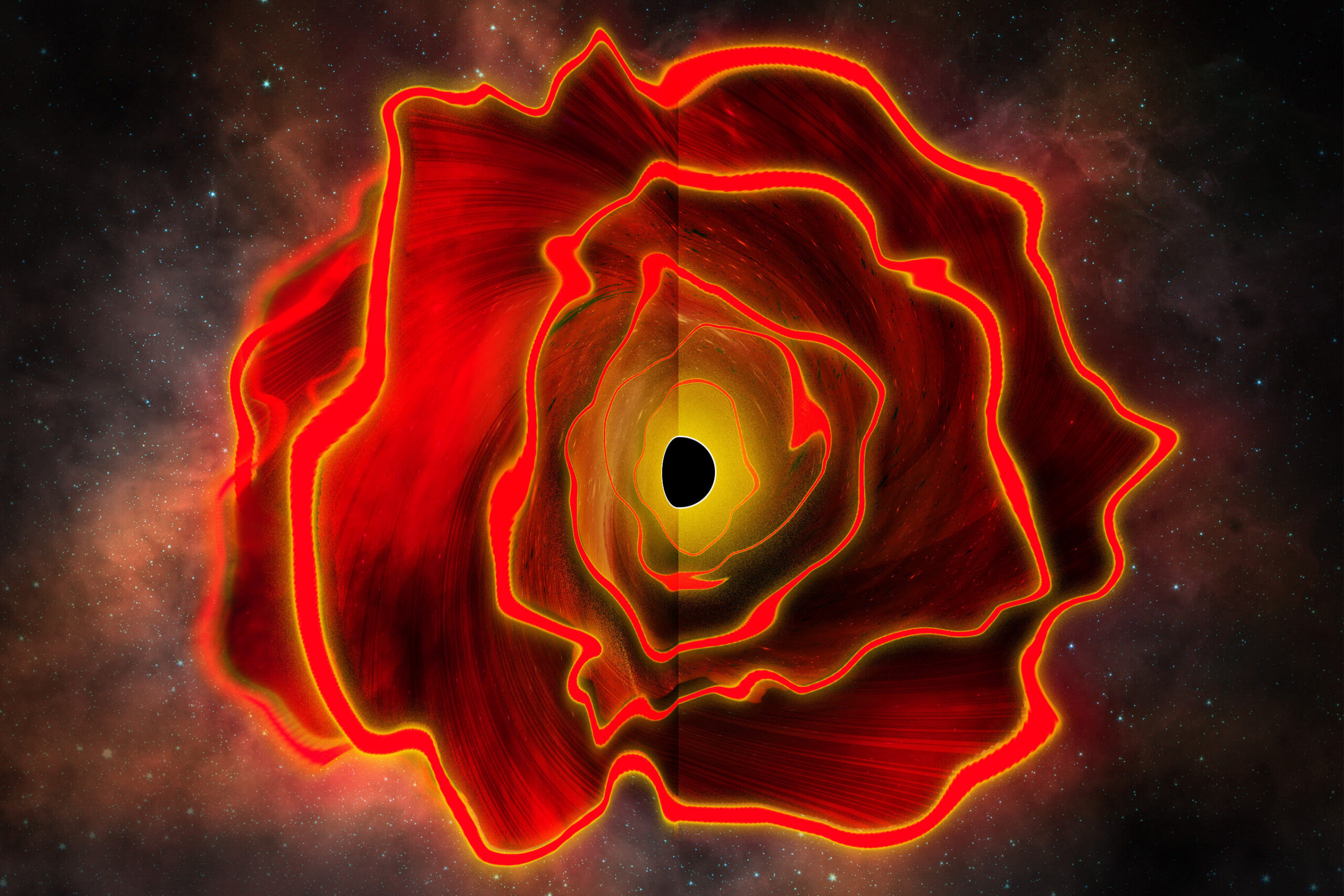
How can a light source as large as our solar system radiate a hundred billion times more energy than any star ever observed? That is the question that has unsettled the astrophysics community since a MIT team laid hands on a totally unclassifiable object deep in the primordial universe. Neither a star, nor a galaxy, nor an isolated black hole, this strange red spot detected by the James Webb Space Telescope could well redefine our understanding of the early ages of the cosmos.
A red dot that should never have existed
It all began with a research program dubbed Mirage or Miracle, whose initial objective was nothing extraordinary: to hunt for the oldest and most distant galaxies in the universe, those formed just a few hundred million years after the Big Bang. Sifting through the images captured by the James Webb Space Telescope, MIT astronomers spotted a detail that stood out among the other sources: a dot of intense red color, with unusual brightness.
Such a hue usually hints at the presence of cosmic dust, a smoky halo that tints the sky red. But the observed light signatures did not match that scenario. The team notably noted a sharp drop in light at certain wavelengths, a phenomenon known as Balmer break. This discontinuity, the deepest ever recorded for this type of source, immediately ruled out the hypothesis of a conventional star. Another troubling clue: the analyzed light revealed almost no trace of metals, only hydrogen and helium, as if this object belonged to a category never before catalogued.
When a star becomes too powerful to be real
To understand the origin of this peculiar color, researchers ran multiple simulations. Their conclusion is as surprising as the question that preceded it: it is possible to produce such an intense red only from hydrogen, with no dust, provided that the gas is extraordinarily dense—almost like the surface of a gigantic star rather than a diffuse nebula. This model finally explained the Balmer break observed and the near-total absence of metals in the spectrum.
Yet one major problem remained: even if we imagined an ultra-dense hydrogen cocoon, no known nuclear fusion can produce energy a hundred billion times greater than that of a conventional star. The usual mechanism that powers stars was therefore completely unable to justify such a burst of energy. We had to look elsewhere for a source capable of delivering that kind of power, and black holes, on the other hand, know perfectly how to generate this kind of extreme energy.
The hypothesis that upends astrophysics: the black-hole star
By incorporating an active black hole at the heart of their simulations of the hydrogen envelope, the astronomers eventually found the combination that best matched JWST observations. The most probable scenario would be a central black hole roughly 100,000 times more massive than the Sun, surrounded by a vast cocoon of dense gas, whose size would be on the order of our entire solar system. An unlikely marriage between a collapsed star and an oversized stellar atmosphere, which the researchers dubbed a black-hole star.
The object was named MoM-BH*-1, referring to the program that detected it, with the idea that it could be the first representative of a hitherto unsuspected family. What makes this specimen particularly valuable is that its luminosity almost completely overwhelms that of its host galaxy. Astronomers therefore observe light that is nearly pristine, not blurred by the rest of the galaxy, making it an ideal case study to understand this new type of object.
What this discovery reveals about the mysteries of the primordial universe
This black-hole star hypothesis could resolve a much larger puzzle—the countless small red dots that pepper nearly every deep JWST image. These objects, extremely common in the primordial universe but almost absent today, have long resisted any convincing explanation. If each of them actually housed a black-hole star tucked inside a young galaxy, it would explain both their color, their brightness, and their gradual disappearance as the universe aged.
This discovery could also challenge how scientists estimate the masses of the black holes present in these distant sources, with a significant risk of overestimation. Understanding how such supermassive black holes could grow so rapidly, within just a few hundred million years after the Big Bang, remains one of the major challenges of modern astrophysics.
This strange red spot reminds us that the primordial universe still harbors treasures capable of shaking our certainties. Between star and black hole, this hybrid object opens a new path to unveiling the secrets of the cosmos’ earliest ages, and suggests how many more surprises might still lie hidden in the depths of the sky photographed by James Webb.
