
In Belgium, scientists have managed to manipulate the surface of water to create “liquid landscapes.” What does this mean, and what could such an innovation be used for?
Programmable liquid landscapes
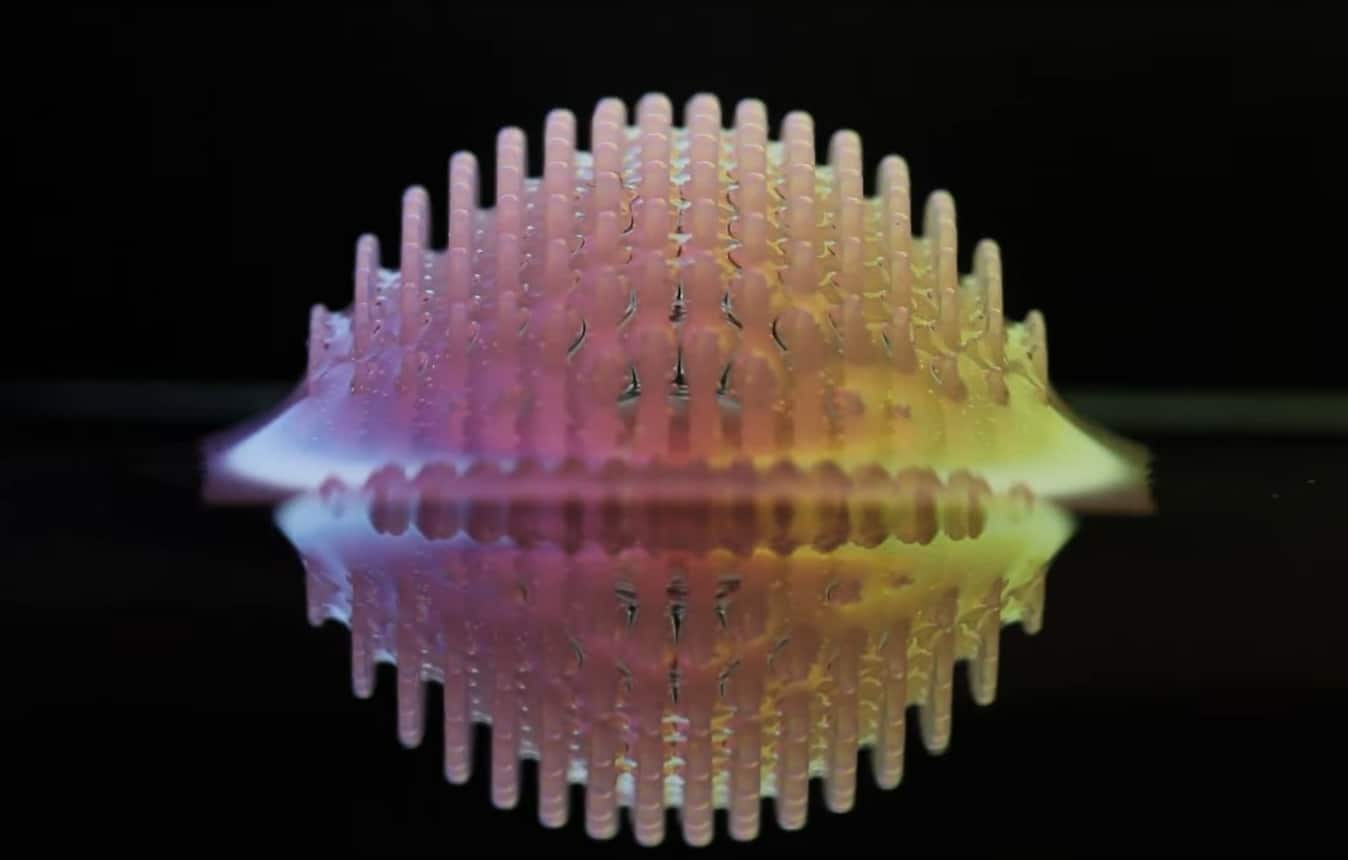
The Research and Applications Group in Statistical Physics (GRASP) at the University of Liège (Belgium) is behind an innovation as curious as it is promising. These researchers used millimetric spikes produced by 3D printing in order to manipulate the surface of water and thus generate programmable liquid landscapes. Moreover, particles can move within these very landscapes. This innovation has been published in the journal Nature Communications in April 2026.
To properly grasp these works, two important concepts must be understood, namely surface tension and the meniscus. The former designates a protective layer of water, a property that allows it to resist external forces. The latter concerns the barely visible curvatures appearing at the surface of a liquid, when the orientation of the surface of an object is not compatible with that of the liquid’s surface.
As part of their research, the scientists therefore considered the possibility of “sculpting” the water and creating menisci. The objective? To generate liquid landscapes on a surface. The authors used a Stratasys PolyJet printer to obtain lattice structures, the result of a combination of voids and material. Here, the material takes the form of millimetric needles with rounded ends placed so closely that they deform the water surface without altering its surface tension.
New perspectives in micromanipulation
The researchers then placed these lattice structures into Petri dishes before adding water—enough to cover the needles and generate a meniscus around them. This manipulation made it possible to understand that by altering the height and the spacing between the needles, the water surface is no longer flat. Several test patches were subsequently created, providing as many different landscapes as the adjustments allowed. What applications could this innovation enable?
This method offers a new way to move and sort floating objects such as beads, droplets, or plastic particles. When the liquid surface is inclined, the lighter objects rise thanks to Archimedes’ buoyancy, and the denser ones descend under their own weight, as if they were gliding on a hill of water.
Concretely, these works pave the way for new perspectives in micromanipulation, notably the sorting and transportation of particles. The researchers believe their innovation could play a significant role in the fight against marine pollution, for instance regarding microplastics.
