
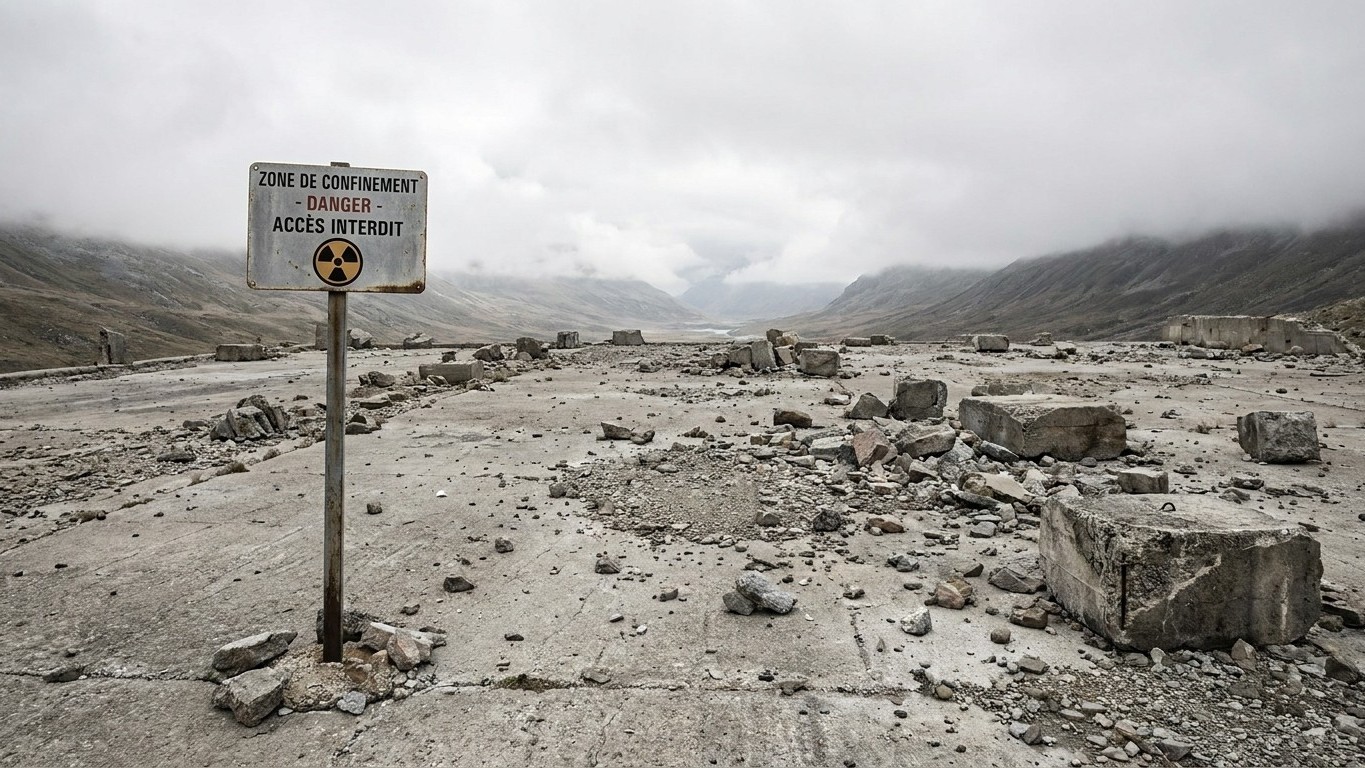
A lake once existed here, south of the Ural Mountains, near the town of Ozersk. Today there is only a gray, flat expanse, covered with earth and rubble, where nothing grows and no one lingers. That lake was called Karatchaï. For decades it served as a liquid trash bin for the Soviet nuclear complex at Mayak, before being completely buried under thousands of concrete blocks between 2015 and 2016.
Key takeaways
- A Siberian lake accumulated an unprecedented level of radioactivity on Earth, far surpassing the Chernobyl disaster
- The drought of the 1960s transformed water storage into an atmospheric threat, dispersing radioactive dust with the wind
- Buried beneath thousands of concrete blocks, the lake did not disappear: it waits under a gray slab, demanding monitoring that will last for millennia
A Spillway Chosen for Its Absence of an Outlet
The choice of this small lake was not accidental: too small to cool the reactors, it instead became the receptacle for the most dangerous effluents, those deemed too “hot” for the underground storage tanks at the site. The Mayak complex, which began operations in 1949 during the Cold War with the aim of producing plutonium to fuel the Soviet nuclear arms program, at any cost and without regard for environmental consequences, quickly produced volumes of waste that could not be managed by any other means.
The initial plan envisioned a temporary use, until these materials could be returned to Mayak’s reinforced concrete tanks. The temporary arrangement lasted almost forty years. From 1951 onward, the Soviet Union used Karatchaï to store Mayak’s radioactive waste, without any pretreatment, directly in the water. The lake covers less than a square kilometer, a surface modest compared with many coastal golf courses, but it would concentrate an unprecedented radioactive burden on Earth.
A Record Even Chernobyl Didn’t Reach
The numbers are dizzying. Karatchaï today contains 4.4 exabecquerels of radioactive material in less than a square kilometer of water. A direct comparison with the saga of the most infamous civil nuclear disaster is warranted: according to a Worldwatch Institute report, the lake accumulated nearly 4.44 exabecquerels of radioactivity in less than a square mile, versus 0.085 exabecquerel of cesium-137 released by the Chernobyl catastrophe over a space that is, nevertheless, a thousand times larger. Biologically, the lake is 42 times more radioactive than Chernobyl.
This level of contamination has a very tangible physical effect on anyone approaching the shore. Scientists have established that spending an hour on the lake’s banks could deliver a radiation dose fatal to a human being. The soil, the water, the mist sometimes rising from the surface: everything was contaminated. Guinness World Records officially classified Karatchaï as the most radioactive lake ever recorded, a title not enviable but fully deserved.
When the Wind Becomes a Weapon
The real turning point came at the end of the 1960s. A drought lowered the lake’s level and exposed pulverized radioactive sediments, previously submerged. The drought, by revealing contaminated sediments that later blew off with the wind, further polluted surrounding areas, leading to the decision to fill the lake completely. The water contained the poison; without it, the radioactive dust would spread freely through the atmosphere, threatening territories far beyond the site.
An emergency response was mounted by the late 1970s. About 10,000 hollow concrete blocks were dumped into the lake between 1978 and 1986 to fill it in, preventing the pulverulent radioactive sediments and surface debris from being blown away by the wind during droughts. That was only a step. It would take another three decades before the operation was completed in full.
The Final Burial, Completed in the 2010s
The definitive project unfolded in two major phases. In November 2015, the lake was completely backfilled using concrete blocks and rocks, and then in December 2016, a final layer of rock and earth was laid down and a monitoring system was deployed. Karatchaï Lake no longer exists, in a literal sense. In its place sits a permanently monitored mineral platform, transformed into a dry nuclear waste storage facility, nearly permanent and near the surface.
The initial monitoring results are reassuring, without fully allaying concerns. Monitoring data indicate a clear reduction in surface radionuclide deposition after ten months. But the subsoil continues to raise questions. According to data cited by several environmental outlets, the operator Rosatom continues to fund a monitoring system, with an annual budget around 130.5 million rubles dedicated to maintaining the safety of the filled site. Engineers have even modeled the subsurface in three dimensions to anticipate possible ground movements beneath the fill layers.
Concrete as a Lid, Not as a Remedy
One might be tempted to think the matter is closed. It is not. The concrete acts as a lid, not a miracle cure: radioactivity continues its invisible work beneath this gray shell. The groundwater has been under surveillance for decades, and this monitoring must continue without a fixed end date. Researchers following this case are unanimous: this makeshift storage, born out of the urgency of the atomic arms race, will need to be watched for hundreds, even thousands of years before the buried radioactivity truly ceases to pose a danger.
A report shared by the International Atomic Energy Agency sums up the situation with a clinical, almost detached tone: “Even if Karatchaï Lake disappears from the surface of the Earth forever, the problems associated with it will persist.” Karatchaï has thus not disappeared. It has simply retreated beneath a gray slab, somewhere between oblivion and perpetual vigilance, a reminder that some waste never really closes; it simply changes form.
Sources: dailygeekshow.com | shango.media
