
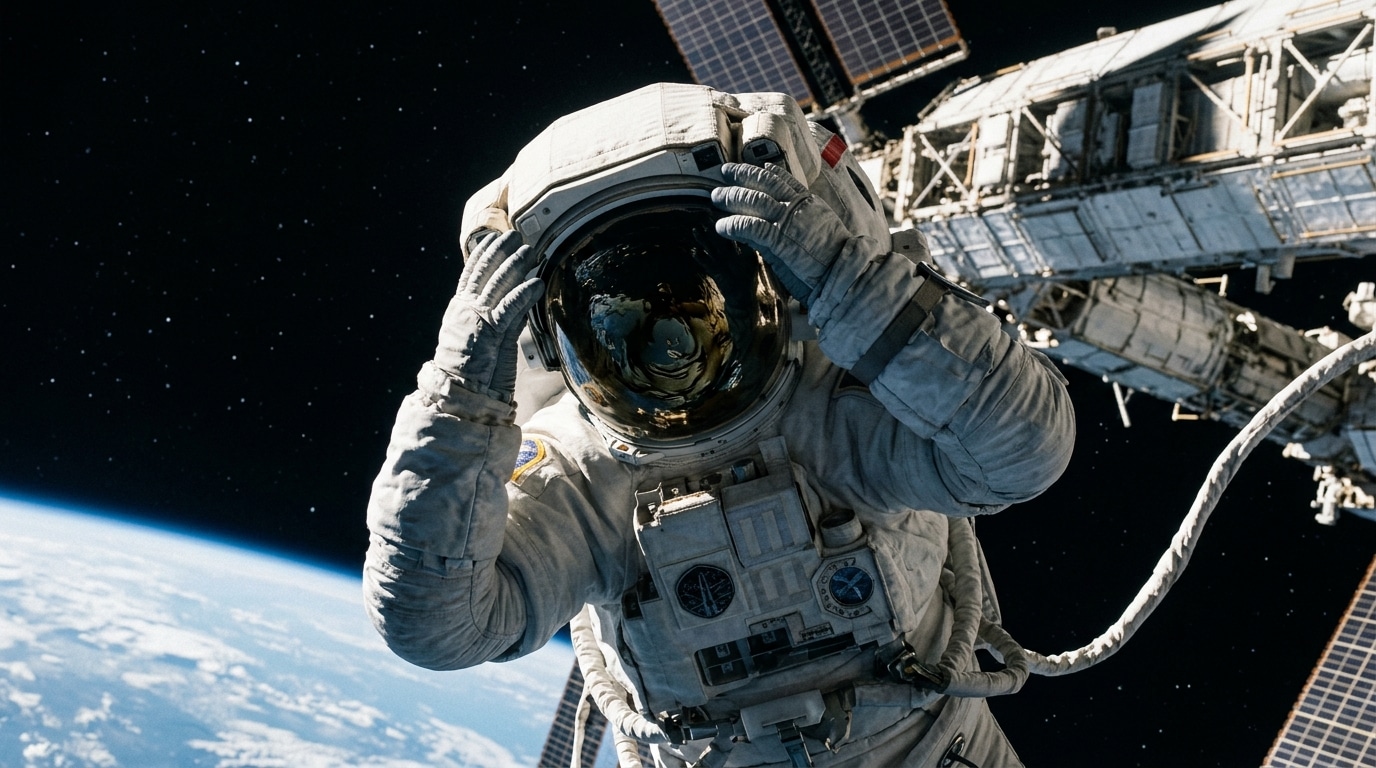
Water filling a helmet 400 kilometers above Earth: that is the nightmare Luca Parmitano endured, victim of a clogged filter that turned a routine maintenance task into a race against time. What was supposed to be a routine extravehicular activity, almost banal in the meticulously timed routines of the International Space Station, nearly cost the life of the Italian astronaut from the European Space Agency. In just a few minutes, his suit designed to protect him from the vacuum transformed into a liquid trap, forcing him to retreat to the safety of the ISS completely blind. A look back at one of the most chilling incidents in recent space exploration history, long kept in the shadow of more high-profile disasters.
A routine spacewalk that flips in a matter of seconds
Today is July 16, 2013. Luca Parmitano, then 36 and a major in the Italian Air Force, is about to undertake only his second extravehicular activity. A rare and awaited moment, almost a privilege in an astronaut’s career. The mission for that day? To install a cable between the station’s Unity node and the Russian Zarya module, a technical task but with no obvious danger.
Everything proceeds normally until the Italian man feels an unexpected sensation: a strange dampness at the back of his neck. Water, floating in zero gravity, begins to accumulate inside his helmet. At the moment, neither he nor mission control panics. It is assumed that the liquid comes from a simple leak in the drinking pouch housed in the suit. A reassuring hypothesis… but completely wrong.
Water in the helmet: the worst enemy in weightlessness
That is where the cunning of the situation lies. On Earth, a bit of water in a helmet would run downward, with little consequence. But in space, in weightlessness, the liquid does not fall. It forms droplets, clings to surfaces, and, above all, envelops the face like a sticky film. The helmet then becomes a miniature aquarium from which one cannot escape.
Twenty-four minutes after the first report, Parmitano alerts the control center again: the amount of water has increased, and it has moved from the back of his head toward his face, eyes, nose, and mouth. This time, the warning is taken seriously. The flight director immediately ends the EVA and orders the two astronauts to return to the airlock. About 45 minutes after the operation began, the upper part of the helmet is full of water. The Italian would later describe this sensation as akin to a goldfish in its bowl, unable to tell whether his next breath would fill his lungs with air or with liquid.
The blind return that kept the station on edge
This is the dramatic moment. Water now covers his eyes, completely obscuring his vision. Impossible to discern anything, or to locate the direction of the lifesaving airlock. Worse still, radio communication degrades: the voices of his American partner Christopher Cassidy and mission control weaken, until no one can hear him. There he is alone, deaf and blind, suspended in the void.
To find his way back, Parmitano must rely on memory and the contact of the safety tether that binds him to the station. By feeling his way, guided by his calm demeanor and training, he manages to reach the airlock. A long, painstaking progression, where every gesture mattered, where the slightest misstep could mean the end. The astronaut ultimately comes through unharmed, but the incident will endure as one of the most critical situations ever faced during an EVA.
What this incident changed in space suits
Once calm had been restored, engineers set about understanding the source of the failure. Their investigation revealed that the leak originated from a clogged filter, causing water to accumulate in the cooling system. Troubling detail: they could never determine with certainty what had initially contaminated that filter. More worrying still, the same suit had already exhibited a leak during a previous EVA, without the problem being properly identified at the time.
NASA acknowledged, a few months after the incident, that Parmitano had nearly drowned because information about this earlier leak had not propagated up the chain of command. Investigators cited an organizational flaw: management had allowed the EVA without having all the necessary information and had not reacted quickly enough. In the wake of this episode, absorbent cushions and emergency breathing tubes were added inside helmets, specifically to prevent such a scenario from recurring.
This mishap recalls a truth sometimes forgotten: in space, routine truly does not exist. Behind every seemingly ordinary gesture lies a sum of risks that only constant vigilance can manage. By turning a chilling incident into a lasting lesson, space exploration once again demonstrated its ability to learn from its mistakes. A fascinating question remains: how many other details, today deemed insignificant, could one day reveal their true danger during future journeys to the Moon or Mars?
