
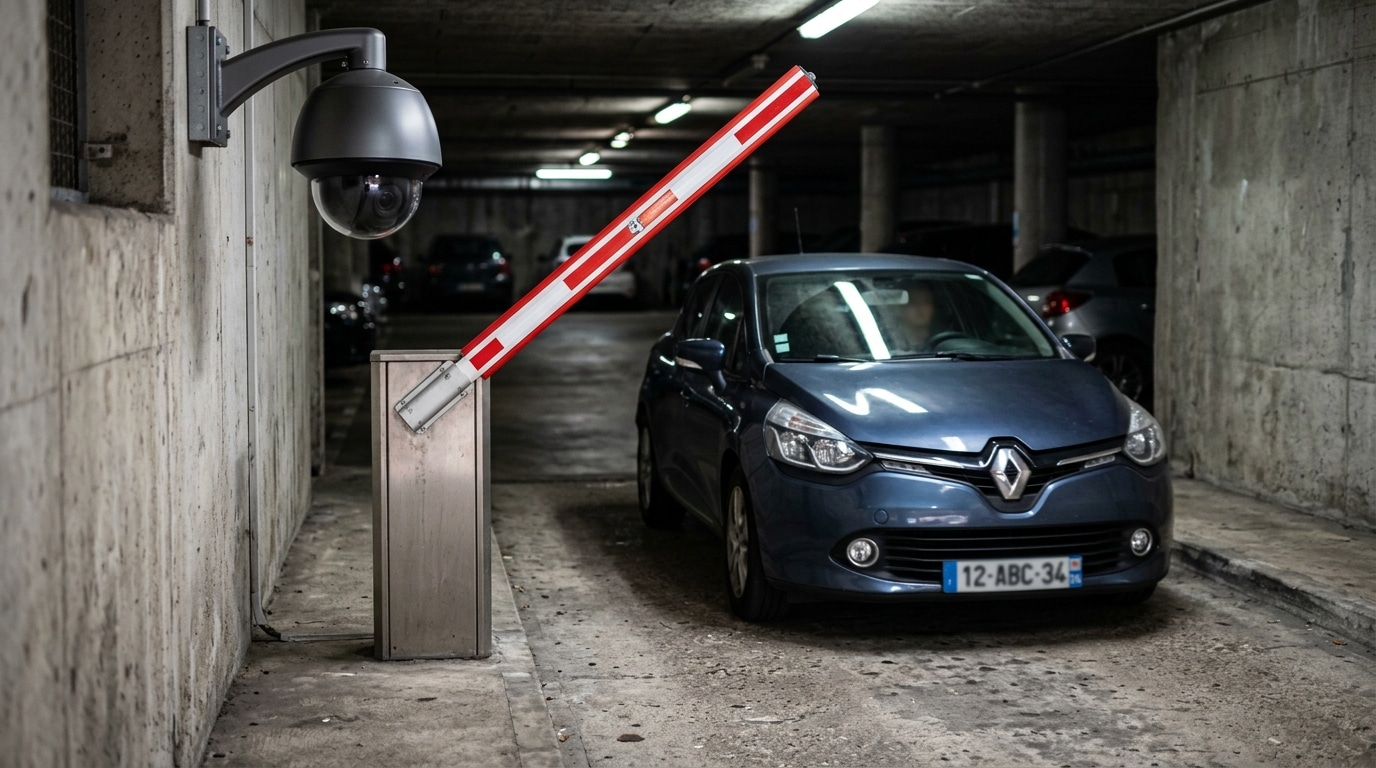
You step into a shopping mall parking lot, grab your ticket, the barrier lifts, and you head off to park without thinking twice. Yet, in a fraction of a second, a small device mounted above the barrier does far more than simply check for an available space. It photographed your license plate, recorded the exact time, and saved everything into a database. This seemingly trivial gesture, repeated millions of times every day in France, feeds a system more chatty than it appears. Behind the apparent banality of managing free spaces hides a technology capable of reconstructing, piece by piece, a portion of your movements. Here is what is really at stake when you pass that famous barrier.
These cameras don’t count the spaces, they read your plate
We often imagine that these small boxes are used to display the number of available spaces on the entrance signs. This is sometimes true, but it is usually not their primary function. Most of these devices are actually automatic license plate readers, better known by the acronym LAPI. Their mission isn’t to spot a free space, but to decipher the characters of your plate on the fly, exactly as a human eye would read a sequence of letters and numbers, but with formidable speed and precision.
The principle is breathtakingly simple. Each time you pass, the camera captures an image, software isolates the plate, converts it into text, and links this information to two valuable data points: the exact time and the location of the passage. In a parking lot, this mainly enables automated billing, to know how long you stayed and to open the barrier without a ticket. But what many do not realize is that this same mechanism leaves a digital trace of your presence, at a given place and time.
How a single barrier reconstructs your entire journey
Taken in isolation, a data point of this kind may seem perfectly harmless. After all, knowing that a vehicle entered a parking facility at a certain time isn’t earth-shattering. The trouble begins when you start to cross-reference these data. Imagine your plate being read at the entrance of a parking lot in the morning, then at the exit of another in the afternoon, and again somewhere else in the evening. Each point by itself is trivial, but linked together, they form a real map of your movements.
That is precisely the Achilles’ heel of these systems. A LAPI doesn’t merely notice a passage: it pieces together a chronological thread. By adding up the records, you can reconstruct your habits, your schedules, the places you frequent regularly. A bit like pebbles scattered along a path, each plate reading becomes a waypoint that, stitched together, allows you to retrace your itinerary. It is no longer a single frozen photograph, but a continuous narrative of your comings and goings.
What the law really says about these recordings
Rest assured, none of this happens in a lawless zone. In France, a license plate is considered personal data, because it indirectly identifies a person. As such, its collection is strictly governed by data protection regulations. A parking operator cannot retain this information indefinitely or use it at will. The recordings must serve a specific purpose, such as billing or fraud prevention, and they should be deleted within a reasonable timeframe.
The general rule also mandates transparency. You should normally be informed of the presence of these devices, often by a sign at the entrance. In theory, the retention period remains short and the data should never be used to build a profile of your movements without your knowledge. The gap between theory and practice can be substantial, especially when several operators each maintain their own databases.
Take back control: your rights and the blind spots to watch
Good news: you are not completely powerless against these quiet aims. Regulation grants you concrete rights. You can request access to the data that a company holds about your vehicle, demand corrections if they are wrong, and in many cases, request their deletion. It is enough to contact the management of the specific parking lot and, if refused or left unanswered, to appeal to the competent data protection authority.
The real blind spots lie in the details. How long are these records really kept? Are they shared with third parties? Are they cross-referenced with other files? These questions often lack clear answers for the average user. Vigilance is therefore essential: read the information panels, question what happens to your data, and do not treat these cameras as mere space counters—cultivating such reflexes is wise.
What looked like an innocent management tool thus reveals itself as a powerful sensor of our habits. These cameras don’t count spaces: they read, timestamp, and memorize, turning a mundane gesture into a lasting digital trace. Technology isn’t inherently good or bad, it depends on how it is used and the framework that surrounds it. So, the next time the barrier rises before you, perhaps you’ll view that little lens with new eyes. And if the real question wasn’t what these cameras record, but how far we allow them to go with it?
