
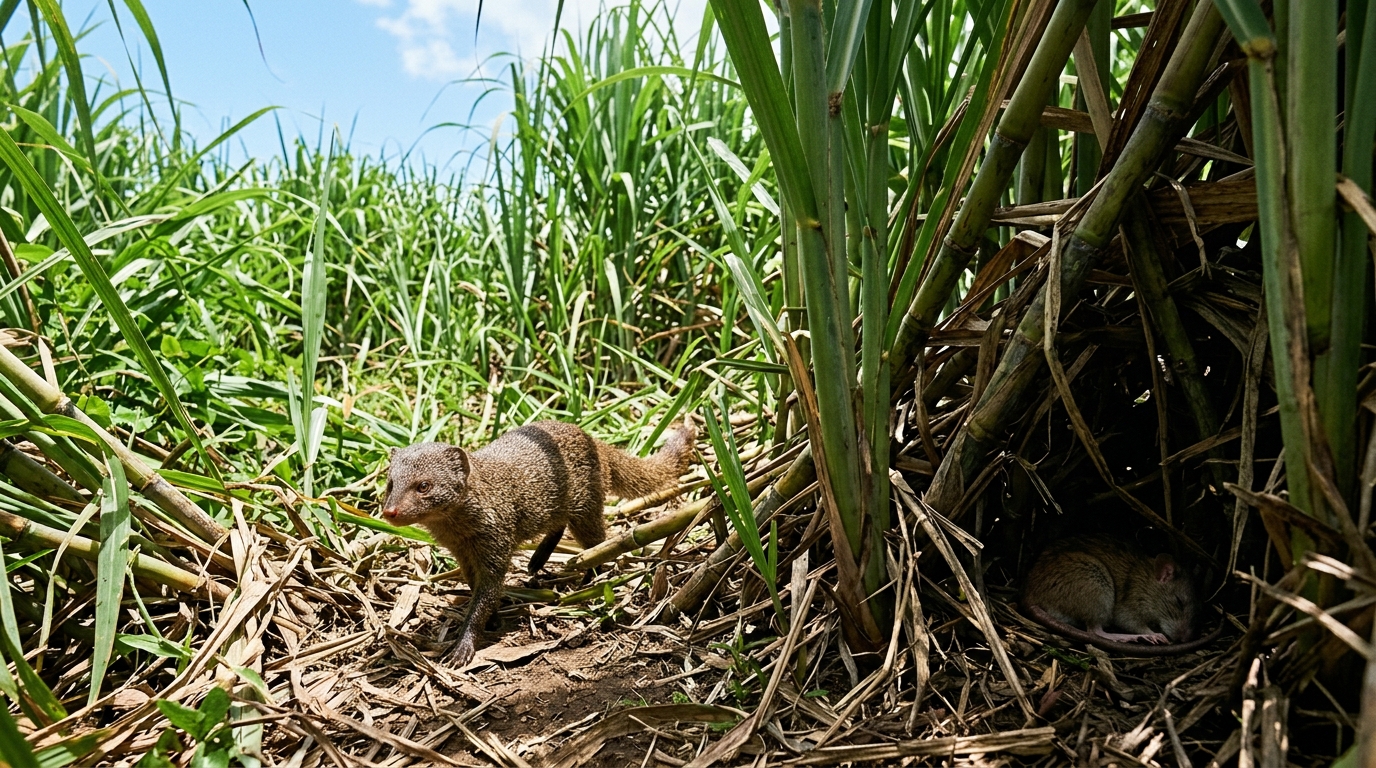
There are stories that begin as a good idea and end as a textbook case in ecology. The tale of the Jamaican mongooses is undeniably one of them, even if the initial reasoning seemed unimpeachable. At this late summer moment, while the sugarcane fields bend under their golden stalks in the Caribbean, it is worth remembering that a century and a half earlier, these same plantations were the scene of a biological control experiment that went badly wrong, very badly wrong, but not at all as one might have expected. Nine small carnivores imported from India were meant to save the harvest from the rats’ claws. They revealed, with an irony almost cruel, how much nature grossly ignores the plans we build for it.
A Schedule Mismatch No One Had Anticipated
The affair begins with a very concrete problem: around 1870, 20 % of the harvests of Jamaican sugar cane were disappearing into the stomachs of rodents. Facing this economic hemorrhage, planter W. Bancroft Espeut decided to try a solution from elsewhere. He imported from Calcutta nine Java mongooses, which he released on his property. The exact date remains debated among researchers, some mentioning 1872, others 1874, but the essential is not there: the idea seemed devastatingly effective on paper. The mongoose is an agile, opportunistic hunter, capable of attacking prey much larger than itself. Enough to impress any rat, in theory.
But no one at the time had taken the time to compare the timelines of the two species. The Indian mongoose is a diurnal animal, active in the sun, whereas the rat that ravages the cane is a nocturnal creature, discreet and furtive as soon as night falls. In other words, the predator and its prey simply never crossed paths. A decade after the introduction, mongooses had multiplied at full speed, and they had indeed exterminated the African rat as well as the American rat, two species that remained somewhat more active during the day. The black rat, smarter or luckier, escaped the massacre by taking refuge in the trees, where it continues today to prey on bird nests.
When the Cure Becomes Worse Than the Disease
This schedule mismatch is not a trivial anecdote; it is the keystone of the entire program’s failure. The mongoose never fulfilled the mission for which it had crossed an ocean. Deprived of its designated prey at night, it naturally turned to whatever it found under its paw during the day. And in Jamaica, as in the rest of the Antilles, the diurnal ground fauna did not lack: iguanas, nesting birds, sea turtles coming to lay their eggs on the beaches. An unexpected feast for a predator that was believed confined to the sugar fields.
What stands out, looking back, is the way in which a seemingly logical line of reasoning produced a result totally contrary to the initial objective. We wanted an ally against rodents, we obtained a generalist, opportunistic predator, capable of adapting to virtually any habitat. Jamaica, moreover, was not new to this: the island remains in the memory of naturalists for a sequence of biological-control attempts designed to solve a recurring problem, but which often ended up creating a new problem, more difficult to master.
Birds, Turtles, and Iguanas: The Ecological Toll Grows
The consequences of this misjudgment spread far beyond Jamaica. Convinced by the apparent results achieved on the introduced rats, other Caribbean territories imported the mongoose with the same hopes. Guadeloupe welcomed it in 1888, Martinique between 1890 and 1891, this time with a double objective: to combat the rodents, but also to curb the proliferation of the dreaded Trigonocéphale snake. Yet the pattern repeated itself identically, with the same disappointments.
The ecological bill, however, continued to rise. The iguana nests of the Lesser Antilles, a species currently listed as Critically Endangered, are among the mongoose’s favored targets. Ground-nesting birds, unable to flee a predator so fast, suffer the same fate. More seriously still, sea turtles laying eggs on the beaches sometimes see entire clutches destroyed in a single night… or rather in a single day, since that is precisely when the mongoose prowls. The animal seen as a savior thus transformed into a silent threat to species that had never had to beware of such an intruder.
A Jamaican Lesson the World Should Have Learned
What was meant to stay a localized experiment has today become a genuine global invasion. The Indian mongoose has spread far beyond the Caribbean, colonizing ecosystems that are extremely varied. It is now found in Cuba, the Bahamas, of course Jamaica, but also in Japan, Hawaii, or Costa Rica, in both agricultural zones and humid forests or the arid coastal environments. Wherever it settles, the same pattern repeats: rapid adaptation, opportunistic predation, and a lasting imbalance for the local fauna.
This story, more than a century old, continues to resonate as a reminder of unsettling relevance. It recalls that introducing one species to fight another sometimes amounts to opening a Pandora’s box whose contents and long-term consequences we do not master. The Jamaican example retains all its demonstrative force: a simple schedule shift between two animals can transform a solution into a lasting ecological catastrophe.
Nine mongooses released into a sugar cane field were thus enough to upset the biodiversity of an entire archipelago, without ever accomplishing the mission for which they had been imported. A seemingly harmless schedule shift was enough to derail an entire biological-control plan and to condemn species that had nothing to do with it. A reminder, even today, to question every solution we deem flawless before we have looked more closely at nature.
