
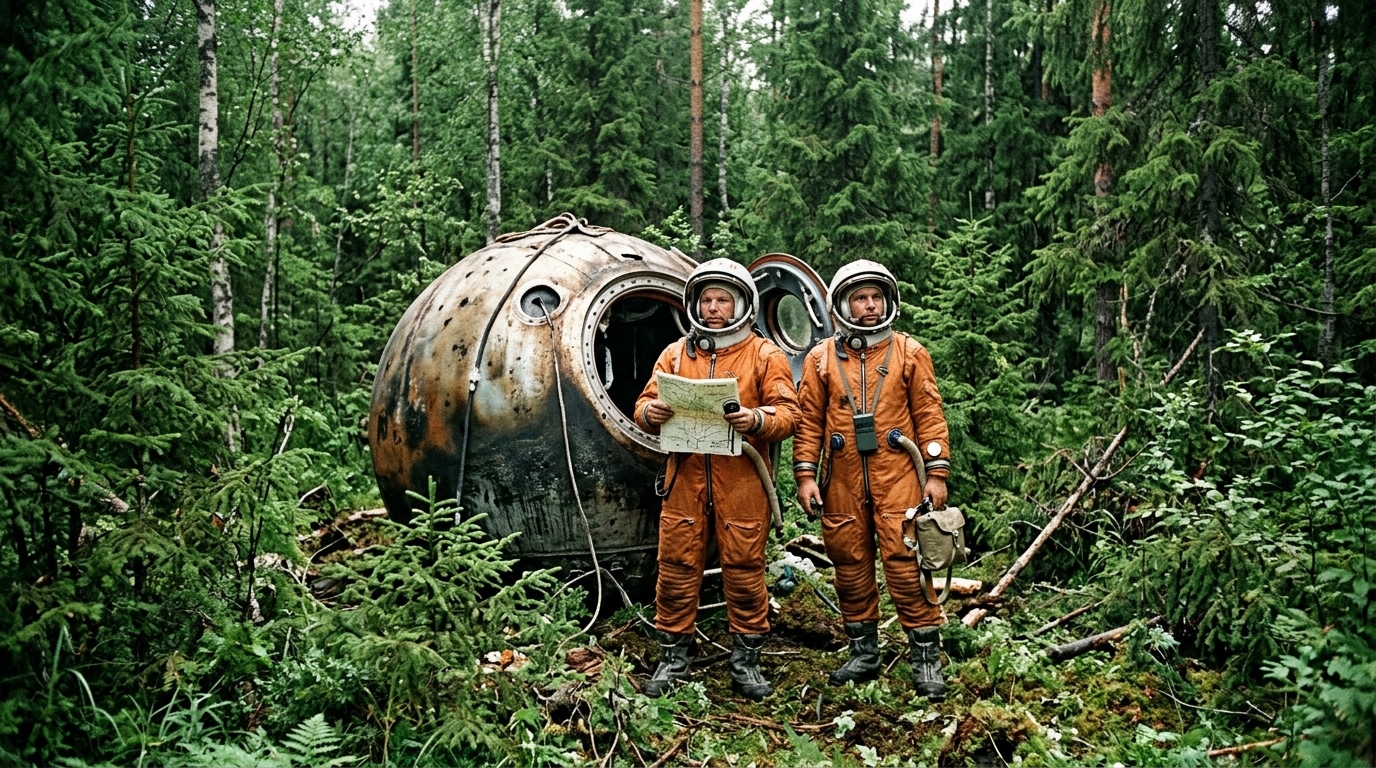
Imagine the scene: two men had just accomplished one of the craziest feats in human history, only to find themselves trapped in a frozen forest, with a pistol as their only protection and no idea whether help would ever arrive. In 1965, the Soviet Union celebrated a resounding space triumph, yet discreetly swept under the rug an embarrassing detail: its two heroes had literally disappeared for two days. Far from the spotlight and propaganda, the Voskhod 2 adventure ended not in the arms of a triumphant recovery team, but in the heart of a hostile taiga where cold, wolves, and silence reigned supreme. A look back at one of the most improbable missions of the space race.
When the spacewalk turns into a nightmare
In the spring of 1965, the Soviet spacecraft Voskhod 2 lifted off from the Baikonur Cosmodrome with two men aboard: commander Pavel Beliaïev and Alexei Leonov, the latter only 30 years old. The mission carried a spectacular objective: to carry out the very first extravehicular activity in history. Leonov thus left the capsule and floated in the vacuum of space, ahead of the American Ed White by nearly three months. A moment of absolute glory… that quickly became a silent tragedy.
For in space, without atmospheric pressure to contain him, Leonov’s suit swelled like a balloon. The cosmonaut was supposed to shoot photos with a camera strapped to his leg, but when he tried to bend, his suit had become rigid and prevented any movement. Worse still: there was no way to re-enter the airlock. To slip back inside, he faced a perilous choice: dangerously vent the pressure of his suit, risking a decompression accident. A move worthy of a tightrope walker without a safety net, hundreds of kilometers above the Earth.
An off-target landing, deep in a hostile forest
One might think the hardest part was over. Wrong. As they returned, the automatic retrorocket system intended to slow the craft for descent refused to function. Beliaïev and Leonov had to carry out a manual firing, performed one orbit later. This small delay had enormous consequences: the re-entry trajectory was completely skewed.
The result: the landing module touched down far from the planned recovery zone, in the Perm Krai, deep in the Urals. According to measurements, the gap varied from about 400 kilometers to figures close to 1,000 kilometers depending on Soviet sources. Around them, there was neither a shot nor a rescue team—only an endless taiga of pines and birches buried under deep snow. To top it off, the airlock hatch ended up jammed against a tree. The cold, meanwhile, moved in as the number one enemy.
Two nights in the taiga: wolves, frost, and waiting
Meanwhile in Moscow, a muffled panic set in. Controllers had absolutely no idea where the spacecraft had landed or whether the two men had survived. To avoid tarnishing the image of the national triumph, officials calmly told the families that the cosmonauts were resting after being recovered. A state lie, while the two heroes shivered in the middle of nowhere.
Leonov would later recount the fear of those hours. They knew the taiga housed bears and wolves, particularly aggressive during mating season. For defense, they had only a pistol, but a generous supply of ammunition helped somewhat. At dusk, the scene grew downright sinister: the trees groaned under the frost, the wind howled, and the temperature dropped to −5 °C. The hatch, meanwhile, had been blown off by explosive bolts, leaving the cabin exposed to the biting wind.
Planes quickly located the capsule, but intervention was impossible: the forest was far too dense for a helicopter to land. The next day, a rescue team reached the site on skis, yet they still needed to find a clearing for evacuation. Beliaïev and Leonov spent a second night in the frozen forest, before joining a ski route to an evacuation point from which they could finally be hoisted by helicopter. It was ultimately the help and shelter found among locals and rescue teams that brought this icy nightmare to an end.
What this mishap revealed about space exploration
Beyond the chilling anecdote, the mission highlighted a truth propaganda had sought to mask: space exploration was a terribly risky undertaking, where the slightest technical failure could turn a hero into a castaway. The Voskhod 2 affair reminded us that a cosmonaut does not only gamble his life in space, but also upon returning to Earth, sometimes under conditions worthy of a polar expedition.
This lesson left a real mark. It is in part because of this episode that the famous TP-82, a survival pistol specially designed for cosmonauts, capable of protecting them against wild animals in case of landing in hostile terrain, was developed. An official acknowledgment, in short, that space is not conquered only with rockets, but also with a solid sense of survival.
Ultimately, the story of Beliaïev and Leonov beautifully illustrates the pioneers’ paradox: to brush with immortality one day, and to fight for survival against wolves the next. While today manned flights have become almost routine and discussions of space tourism are increasing, shouldn’t we remember more often these adventurers who paid a heavy price to open the way to the stars?
