
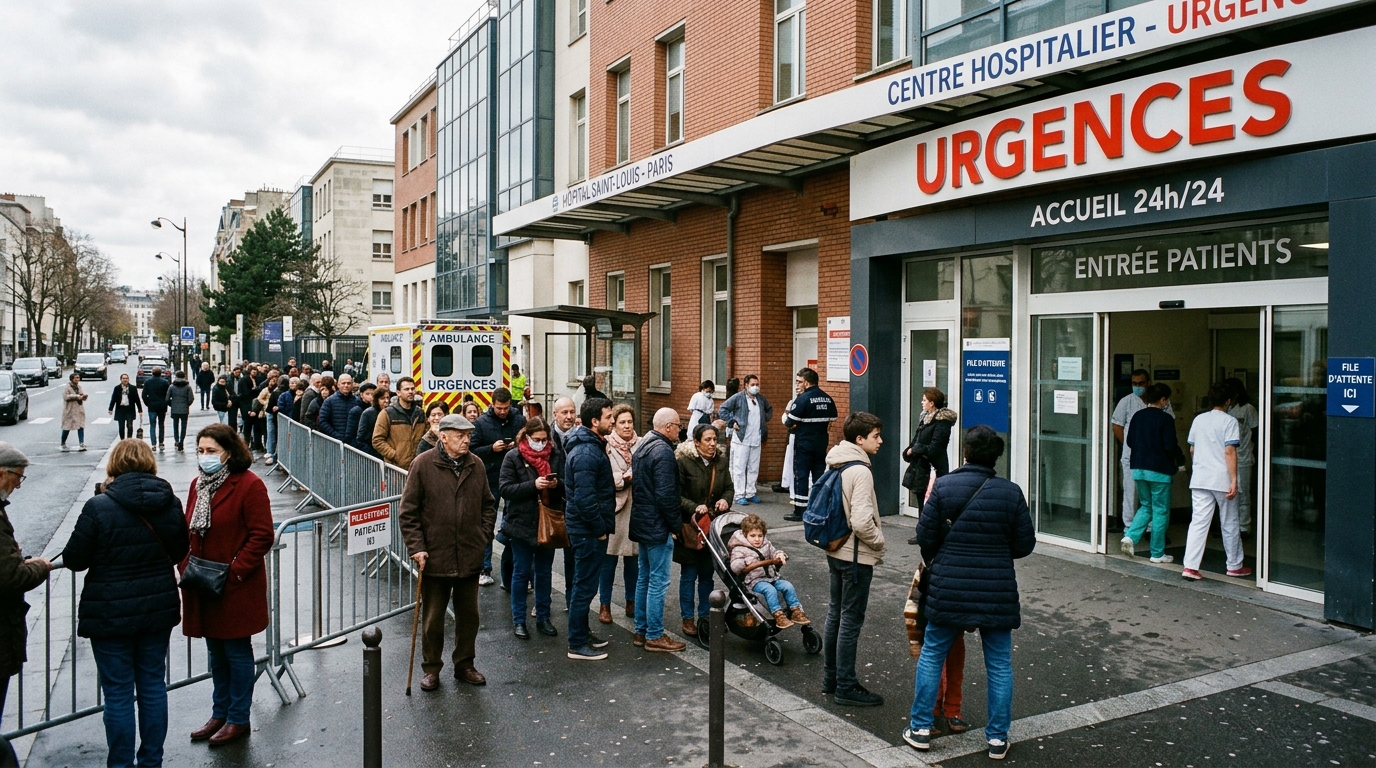
Created in 2021 to alleviate pressure on French emergency departments, the Service for Access to Care is built on a simple idea: by calling 15, a patient without an available primary physician can secure an appointment in the city within 24 to 48 hours rather than clogging a hospital corridor. Three years after its launch, data from DREES deliver an assessment that directly contradicts the initial objective: in 2024, visits to emergency departments rose again by 2.5%.
What you will learn
- Why the SAS, designed to filter emergency department visits, did not reverse the trend
- What the DREES figures reveal about the real evolution of emergency department attendance since 2021
- Which mechanisms explain this apparent failure—and what they reveal about the state of the city-based care system
A number born from an unequivocal finding
The Service for Access to Care does not emerge from nowhere. It is part of Measure 1 of the Pact for the Refounding of Emergencies from September 2019, then Measure 26 of the Ségur de la Santé in July 2020. Its starting point: a finding documented by ARS Hauts-de-France indicating that between 30% and 40% of patients admitted to emergency departments could be safely managed in a clinic, a health house, or a health center.
The idea is therefore appealing in its logic. By calling 15, a patient whose primary care physician is not available and whose condition does not constitute a vital emergency can obtain an appointment with a city-based health professional within 24 to 48 hours. To make this possible, the SAS relies on a national digital platform allowing regulators to search in real time for non-scheduled care slots available with city doctors. Rolled out from 2021 initially in departments facing the greatest tensions, and then generalized via a decree—with a flexible approach to territorial deployment—the system was supposed to mark a turning point.
What the DREES figures really show
The reality of the available data is more nuanced than the promise. In 2023, the number of visits to emergency departments stood at 20.8 million according to DREES — a 3.4% drop from 2022. A figure that initially seems encouraging. But other data from the same institution point to 20.9 million visits — a level close to that of 2017, i.e., well before the SAS was created. In other words, after two years of deploying the system, emergency department attendance returns exactly to where it was before the problem was officially addressed.
And the decline observed in 2023 does not hold up in 2024: according to DREES, visits to public hospital emergency departments rebound by 2.5% that year to reach 2.13 million visits — and this rebound affects most metropolitan regions. DREES itself notes that this rebound occurs “even as various measures are being rolled out to curb this use, including the service for access to care.”
To gauge the scale of the challenge, these figures must be placed in their historical context. Between 1996 and 2019, emergency department visits rose by an average of 3.3% per year, reaching 22 million visits in 2019. The health crisis caused a sharp drop to 18.1 million in 2020. The rebound began in May 2021 and continued thereafter—and the SAS was not enough to stop it.
Why the filter does not filter
Several mechanisms explain this gap between promise and result. The first lies in the very structure of the city-based care system. Even with a high-performing digital platform, if the slots available with city doctors are insufficient or too unevenly distributed across territories, the regulator has no choice but to direct the patient toward emergencies — which guarantee care, even when it is lengthy and uncomfortable.
The second mechanism concerns the evolution of emergency departments themselves. According to the Urgencies survey cited by DREES, between March 13 and June 13, 2023, 8% of emergency reception points closed at least once and 23% implemented regulated access. This regulation, intended to limit unnecessary visits, may have produced a perverse effect: by forcing more patients to go through 15 to validate their request, it fed the hospital-directed pathway instead of bypassing it.
The third factor is behavioral. DREES itself points to “an evolution in care-seeking behavior” as one of the factors behind the 2024 rebound — alongside tensions in the city-based care supply and changes in the health status of the population. Being offered a city appointment in two days does not always reassure as much as an immediate emergency department admission, perceived as more secure in cases of doubt about symptom severity.
What this failure reveals about the system
This result illustrates a classic limitation of reforms built around a single lever. Creating a digital orientation platform, no matter how well designed, changes little if the upstream city-based medical offering remains insufficient. The SAS did not fail due to design flaws — it collided with a system already under structural strain.
In 2024, visits to emergency departments are rising again. The estimate that 30 to 40% of visits could be avoided identified before the SAS launch remains valid. And the question posed in 2019 remains: how to redirect to city-based care patients who do not have a GP available, in regions where non-scheduled care slots are lacking?
Sources : DREES, Panorama des établissements de santé 2025 — DREES, Études et Résultats no. 1305, July 2024 (Urgences 2023 survey) — DREES, Études et Résultats no. 1320, December 2024 — DREES, Études et Résultats no. 1344, July 2025 — ARS Hauts-de-France — Pacte de Refondation des Urgences, September 2019 — Ségur de la Santé, measure 26, July 2020
