
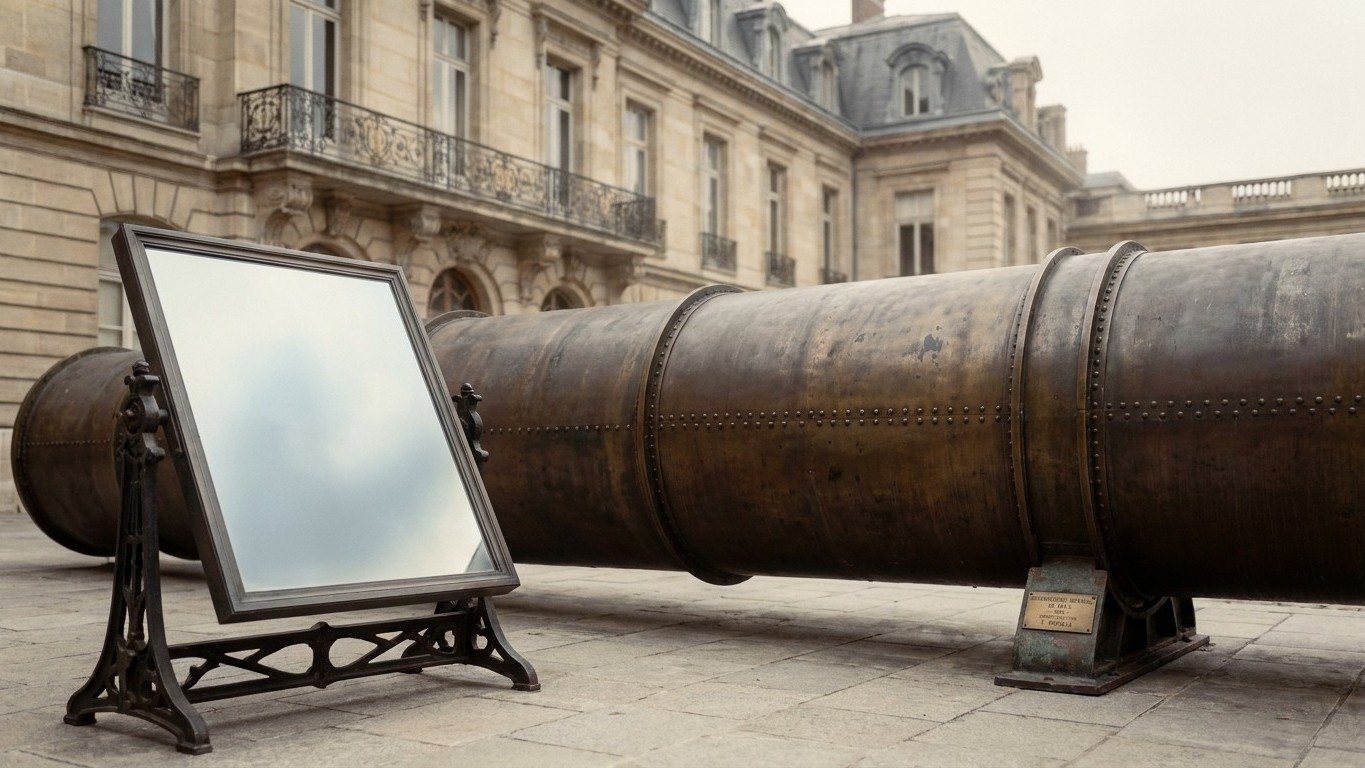
Sixty meters of tube aimed horizontally, two giant lenses of 1.25 meters in diameter, and yet: not a single time was this instrument pointed directly at a star. The Great Telescope of the Palace of Optics, built for the Paris Universal Exposition of 1900, delighted crowds at the Champ-de-Mars with images of the Moon projected onto a screen. But its secret lay in a detail no one would imagine when glancing up at that colossal tube: it was a mirror, not the telescope itself, that tracked the sky.
To Take Away
- A 60-meter telescope couldn’t pivot: how the engineers solved this seemingly impossible problem
- A two-meter-diameter mirror guided the light: an innovation that changed everything
- The public saw the Moon enormous on screen, but why was the instrument ultimately scrapped
A Fixed Tube, a Movable Mirror: the Trick That Changed Everything
Impossible to rotate such a massive instrument. Because of its sheer size, the telescope was mounted in a fixed horizontal position, the use of an equatorial mount proving impossible. The engineers therefore inverted the usual logic of telescopes: rather than moving the instrument, they moved a mirror. The designers conceived a Foucault sidereostat mounted on a cast-iron frame, specially adapted for the telescope. This flat, orientable mirror measured two meters in diameter, a monumental piece of glass for the era.
The principle was simple on paper. A clockwork movement shifted the mirror in such a way that all light rays emanating from a star were reflected in a single, fixed direction, coinciding with the telescope’s axis. The sky turned, the Earth turned, but the mirror continuously compensated to redirect the captured light straight into the tube. Once inside the instrument, this light passed through two interchangeable objectives: one for visual observation, the other for photography. The telescope boasted two interchangeable achromatic lenses of 1.25 meters in diameter, one intended for visual observation and the other for taking photographs, the apparatus functioning as an astrograph, with a focal length of 57 meters. At the end of its run, the image did not land in a discreet eyepiece but on a giant projection screen, where the public discovered an oversized Moon: according to contemporary accounts, its disk reached more than five meters in diameter on the screen.
An Instrument Built for Spectacle, Not for Science
Paul Gautier, a renowned optician who had already supplied dozens of astronomical instruments across Europe, embarked on this oversized project at his own expense. For the Paris World Fair of 1900, he built a telescope far more powerful than the world’s then-largest telescope, the one commissioned at Yerkes Observatory three years earlier. On paper, a world record. In reality, a nightmare of operation.
The problem wasn’t merely the size. By design, aiming at astronomical objects was difficult, so the instrument was not suited for practical scientific use. Even the fabrication timelines betrayed the project’s limits: at the opening of the Exposition, only the lens of the photographic objective was ready, the lengthy polishing of the second lens having been delayed. A far cry from the instrument meant to symbolize the pinnacle of French optics.
The visitors, for their part, didn’t care. They came to see the Moon “one meter away,” as the publicity of the time promised, even if the optical reality was more modest. If it wasn’t true, as was commonly said, that the Moon could be seen at the Palais de l’Optique from a distance of one meter, they certainly enjoyed the illusion of seeing it as if it were four kilometers away, which was already an impressive feat. A scenographic tour de force, then, more of a spectacle than a scientific tool. Moreover, the press did not miss the point: that sensational claim earned the instrument its share of mockery and caricature, as reflected in the archives of the Bibliothèque nationale de France.
The Bankruptcy, the Scrap, and Two Survivors at the Paris Observatory
The venture cost a fortune. Very costly. This ill-fated experiment drove Gautier into bankruptcy and sounded the death knell for giant telescopes. Maintenance of such an optical behemoth, the precision demanded by the sidereostat, and staffing costs: nothing could be amortized by simple entry fees. With its 60-meter length and a 1.25-meter-diameter objective, it drew crowds at the fair but found no buyer.
With no purchaser forthcoming, it headed for the scrap heap. At the end of the exposition, the builders failed to find a buyer for the instrument, which was scrapped. The 60-meter steel tube, the cast-iron frame, the entire structure: all disappeared. Three centuries of optical ambition reduced to a pile of metal, literally.
Only a few components escaped the dismantling. The sidereostat’s mirror and the telescope’s lenses were preserved and are still stored at the Paris Observatory. These glass pieces, originally cast by master glassmaker Despret and polished with extreme care, are today the sole tangible witnesses to this technical and financial gamble. The sidereostat’s mirror, for its part, found a second life, less spectacular but real: reassembled and motorized, it eventually equipped the Meudon Observatory, far from the spotlights and crowds of the Champ-de-Mars. A discreet reconversion for one of the largest plane mirrors ever cast in France, transformed into a scientific tool after having served for a time as a giant fairground attraction.
Sources: parismuseescollections.paris.fr | dp.la
