
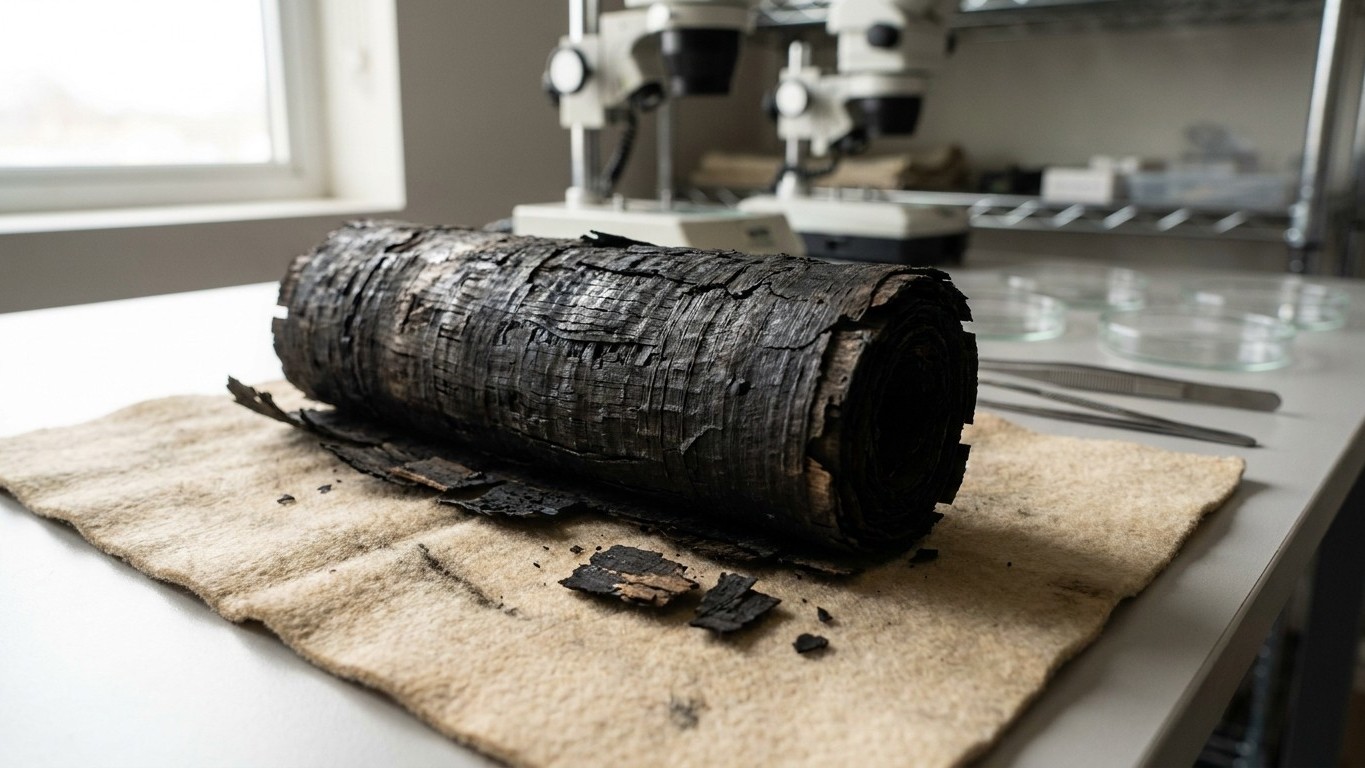
A cylinder of vegetal charcoal, barely larger than a soda can, capable of crumbling at the slightest touch. That was the scroll named PHerc.1 (or “Scroll 1”) before researchers, in late 2023, managed to extract more than two thousand Greek characters without ever unrolling it. The feat carries a name: the Vesuvius Challenge, an international competition with a one-million-dollar prize, launched to unlock the mystery of the Herculaneum papyri through X-ray imaging and artificial intelligence.
The story begins in 79 AD. The eruption of Vesuvius buried Herculaneum under a flow of hot mud and ash. In a luxurious villa, probably the home of Julius Caesar’s son-in-law, an entire library was carbonized on the spot. More than 1,800 papyrus scrolls were discovered at Herculaneum in the eighteenth century, carbonized during the 79 eruption. For centuries they have remained silent. Too fragile to be opened, too precious to be destroyed. To date, it is the only ancient library known to have survived in nearly its entirety. Attempts to physically unroll them, carried out as early as the eighteenth century, often ended in black confetti, unreadable.
Key takeaways
- How a nearly illegible black cylinder became a page of Greek philosophy
- Ancient ink was invisible to X-rays: here is the stroke of genius that changed the game
- Students and algorithms outpaced what two centuries of restorers failed to achieve
Why the ink was invisible to X-rays
The real obstacle wasn’t just the fragility of the medium. It was the ink itself. Unlike metallic inks, such as iron gall or other metallic pigments used for medieval documents, the carbon-based ink has a density similar to the carbonized papyrus on which it rests, making it invisible to X-rays. It’s like searching for a black letter on a black background. Tomographic scanners could reveal the spiral structure of the scroll, its layered sheets and folded pages. But the text, itself, remained a total mystery, invisible to the naked eye as well as to the sensor.
It was Brent Seales, a computer scientist at the University of Kentucky, who conceived the idea of entrusting this puzzle to algorithms rather than restorers. In March 2023, he published his work and, with entrepreneurs Nat Friedman and Daniel Gross, launched an open competition aimed at teaching artificial intelligence to detect the micro-reliefs left by the ink on the papyrus fiber. The Vesuvius Challenge was launched in March 2023 to bring the world together around reading the Herculaneum scrolls, and more than 1,000 teams took part. The principle: unroll the scroll not in reality, but in a virtual space, column by column, starting from the 3D scans.
A word, then two thousand characters
The first breakthrough comes with a single word. In October 2023, a computer science student at the University of Nebraska, Luke Farritor, managed to make a handful of Greek letters appear on an image generated by his model. The word that emerges is πορφύρας, meaning “purple” in ancient Greek. Farritor identified the word porphyras, meaning “purple,” on the papyrus, earning the contest’s “First Letters Prize.” A spark for the research community, which then understood that the method actually worked.
A few weeks later, three participants joined forces to push further: Youssef Nader, an Egyptian PhD student in bio-robotics in Berlin; the same Luke Farritor, then a SpaceX intern; and Julian Schilliger, a robotics student in Zurich. Their AI model managed to isolate entire columns of Greek text on the final, hermetically sealed portion of the scroll. The trio decoded more than 2,000 characters of text, which papyrologists translated as a discussion on the nature of pleasure, probably from an unpublished work by the Epicurean poet and philosopher Philodemus of Gadara. Philodemus, indeed, is the central author of this library: his writings on music, food, and the pleasures of existence already occupied a large portion of the scrolls deciphered over the previous decades.
To claim the Grand Prize of $700,000, the submission had to meet a precise set of criteria. The winning entry satisfied the requirements announced from the outset of the Vesuvius Challenge: four passages of 140 characters each, with at least 85% of the characters recoverable, which earned the three-person team the Grand Prize of $700,000. A panel of papyrologists validated each letter and each word by comparing the AI-generated images with the conventions of Roman-era writing.
What the text really reveals
The fragment isn’t telling a trivial anecdote. It sits within a philosophical meditation on what makes life pleasant, a theme dear to the Epicureans who regarded measured pleasure as the key to happiness. For scholars of the Antiquity, recovering an unpublished Philodemus text isn’t a minor detail: this author, frequently cited but rarely preserved in his entirety, illuminates a whole strand of late Greek thought that circulated in Roman circles during the first century BCE.
The method opens up a vertiginous perspective. There is hope of an even vaster library buried underground, since two levels of the villa remain unexcavated. The scroll read in 2023 may have been only a foretaste. Hundreds of other pieces, stored at Naples’ National Library, await the same treatment. And beneath the twenty meters of hardened mud covering part of the Villa dei Papiri, thousands of ancient texts could sleep, intact, waiting to be scanned in turn one day.
What stands out in hindsight is the speed of the technological switch. For two and a half centuries, opening a scroll from Herculaneum often meant destroying it; it took only a few months of an open competition, bringing together students, amateur computer scientists and seasoned papyrologists, to turn a pile of unreadable charcoal into a page of Greek philosophy. The project did not stop there: teams have since refined their X-ray scanning techniques at the Grenoble synchrotron, reducing the scan time for a large scroll to under two hours, with the stated ambition of reading, someday, all of the roughly three hundred scrolls still preserved.
Sources: actualitte.com | clubic.com
