
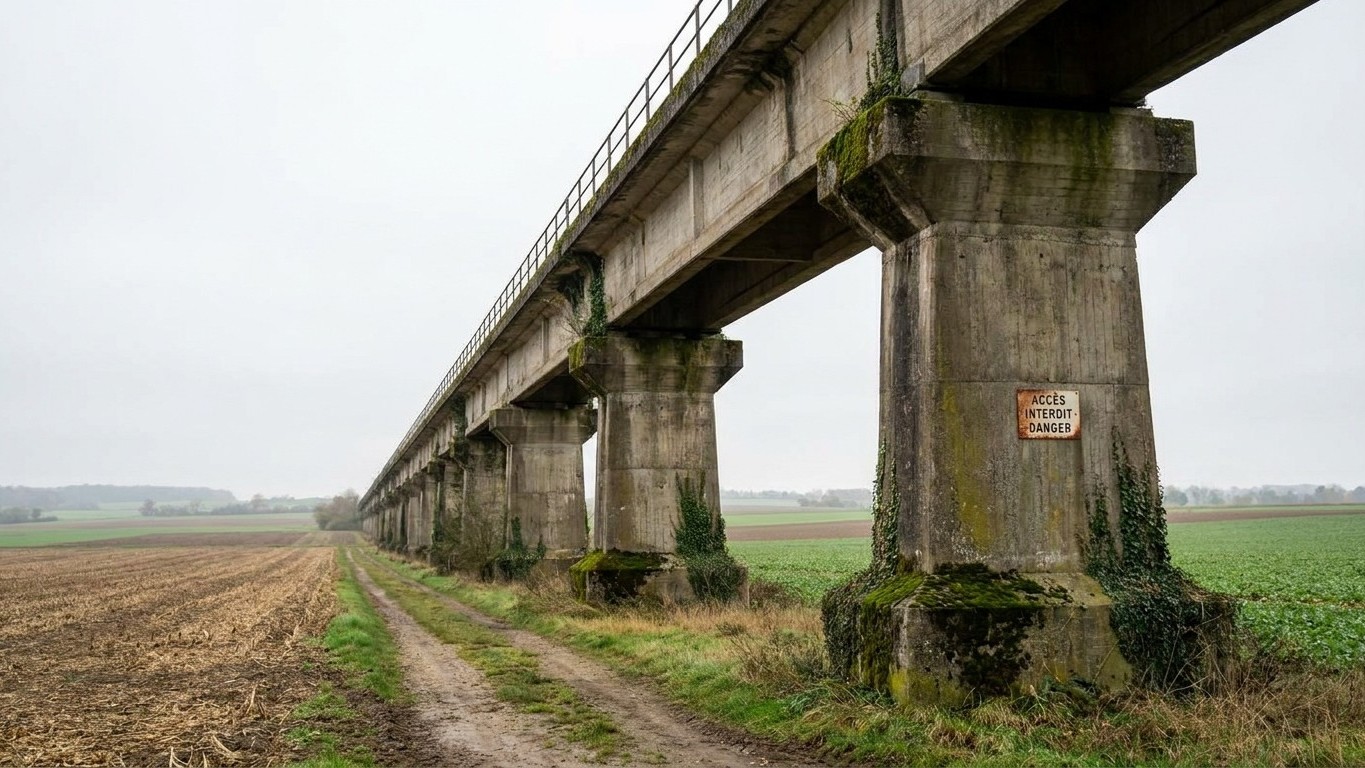
A 31.5-kilometer railway line, entirely elevated, has been idle for fourteen years. Its planned removal by the German state will cost more than its construction ever yielded: 68 million euros, against the 40 million originally estimated. The demolition project of the Transrapid test track, in Emsland, Lower Saxony, is scheduled to be completed in 2034. Twenty-three years after its closure, for a site that disturbs no one.
Key takeaways
- A pioneering railway has waited since 2011 for the execution of a costly verdict — but why?
- The demolition budget has nearly doubled without a single meter of concrete removed
- Companies want to reuse it, residents defend it, but the state persists in wanting to tear it down
A World Record Turned into an Industrial Wasteland
Everything begins in 1980, when the Transrapid consortium, formed by Siemens and ThyssenKrupp, launches construction of a test line between the villages of Dörpen and Lathen. The 31.5 km testing installation was built in 1983 by the Transrapid consortium, which included Siemens and ThyssenKrupp, and stayed in service until 2011. On this elevated concrete ribbon, several generations of magnetically levitated trains took turns, each pushing a little further the boundaries of rail speed.
The apex is reached in June 1993. The line’s speed record was set in June 1993 when Transrapid 07 reached 450 km/h. At that time, no wheeled train on conventional rails came close to that figure. Germany then possessed, in a quiet corner of Lower Saxony, the world’s fastest prototype.
But the story takes a turn in 2006. On September 22, 2006, during its first passenger-carrying trip, Transrapid 08 rolled onto the 31-kilometer test circuit at 170 km/h, before colliding head-on with a maintenance vehicle that had been left on the track, fifteen minutes later, killing 23 people. The investigation concluded human error in the application of safety protocols, not a flaw in the technology itself. The damage is done: Transrapid becomes, in the public imagination, synonymous with catastrophe rather than technical prowess. The operating license expired at the end of 2011 and the track closed for good.
Dismantling Costs More Than Expected, and It Isn’t Getting Anywhere
From 2012, the State decided: the line must disappear. Early 2012, the demolition and conversion of the entire Emsland site, including the tracks and the factory, were approved. On paper, the matter seemed straightforward. In reality, the field told a different story.
The main obstacle is the pillars. The dismantling is particularly challenging because the elevated track rests on support pillars every 25 meters, buried 15 meters deep. Each segment of the line is anchored in the ground like a building. Dismantling 31.5 kilometers of such structures implies hundreds of drilling and extraction operations, a heavy logistical undertaking in agricultural land.
Consequently, work has advanced at a crawl for nearly a decade. Demolition began around 2016, largely focusing on the removal of electrical equipment. By 2024, none of the concrete structures had been demolished. Copper cabling had been recovered, sold, and that was about it. The concrete framework remained standing, visible from the bike paths crossing the Emssland countryside.
Meanwhile, the budget exploded. Between 2013 and 2016, about 11.2 million euros were allocated to the project; followed by 25 million euros in 2023, then another 26 million euros planned through 2028 in the 2025 budget. And in October 2025, the government revised again. Instead of the 40 million euros estimated in 2011, the plan now counts on 68 million euros for full dismantling by 2034. A bill that has almost doubled without moving a single meter of concrete.
A Decision That Convinces No One Locally
On the ground, anger is mounting. Local residents, elected officials, and a dedicated association advocating to preserve the site question the real usefulness of razing it all. The test installation disturbs no one: it largely sits on stilts above farmland, does not block any roads, inhabit any area, or threaten any new project, and beneath the beams farmers continue to plow and harvest. A recurring argument in the local debate, echoed notably by magnetbahn.de.
It is not that there is no interest in a second life. The Chinese rail manufacturer CRRC has expressed interest in reusing the test track, and Hochschule Emden/Leer would like to reactivate it as a testing track for a Hyperloop system under development. These tracks even temporarily suspended demolition work until the end of 2023, before the administration resumed its schedule for total dismantling.
A local councillor, Gitta Connemann, tries to calm the situation by explaining that the credits allocated in the federal budget fall under a “Rückbau-Mittel im Bundeshaushalt rechtlich notwendige Vorsorge und kein konkreter Abrissbeschluss,” i.e., a legally required budgetary provision rather than a concrete decision to demolish everything. The explanation hardly eased the growing distrust among Emsland residents.
While Germany debates the fate of its former showcase of technology, the Shanghai commercial line, built under a German license, continues to operate. The Transrapid system functions commercially only on the 30.5-kilometer Shanghai Maglev line connecting Pudong airport to Longyang Road station, which entered service on January 1, 2004, and maintains peak speeds of 431 km/h. A paradox that sums up the dossier: the technology born in the fields of Emsland now carries Chinese passengers at speeds above 400 km/h, while its German cradle waits, until 2034, to be torn down for 68 million euros.
Sources: magnetbahn.de | railjournal.com | rollingstockworld.com
