
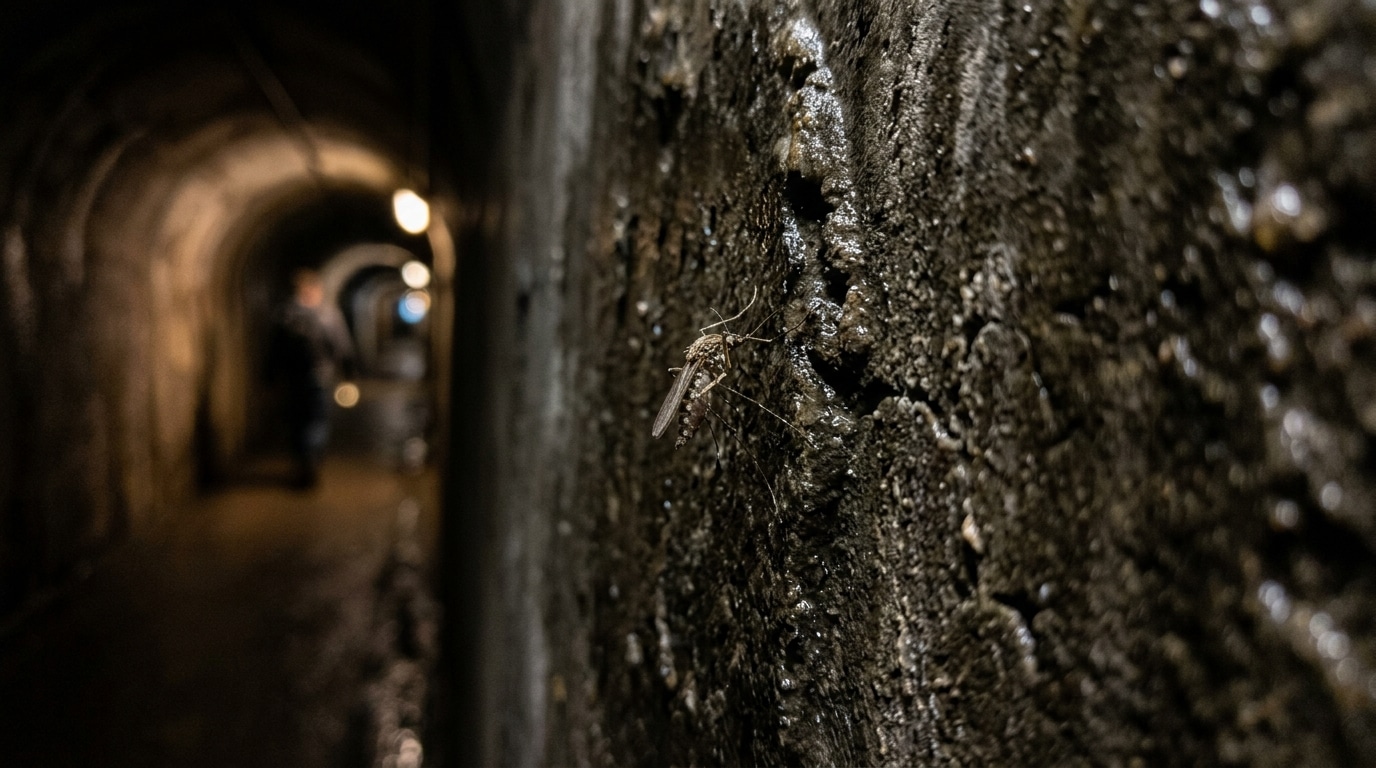
There are invaders who arrive with fanfare, and others who settle in quietly, without anyone noticing until it’s too late. The tiger mosquito clearly belongs to the latter category. At the end of summer, when terrace evenings often come with itching, a more discreet phenomenon is playing out beneath our feet. For Aedes albopictus, the striped little creature we now almost all know, it no longer confines itself to gardens, plant-pots saucers, or clogged gutters. It has found a new realm: the bowels of our cities. Tunnels, sewers, underground parking lots… as many warm refuges where winter can no longer catch up. And the most troubling part is that no one invited it there.
The stowaway who traveled in a tire
Originating from the tropical forests of Southeast Asia, the tiger mosquito apparently had nothing to do with our latitudes. Yet about thirty years ago, it began to land in Mediterranean ports, discreetly, as a clandestine passenger. Its preferred mode of transport? International trade, and most especially that of used tires. These, stacked in the open air, trap rainwater and provide perfect cradles for the mosquito’s eggs, which can survive long dry spells before hatching.
Introduced to Italy via maritime freight in the 1990s, the insect found an ideal ground there, then moved up the continent, kilometer by kilometer, taking advantage mainly of road transport. A true hitchhiker. The result of this long, discreet march is now spectacular: what was once a handful of isolated detections has become a continental-scale colonization, making it one of the most consequential invasive species in Europe.
When concrete becomes softer than winter
Historically, cold was the best ally of Europeans against this intruder. Prolonged frosts were enough to wipe out adult populations and to curb their northward expansion. But two factors have changed the game. First, climate warming, which softens winters and makes our cities hospitable where they were once hostile. Then, and this is the subtlety, the existence of an immense network of artificial refuges: the urban underground.
In the tunnels, the sewers and the underground car parks, the temperature stays surprisingly stable year-round. Neither oppressive heat nor deadly frost: a kind of perpetual spring, sustained by the warmth of machines, pipes, and human activity. These spaces offer the tiger mosquito what winter would deny it: a permanent shelter in which to survive and reproduce out of season. Concrete, in short, has proven more forgiving than nature.
What the underground changes to the public health
This geographical detail is nothing anecdotal. By settling in these warm hideouts, the tiger mosquito extends its season of activity and further accelerates its conquest. In France, its rate of advance has risen from six kilometers per year in the mid-2000s to about twenty today. It is now present in 81 metropolitan departments, a figure that would have seemed outlandish twenty years ago.
Yet, this mosquito is not merely a seasonal nuisance. It can transmit tropical diseases such as dengue or the chikungunya. Europe has even recorded several hundred locally contracted dengue cases in a single recent year, far more than over the entire previous decade. By prolonging their presence thanks to subterranean refuges, these insects mechanically increase the windows of possible contamination. Cities once spared, such as Lille, Vienna, Frankfurt, or even London, could one day experience such foci.
Tracking the enemy where you wouldn’t expect to look
For a long time, the fight focused on visible surfaces: emptying saucers, covering water collectors, tracing every stagnant puddle in gardens. These measures remain essential, because the tiger mosquito lays eggs in very small volumes of water and will settle for the smallest forgotten container. But neglecting the underground would be like watching the front door with the basement wide open.
Understanding that the insect hides underground requires rethinking the entire strategy. It means inspecting sewer inlets, technical galleries, and underground parking lots, those forgotten territories where water stagnates and heat never wanes. The battle is now fought as much in the surface as in the shadows, where one did not expect to search.
The tiger mosquito reminds us of a vertigo-inducing truth: our cities, becoming warmer and deeper, unintentionally create shelters for the very species we would like to keep at bay. Will we, in the future, design our subterranean infrastructures with those tiny beings in mind, who could settle there without our knowledge?
