
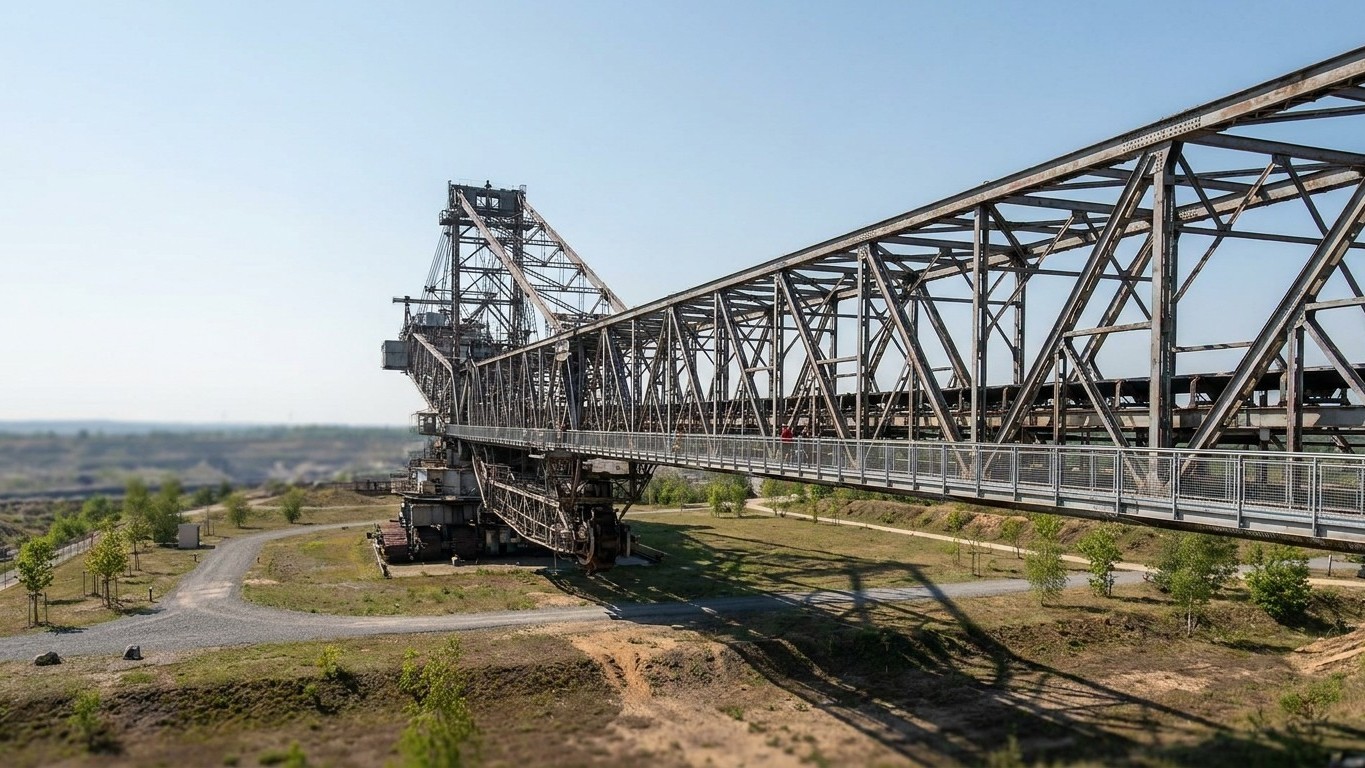
Eleven thousand tonnes of steel, five hundred and two meters in length, only about a year of operation before its permanent shutdown. The F60 bridge-gantry in Lichterfeld, Lusatia, in eastern Germany, was supposed to be cut up with a blowtorch like many other RDA industrial remnants. But dismantling a machine of this size was so expensive that the most economical solution ended up being… doing nothing. The result: the behemoth is still standing, transformed since 2002 into an open-air museum nicknamed the “lying Eiffel Tower.”
Key takeaways
- A giant excavator worked for only 13 months before its permanent shutdown
- Dismantling it would have cost more than its scrap value — a calculation that changed everything
- Saved from the blowtorch, it became one of Lusatia’s most-visited tourist attractions
A mining career that ends after thirteen months
The F60 was not born to become a tourist attraction. It is an excavator-conveyor, a machine designed to scrape away the earth covering lignite seams, before the shovels could extract the brown coal. Built by VEB TAKRAF Lauchhammer between 1989 and 1991, it was the last of a five-unit series, and it operated from March 1991 to June 1992. Thirteen months of activity, not a day more.
The fault wasn’t due to a breakdown or an accident. After German reunification, the mine came under the administration of the Lusatian and Central German Mining Administration (LMBV), which closed the site by order of the federal government. Overnight, a machine designed to run for decades found itself out of work, stranded in a mining landscape that German unification had just rendered obsolete. During that brief period, the machine did not idle: from its commissioning to its shutdown on June 30, 1992, it moved roughly 27 million cubic meters of overburden. Enough to fill the Stade de France with rubble, for a professional career that lasted only a year.
Scrapping a giant: a calculation that wouldn’t stand up
What does one do with an eleven-thousand-ton machine that has become obsolete? In theory, scrap metal. In practice, demolishing a machine of such mass requires cutting high-strength steel girders over five hundred meters in length, inside a structure as tall as a twenty-five-story building, with specialized teams deployed for months. The price of this operation far exceeded the value recoverable from the metal. Destroying it would have cost more than what selling the scrap would fetch.
The project nearly ended with explosives. The five-hundred-meter-long, eleven-thousand-ton structure narrowly escaped dynamite in the late 1990s. No one at the time saw this metal skeleton as anything more than a cumbersome logistical problem. Moreover, the idea of preserving it took time to persuade: initially the project had more opponents than supporters. One must admit that the region, in the midst of post-coal restructuring, had other priorities than saving an out-of-use mining machine.
Ultimately, an unusual operation sealed the F60’s fate: instead of leaving it on its original site, slated to be flooded during the rehabilitation of the mine terrain, the machine was moved five hundred meters along its own rails to a stable site near Bergheider Lake. A spectacular relocation for a machine designed to stay almost motionless, but far cheaper than a full cut-up. The economic calculation, as cynical as it may be, eventually favored preservation.
From a cumbersome wasteland to an industrial monument visited by hundreds of thousands
The turning point came in 2002. The F60 reopened, not as a production tool but as a project of the Internationale Bauausstellung Fürst-Pückler-Land, an international mining exposition, becoming a cornerstone of the European Route of Industrial Heritage. The success, initially modest, eventually surpassed expectations: by 2010, well over a half-million people had already visited the site.
The nickname “lying Eiffel Tower” is no marketing shortcut. With a total length of 502 meters, the F60 surpasses the Eiffel Tower by 182 meters. If stood upright, it would tower far above the Paris monument. On site, visitors discover a vertigo-inducing walkway: they can inspect about 1.3 kilometers of the structure and access an observation cabin located 74 meters above the ground. The sky-walk, as local guides call it, lasts about 90 minutes.
The weight displayed today is not exactly the original one either. After modifications and the removal of certain components, the structure still weighs eleven thousand tonnes. A figure already substantial in itself, but it recalls that parts of the machine were indeed removed during conservation work, without necessitating a full dismantling. The site continues its evolution: according to recent data from the Lusatia regional tourism office, a new anti-corrosion treatment must be applied to the structure, and the construction of a multifunction service and exhibition building is planned. The steel monster, saved by a simple cost calculation, continues to attract curious visitors wherever other East German giants have ended up under explosives or scrapped.
Sources: media24.fr | youtube.com
