
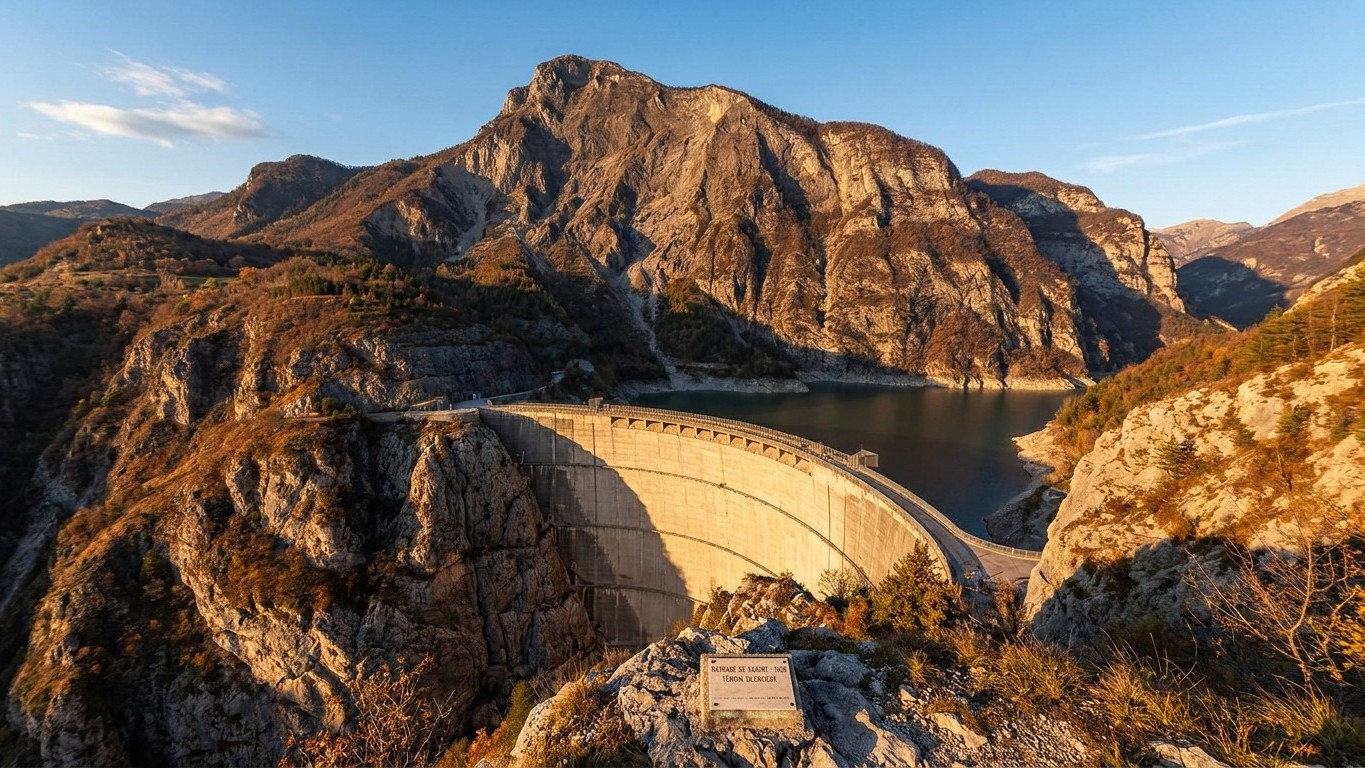
On October 9, 1963, at precisely 22:39, an entire flank of Mount Toc collapsed into the Vajont reservoir in the Italian Dolomites. The rock mass unleashed a wave that vaulted over the dam’s crest and ripped across the valley in a matter of minutes, killing around 2,000 people. The dam itself never broke. The engineering of the structure was flawless: the dam withstood extraordinary forces and remains standing today, though unused. It was the mountain that gave way, not the concrete.
Key takeaways
- Geologists had forecast the landslide as early as the 1950s, but their reports were largely ignored
- A 250-meter wave crossed the dam crest in seconds, yet the structure remained upright
- The courts would take 34 years to establish accountability and compensate the victims
A Mountain That Had Been Groaning for Years
The Vajont Dam was erected between 1956 and 1960. It was a double-curvature arch dam, towering 262 meters above the valley, located about a hundred kilometers north of Venice. At the time, it represented a new high-water mark in height and stood as a national pride.
The problem lay in the instability of Mount Toc’s flank, not in the dam’s design. As early as 1948, a geological report by Giorgio Dal Piaz warned of debris zones with precarious stability. In 1959, geologist Edoardo Semenza identified geomorphological signs of ancient landslides on the Mount Toc slope, leading him to suspect a colossal prehistoric rockslide. The mountain had already slithered once, millennia ago. And hardly anyone wanted to listen.
Water impoundment, begun in 1960, confirmed the fears almost immediately. An M-shaped crevasse, between 50 centimeters and 1 meter wide, opened at elevations from 930 to 1,360 meters, extending over more than two kilometers. A few months later, in November 1960, a more serious landslide occurred. Engineers understood then that a massive slide could split the lake in two and drastically reduce the reservoir’s capacity: they built a diversion tunnel to mitigate this scenario while continuing to fill the lake.
The summer of 1963 turned out to be unusually rainy. Heavy rainfall pushed the reservoir level to nearly 250 meters—about 30 meters above the recommended maximum depth. Only 15 meters of concrete kept the lake from overflowing. Yet the hillside could not keep pace: ground movement reached up to 3.5 centimeters per day. Faced with these signals, the mayors of Erto and Casso, the two villages upstream of the lake, sounded the alarm. The mayor of Erto published a manifesto urging residents to evacuate, but few followed the call. The mayor of Casso ordered evacuation and issued a notice about a possible wave triggered by a landslide. A month before the disaster, the operating company still dismissed the concerns: according to correspondence from the era, SADE claimed the region was not threatened and that the reservoir was monitored daily.
The Night the Mountain Fell into the Lake
What happened on October 9, 1963 exceeded all engineering projections. Roughly 270 million cubic meters of rock toppled into the reservoir in mere seconds, a volume comparable to hundreds of football stadiums stacked together. The resulting water displacement was colossal: it surged over the dam’s crest, cascaded down the 250-meter cliff, and then plunged another 250 meters into the valley below.
The tranquil villages of the Piave valley were swept away in minutes, burying sleeping families and leaving survivors homeless. Longarone, the town most affected, was almost erased from the map. Most of the victims were in Longarone, a small town that still exists today in the shadow of the Vajont Dam, which survived the catastrophe intact. The paradox is total: the structure that people blamed for threatening the valley remained standing, while nature itself caused the carnage that many thought it had caused.
The Dam Held, Justice Stumbled
The public debate that followed the disaster split into two irreconcilable camps. On one side, SADE and the Italian government argued it was a case of force majeure; on the other, some claimed that the early warnings from geologists indicated an avoidable human error. The trial opened in 1968, but far from the scene of the tragedy: it took place in L’Aquila, in the Abruzzo region, and SADE engineers received light sentences.
The full judicial outcome would take decades. In 1968, eleven people were tried for involuntary homicide; one committed suicide, two died before conviction, and most were acquitted for lack of sufficient evidence. In 1977, the project’s chief engineer was sentenced to five years in prison, a sentence later reduced to one year served. It would take until the 1980s and 1990s for the financial responsibility of the state-owned ENEL and the involved private entities to be established in court, with compensation totaling 55.66 billion lire paid in 1997 to the affected municipalities. Thirty-four years of proceedings for a case in which many beneficiaries had already passed away by the time of resolution.
In 2008, UNESCO described the catastrophe as a case study of caution. The organization called the tragedy “a classic example of the consequences of engineers and geologists failing to understand the nature of the problem they were trying to solve.” A polite way of saying that the concrete calculations were correct, but the reading of the mountain was catastrophically wrong.
The Vajont Dam is still open to visitors today. Its concrete vault, intact, overlooks a valley where the ruins of Longarone recount what truly collapsed that October night: not a piece of engineering, but the blind trust placed in geological reports that many chose not to read to the end.
Sources: fr.m.wikipedia.org | waterhistory.online
