
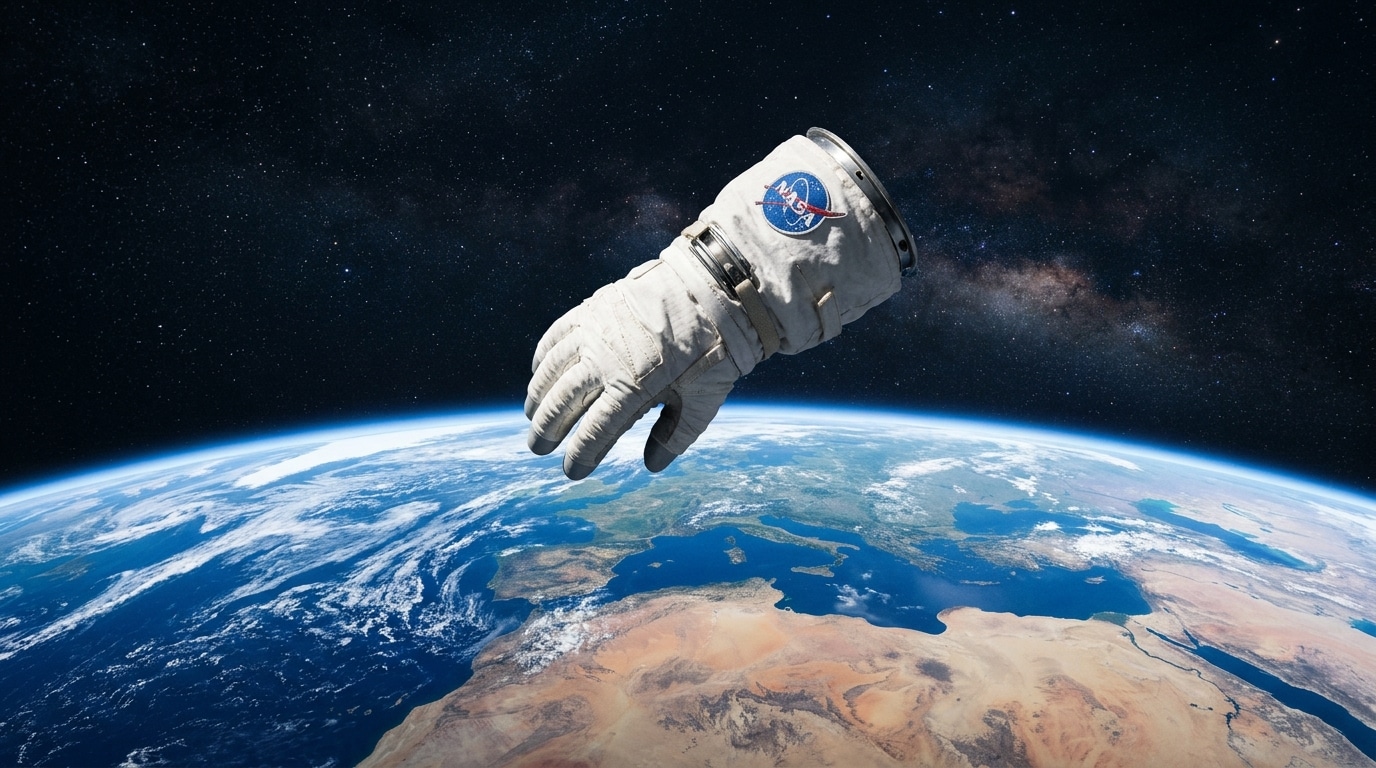
Picture an object left languishing at the back of a closet, a perfectly ordinary glove. Now imagine that same glove streaking around the Earth for an entire month, at a speed capable of crossing France in mere seconds. This space anecdote, dating back decades, deserves a closer look.
A Glove Escapes at 28,000 km/h: The Incident That Marked Space History
Space debris comes in many forms—stages of rockets, defunct satellites, machined fragments of metal—built to endure extreme conditions. And then there was this glove. A simple comfort glove, the one the astronaut Edward White wore over the pressure glove of his suit to keep his hand warm. During the famous extravehicular activity, with the capsule hatch open, that glove slipped free and drifted off into the void.
White himself recounted the moment: the glove glided above his right shoulder before clearly pulling away from the spacecraft, heading into the vastness. This small accessory thus became, unintentionally, one of the most banal objects ever placed into orbit. Propelled by the same orbital velocity as the capsule, it began to circle the planet at around 28,000 km/h, transformed into an improvised and involuntary satellite.
Edward White and Gemini 4: Behind the Scenes of America’s First Spacewalk
Now, the context. In the heart of the 1960s, the space race was in full swing between the United States and the Soviet Union. It was during the Gemini 4 mission that Edward H. White II became the first American to perform an extravehicular activity. The operation began above the Pacific Ocean near Hawaii and lasted barely 23 minutes, concluding over the Gulf of Mexico. In such a short span, White nevertheless covered a distance equivalent to thousands of kilometers.
Connected to his spacecraft by a 7.6-meter umbilical and a 7-meter tether, both wrapped in a golden ribbon to form a single cord, White held in his right hand a small self-maneuvering unit. It was precisely to keep that hand free, so he could wield his thruster and his camera, that he kept a thermal glove only on his left hand. The right glove, left aside, thus offered a one-way journey toward Earth’s orbit. A telling detail: White was so awed that they had to repeatedly tell him to come back. He described his return as the saddest moment of his life.
When a Mundane Object Becomes One of the Most Dangerous Orbital Debris
One might smile at this tale of a lost glove. Yet it illustrates an unforgiving principle of orbital mechanics: in weightlessness, the mass of an object does not affect its velocity. A woven glove, however light, travels exactly as fast as a metal plate. And at 28,000 km/h, the slightest object becomes a formidable projectile.
At that speed, an impact with debris a few centimeters across would be enough to puncture a vessel’s hull or seriously damage a satellite. This glove, remaining in orbit for about a month before burning up in the atmosphere, thus embodies space’s paradox: the most ordinary object can become among the most threatening once it orbits the Earth.
What This Glove Teaches Us About Space Pollution From Then to Now
This glove was likely one of the earliest pieces of human trash to populate low Earth orbit. A foreshadowing, in a sense, of the true headache that space agencies would come to face. Since then, tens of thousands of objects—ranging from the largest to the tiniest—have orbited our planet, forming an invisible belt that could threaten current missions.
Fortunately, low Earth orbit has a natural virtue: objects there eventually fall back and disintegrate as they encounter the atmosphere. That’s what happened to White’s glove. But not all debris is so courteous; many objects remain in orbit for years, even centuries. The question of cleaning up space is more urgent today than ever.
Thus, this glove that escaped during America’s first spacewalk is far more than a humorous anecdote. It reminds us that in orbit, any object, however humble, takes on a new and sometimes troubling dimension. The next time you pull on a pair of gloves to face the wind, consider that one of their distant cousins may have circled the globe faster than any aircraft. And if the story of space exploration could also be read through these small forgotten objects?
