
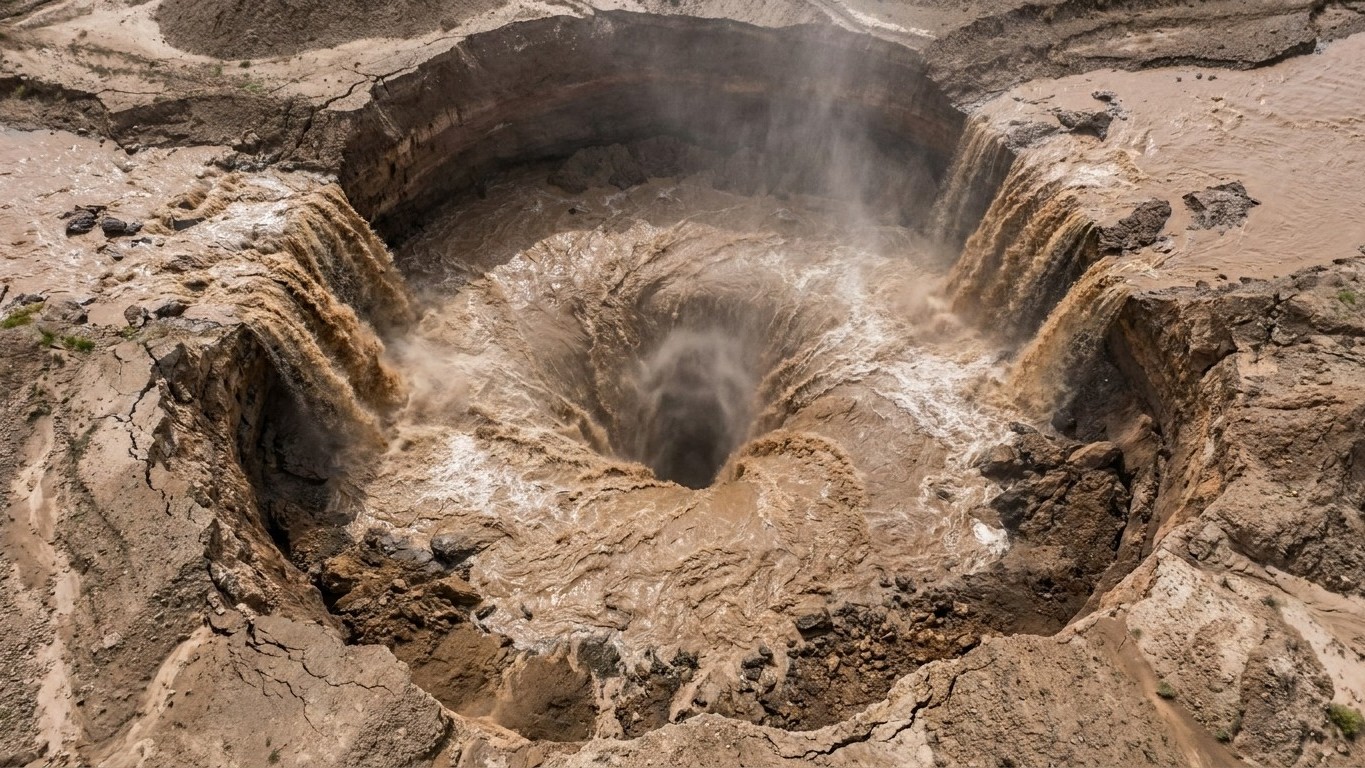
Three hours. That is how long it took for an entire lake to vanish into the ground, sucked away like water from a bathtub emptied in an instant. On November 20, 1980, at Lake Peigneur in Louisiana, an oil-drilling crew transformed a peaceful fishing lake into one of the most spectacular industrial accidents ever documented in the United States. Nobody died that day. But the landscape, it changed forever.
Key takeaways
- An oil platform accidentally punctures the roof of a salt mine beneath a lake
- The entire lake collapses into the mine in under three hours, pulling in barges and equipment
- A canal reverses flow, creating the tallest waterfall ever observed in Louisiana
A miscalculation, a lake that caves in
It all began with a faulty measurement. Texaco had secured the right to drill beneath Lake Peigneur, in Iberia Parish, to search for oil. They had subcontracted the drilling to Wilson Brothers, which operated from a floating platform on the lake. The problem: just below, at several hundred meters depth, lay the Jefferson Island Salt Mine, operated by Diamond Crystal Salt Company since 1919, with multiple levels descending to 460 meters below the surface.
That morning, the 36-centimeter-diameter drill bit got stuck at a depth of 374 meters, two and a half hours before the platform started to tilt. Underground, an electrician named Junius Gaddison was the first to sense that something was wrong. While checking cable reserves at the 1,300-foot level, he heard an unusual banging and then saw a muddy surge more than 60 centimeters deep moving toward the station. He immediately raised the alarm. On the surface, workers on the platform heard dull cracking sounds before the structure began to tilt. They fled to shore just in time.
What happened next belongs to industrial-scale fluid dynamics. The salt pillars holding up the mine ceiling were dissolved by infiltrating fresh water, triggering the collapse of the galleries and the creation of a chasm that swallowed the drilling platform, eleven barges loaded with equipment, a tugboat, numerous trees, and about 26 hectares of surrounding land, including a large portion of Jefferson Island. A whirlpool a quarter of a mile wide formed on the surface, pulling in anything that floated nearby.
A lake drained in three hours, a canal reversing
The ferocity of the phenomenon is enough to induce vertigo. In roughly three hours, the lake, only about three meters deep, containing some 3.5 billion gallons of water (nearly 13 million cubic meters), had vanished entirely into the mine. To grasp the volume: it was roughly the equivalent of 5,300 Olympic-sized swimming pools swallowed in a single morning. The pressure was such that the water entering the mine compressed the air to the extent that it projected a geyser of water and salt up 120 meters above the mine’s opening.
But the real turn of events, the one that makes this tale seem almost unreal, concerns the Delcambre Canal. This channel traditionally connected the lake to the Gulf of Mexico, via Vermilion Bay, routing the freshwater to the sea. With the lake emptying faster than a sink, the current literally reversed direction. The canal began carrying the Gulf’s seawater toward the lake’s bed, and this backflow created for several days the tallest waterfall ever observed in Louisiana, standing about 50 meters high. Barges carried by the canal rode the reversed current and disappeared into the swirl, only to reappear days later, cork-like, once the pressure stabilized. Nine of the eleven barges swallowed up were thus raised to the lake’s surface once the pressure equalized.
The episode also has its share of almost comic details that seem almost improbable. A natural gas pipeline ruptured in the crater’s center caught fire, sending a column of flames into the sky, so much so that federal aviation officials had to reroute all flights over the area for fear of an explosion. Underground, meanwhile, fifty-five miners were evacuating the galleries. Every employee present in the mine that day was able to escape, thanks to the alert from the electrician and a disciplined evacuation via the single elevator. The human toll remains astonishing given the scale of the damage: no human lives were lost, though three dogs were reported dead.
What the mine and the lake became
Judicially, the story settled far from the courts. The Diamond Crystal Salt Company, owners of the salt mine, secured $45 million in damages from Texaco and the drilling company, and withdrew permanently from salt mining. No official liability was ever formally established for the initial measurement error, most of the physical evidence having been sucked up and dissolved into the mine as well.
Today, Lake Peigneur bears little resemblance to the one that existed before 1980. Where there was a shallow freshwater body popular with anglers and bordered by the famed Live Oak Botanical Gardens, there now lies a much larger and deeper expanse of brackish water. The lake, once barely three meters deep, has become a saline body that can reach up to 60 meters in depth, though its salinity has since decreased thanks to freshwater inflows and the return of a normal flow in the Delcambre Canal, never returning to freshwater. The ecosystem has shifted, traditional fishing activities have vanished, replaced by fauna more akin to coastal estuaries. Today, natural gas is stored in caverns around the lake, an industrial use that has itself raised local concerns: a residents’ group secured in 2014 the cancellation of a plan to expand these storage facilities, citing signs of bubbling in the water. Proof that beneath the tranquil surface of Lake Peigneur, the region’s troubled geological history may not be done surfacing again.
Sources: iflscience.com | moneyweek.com
