
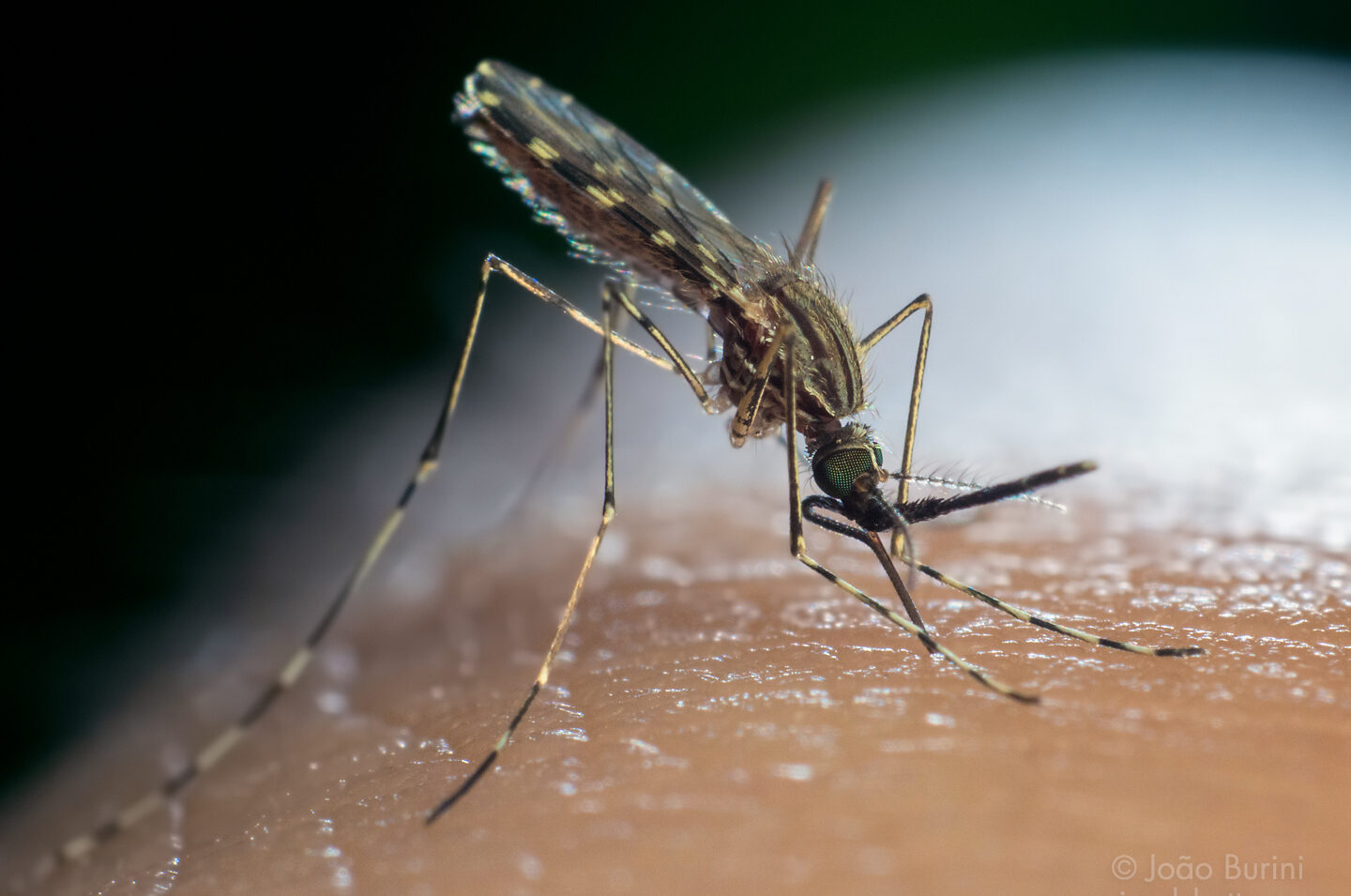
During the 20th century, a family of pesticides triggered a genetic mutation in mosquitoes, enabling their survival. Later, another family of products perpetuated this mutation, revealing another key function related to reproduction. This is a striking example of natural selection in response to human actions.
Chemicals targeting the same nerve receptor for 70 years
In the 1950s, the two flagship products in the battle against insects in agriculture and public health were dieldrine and lindane – historic insecticides. Several decades later, these substances were banned, due to their toxicity and their environmental persistence deemed drastic. Yet there was another reason: the progressive loss of efficacy of these products against mosquitoes of the genus Anopheles, vectors of malaria. These mosquitoes indeed mutated to survive, as explained by the journal Science in an article published on August 4, 2026. More precisely, the mutation involved the Resistance to dieldrin (Rdl) gene.
However, the American review mainly relayed the results of a study published on the BioRxiv platform on July 28, 2026. Led by researchers from the United Kingdom and the Central African Republic, these works build on the abandonment of dieldrine. It turns out that since then, the mosquitoes have not at all lost their mutation. Even better, there is talk of a “cross-selection”: the use of certain current chemical products continues to target the same nerve receptor – the famous Rdl – forcing the mosquitoes to maintain this mutation in order to survive.
The products in question are modern insecticides, namely the fipronil, the broflanilide and the isoxazolines. They are generally substances found in flea and other antiparasitic treatments for companion animals, cockroach gels, as well as certain agricultural treatments.
Better hearing the females amid the city’s din
At first, the Anopheles mosquitoes sensitive to dieldrine died (for the most part), but the “mutants” survived. Then, the global population became entirely insensitive to the product in only a few generations. The study provides a fresh perspective since maintaining the mutation through modern insecticides would have ultimately given these insects an essential auditory advantage for reproduction. What is this advantage? Why must the mosquitoes preserve their mutation?
Let us recall that mosquitoes mate in mid-flight within swarms. The males use their highly sensitive antennae as ears to detect the wingbeat of the females. In fact, the males produce a frequency of about 600 Hz and seek females emitting around 500 Hz. By combining these two frequencies in their auditory system, they perceive a kind of auditory illusion (a phantom tone) at a low frequency that points to the exact position of the females. Yet the fact remains that city-dwelling mosquitoes are strongly disrupted by low-frequency background noises, namely the usual constant urban sound pollution (engines, air conditioners, construction, etc.). By directly interfering with their courtship signal, the ambient noise makes the females very difficult to hear for ordinary males.
As the researchers explain, the Rdl mutation slightly modifies the physiology of the nervous system connected to the mosquito’s antennae. This modification acts surprisingly as a high-pass filter, attenuating the low-frequency urban background noise. Thus, the mutant males detect the phantom tone of the females much more clearly amid the city’s racket. For the authors, it is certain that the perpetual noise of the urban environment artificially maintains this mutation dating from the 1950s, with the help of modern insecticides.
