
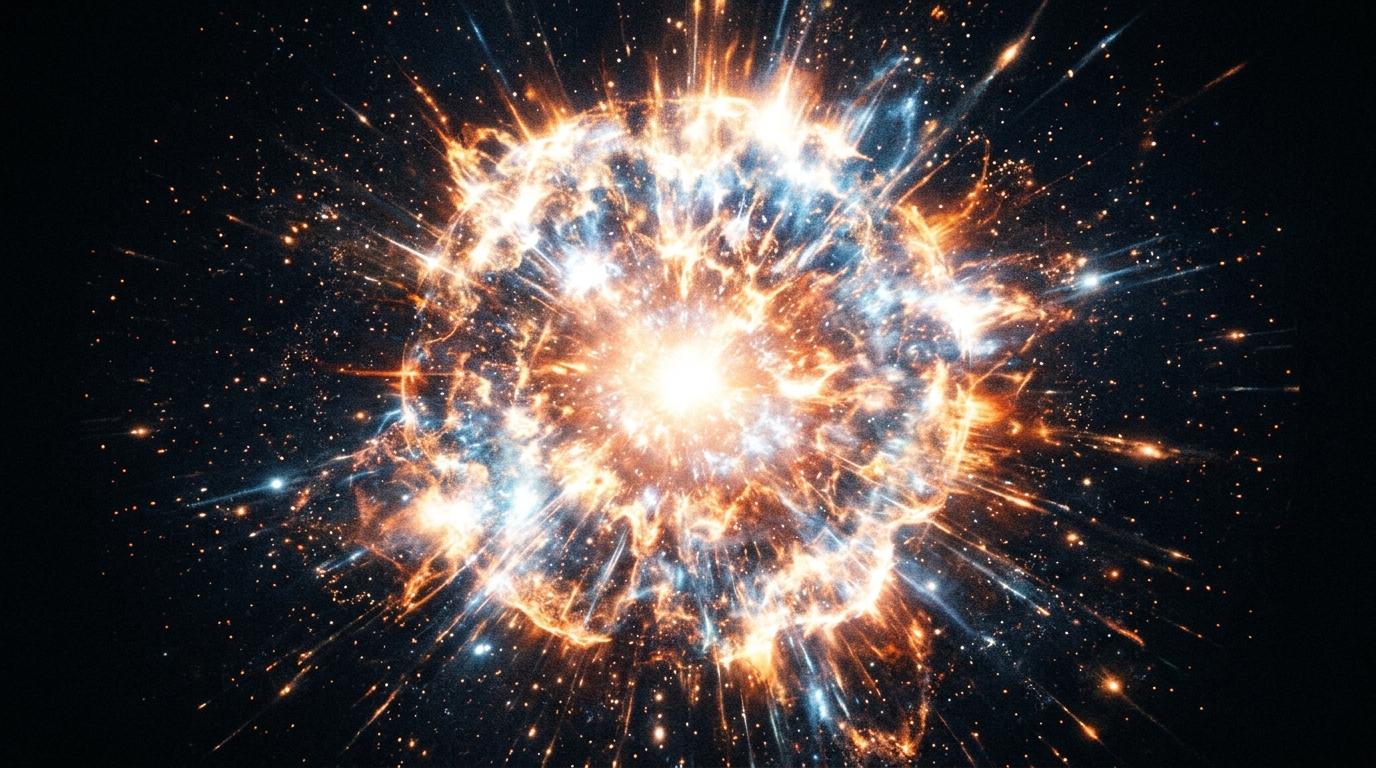
Imagine a scale of extraordinary sensitivity, capable of detecting a few grams of imbalance across several tons. Now replace the pans with the entire Universe. That is roughly the level of fineness that has allowed our cosmos to exist in the form we know. For a long time, the cosmic expansion was presented as obvious, an inevitable motion set off by the Big Bang that could not have been otherwise. Yet the physicists who study the very first moments of the Universe tell a different, far more dizzying story. One of an equilibrium so fragile that a minuscule difference in the initial conditions would have been enough to tilt our reality toward a radically different scenario: either an immediate collapse in on itself, or a dilution so extreme that no galaxy, no star, no complex atom could ever form.
La densité critique, ce fil invisible sur lequel tout repose
To understand why the very existence of the Universe hinges on nearly miraculous statistics, one must first dwell on a key concept of modern cosmology: the critical density. It is, in a sense, the perfect balance between two forces that have been waging a quiet battle since the cosmos’s earliest moments. On one side, expansion, which drives space to stretch. On the other, gravity, which pulls all matter toward itself and tends to make everything collapse. When the density of the Universe matches exactly this critical value, spacetime becomes flat, not curved like a sphere or a saddle, but like a perfectly taut sheet of paper.
However, the most precise measurements carried out thanks to the WMAP satellite and then Planck revealed something troubling: the total density of our Universe is estimated at 1.02 times the critical density, with an error margin of only 0.02. In other words, we stand on the edge of perfect flatness. Some analyses of Planck data, published in the journal Nature Astronomy in late 2019, have even suggested the possibility of a slightly closed Universe, shaped like a sphere rather than flat. This scientific debate, far from being merely academic, illustrates how our cosmos rides along a razor-thin line of almost inconceivable finesse.
Un cheveu près de l’effondrement, un cheveu près du néant
Let’s take a moment to imagine the two catastrophic scenarios that could have unfolded if this balance had not been maintained. If the density of matter and energy had been slightly higher than the critical value, gravity would eventually have overtaken expansion. The dilating motion would slow down, then reverse. The Universe, instead of growing, would have recontracted on itself, much like a balloon being deflated violently, returning to an extremely dense state reminiscent of the one in which it was born.
Conversely, if the density had been too low, expansion would have run away unchecked. The matter would have diluted so rapidly that gravity would never have time or the force needed to gather particles into gas clouds, then stars, then galaxies. A Universe of this kind would have remained a cosmic desert, cold and empty, incapable of developing any complex structure. Neither you, nor I, nor any form of life would have had a chance to appear. It is precisely because the actual density of our Universe turned out to be so close to this critical value that the expansion could continue for billions of years, at a pace sufficiently measured to allow matter to organize itself gradually.
L’inflation cosmique, la théorie qui explique l’inexplicable
Facing this troubling observation, a natural question arises: how can such precise tuning be explained? The strongest answer cosmologists currently have is named cosmic inflation. This theory posits that about 10^-35 seconds after the Big Bang, an utterly brief moment, the Universe underwent an era of incredibly rapid expansion. In a fraction of a second, distances would have multiplied by an enormous factor, erasing any irregularities that might have existed and flattening the geometry of space-time itself.
It is a bit like inflating a crumpled balloon until it becomes perfectly smooth and taut: the more the surface stretches, the fewer creases remain. Inflation would thus have naturally driven the Universe toward the flatness we observe today, independently of the exact initial conditions. The problem is that scientists still do not know precisely what triggered this phase of explosive expansion. Inflation remains an extremely compelling theoretical framework to explain our observations, but its triggering mechanism remains one of the great unsolved mysteries of modern physics.
Ce que cet équilibre presque parfait nous apprend sur nos origines
Beyond inflation, this delicate balance leads us inevitably to the ultimate origin of everything: the famous initial singularity. Current cosmological models indicate that when we go back far enough in time, there was a moment where the entire Universe was compressed into a single point of infinite density, with no space or time as we understand them. This singularity remains poorly understood physically, because the laws that describe matter and energy cease to function at such extreme scales. To describe it properly, one would need new theoretical tools capable of reconciling general relativity with quantum mechanics—a challenge that has occupied physicists for decades.
What makes this story so fascinating is, ultimately, the realization that the initial expansion of the Universe was extraordinarily close to the critical balance, a tuning so precise that it continues to challenge even the most rigorous minds in cosmology. It isn’t a comforting certainty but a reminder of the fragility of our collective existence, suspended on a parameter whose exact origin remains elusive.
As we probe these questions, we come to understand that the Universe we observe each night, with its glittering stars and distant galaxies, was by no means an inevitability pre-programmed. It rests on a balance of a delicately poised tension between two opposing forces, a balance that the inflation theory tries to explain without revealing all of its secrets. So, the next time you lift your eyes to the starry sky, perhaps you will spare a thought for this dizzying precision that allowed, against all odds, that something should exist rather than nothing.
