
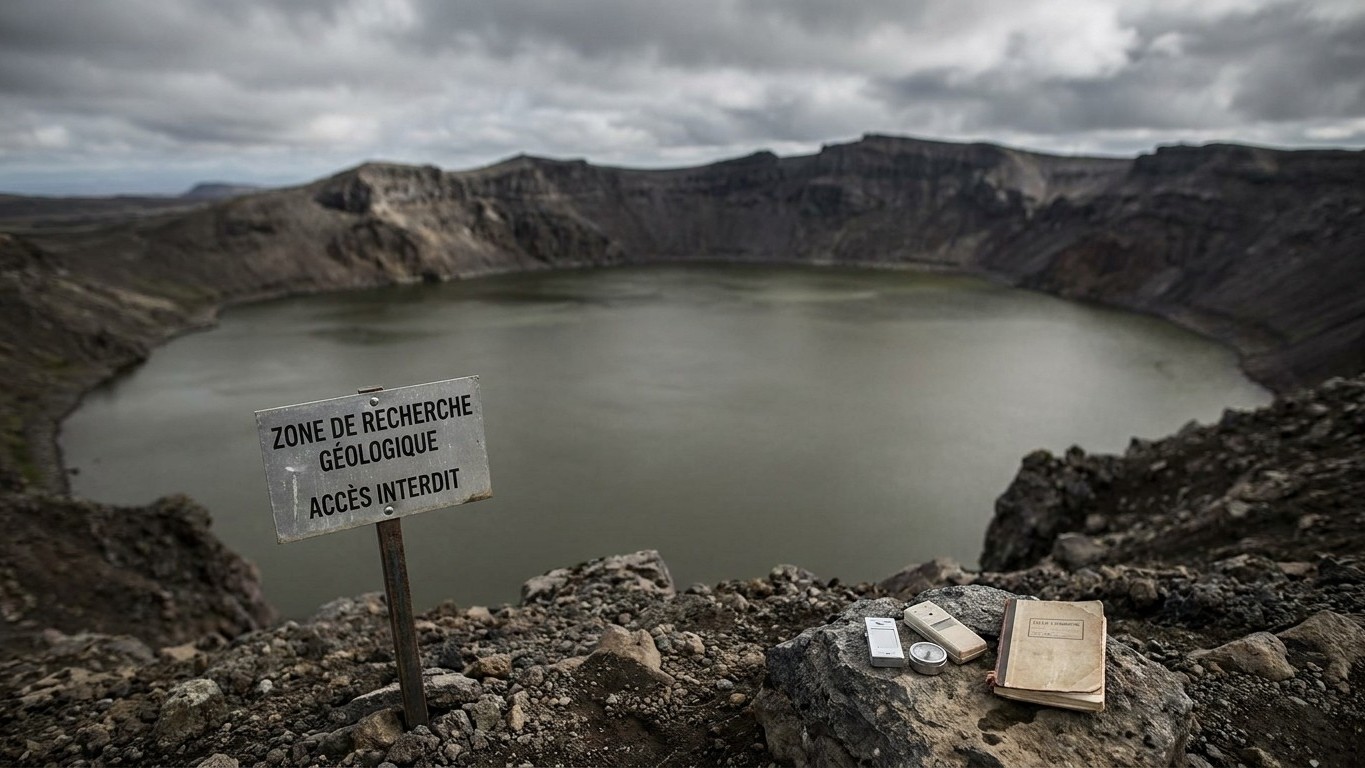
On January 15, 1965, at dawn, a 140-kiloton nuclear charge exploded 178 meters beneath the dry bed of the Chagan River in the Kazakh steppes. In a matter of seconds, the ground collapsed in on itself and gave way to a crater more than 400 meters in diameter and about a hundred meters deep. This hole, since filled with water, still exists today. It remains radioactive sixty years later.
Key takeaways
- A Soviet nuclear explosion creates a massive artificial lake in seconds
- The project secretly imitates a similar American program but on a larger scale
- Six decades later, the lake remains one of the most contaminated sites in the world
A Soviet clone of the American Plowshare program
The Chagan test is nothing like an accident or a conventional military detonation. It was the first and largest of the 124 detonations carried out under the program of explosions for the national economy, designed to produce peaceful nuclear explosions for earthmoving purposes. The idea isn’t new: Moscow copies Washington. The concept of using peaceful nuclear explosions to create artificial lakes, ports, and canals had been modeled on an American program, the Plowshare Project, which had conducted the first peaceful nuclear explosion (the Sedan shot of 104 kilotons, a shallow crater) at the Nevada Test Site in July 1962.
Moreover, Soviet engineers did not hide it. Described as a “quasi clone” of the Sedan shot, the Chagan detonation had a yield equivalent to 140 kilotons of TNT and aimed to produce a large conical crater conducive to the formation of a lake. The ambition went far beyond a technical test: in a region where water is desperately scarce, the USSR dreamed of digging reservoirs in rapid succession, even diverting whole rivers southward with the power of the atom.
Ten million tonnes of earth hurled into the air
The choice of site was no accident. The device was placed at the confluence of the Chagan River and its tributary Achtchissou, precisely so that the crater’s lip would serve as a natural dam during spring floods. The blast’s shockwave launched material to nearly 950 meters in height. The soil displacement reached 10.3 million tonnes. Around the gaping hole, a mound of rocks up to 1,000 meters in diameter and up to 35 meters high formed from rockfalls and fracturing.
The result looked impressive on paper, at least. The explosion created a crater 400 meters in diameter and 100 meters deep, with a rim rising 20 to 38 meters. By spring 1965, the Chagan valley was linked to the crater by a channel cut through the rock debris, allowing the meltwater to fill the cavity. A ten-million-cubic-meter artificial lake was born, literally blasted from the Kazakh soil.
The lake Moscow boasted about
For several years, the Soviet authorities flaunted their success as a trophy. A film even shows the minister of machine-building—the man responsible for the entire Soviet nuclear program—bathing peacefully in the crater’s waters. The message is clear: the atom, tamed, now serves agriculture. The water of the Chagan Lake was then used to water nearby livestock, with no official mention of any danger.
The problem, however, is that the test did not stay as confined as announced. A non-negligible portion of the radioactive products produced by the explosion escaped into the atmosphere, being detected over Japan, which provoked Washington’s anger: the USSR had violated the 1963 Partial Test Ban Treaty, which banned atmospheric tests. Locally, fallout affected eleven villages housing about two thousand inhabitants, with gamma radiation measured at 30 roentgens per hour at the crater’s edge on the first day, dropping to 1 roentgen per hour after ten days.
Sixty years later, the water remains contaminated
The Chagan Lake, today locally renamed the “Atomic Lake,” has hardly changed in shape since 1965. But beneath the surface, the radioactive legacy persists. Measurements have shown the water remains around one hundred times the permissible limit for drinking water, though at about one hundred meters from the crater, the levels fall back to natural background. A 2017 study of surrounding soils revealed radionuclide concentrations reaching up to 22,000 becquerels per kilogram, a contamination that remains confined to a narrow band of one to two kilometers downstream from the crater.
The Kazakh authorities now categorize this site among the most affected by the entire Semipalatinsk test complex, a polygon that spans nearly as large as Belgium and witnessed 456 nuclear tests between 1949 and 1989. Despite this, livestock still drink near the lake, carp survive and sometimes end up on the plates of residents who do not always grasp the danger, while passing tourists come to photograph this water hole born from a bomb. To date, there is no other body of water in the world formed in this manner and still open to life, human as well as animal, under such a context of persistent contamination.
Sources : nnc.kz | sciencephoto.com
