
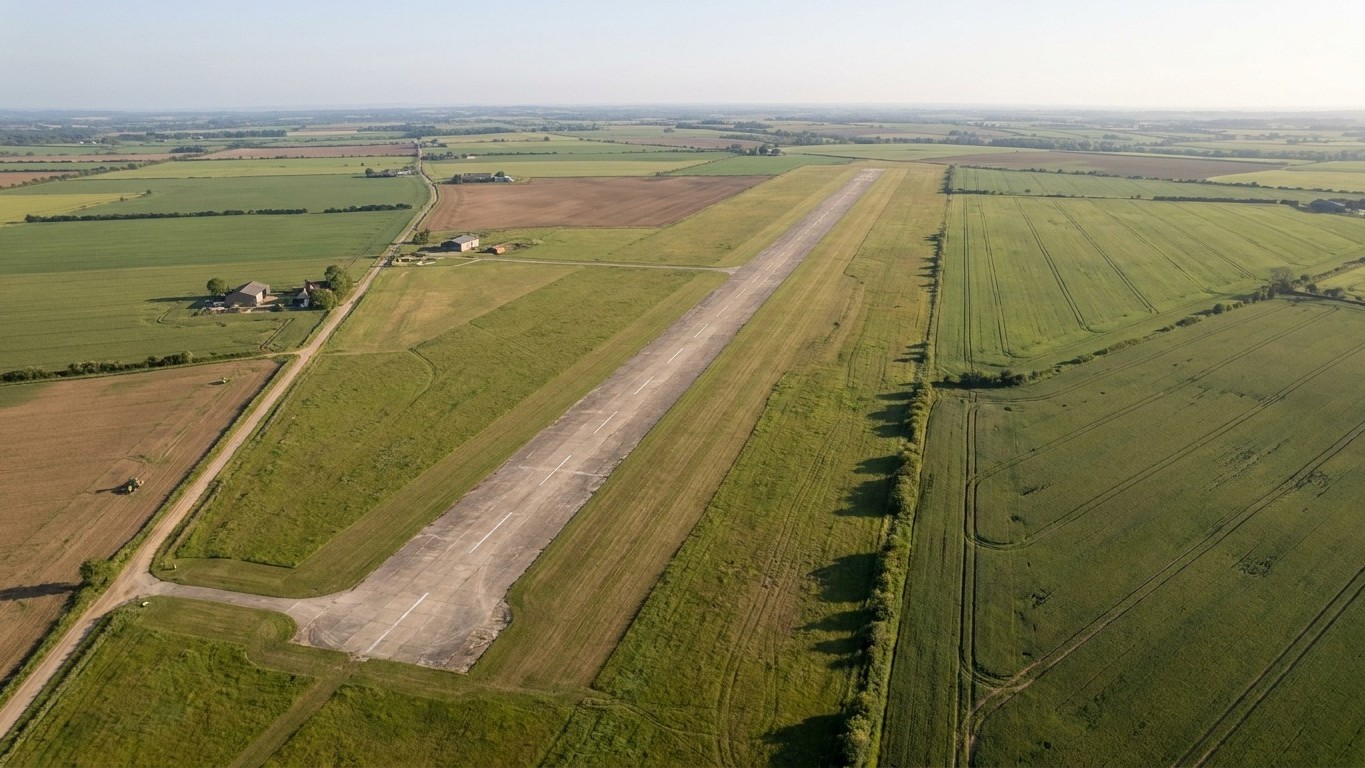
Three thousand eight hundred sixty meters of asphalt concrete laid in the heart of the Marne’s agricultural lands, about 100 kilometers east of Paris. Since its opening in 2000, the Paris-Vatry Airport has boasted one of the longest runways in the country, almost as long as the Roissy-Charles de Gaulle runway. A scale designed to receive the world’s largest cargo aircraft. But the massive traffic that was supposed to justify this infrastructure has, for the most part, never really taken off.
Key takeaways
- A runway of 3,860 meters, nearly as long as Roissy’s, built without a real market study
- 150,000 tonnes of freight promised by 2010, but only 4,585 tonnes handled in 2015: what a gap?
- A two-euro Chinese tax cut traffic by five in a month: how can an airport depend so much on a distant decision?
A Runway Sized for Freight Giants
The Marne platform traces its origins to a former NATO military base. Its operation has been handled since April 2000 by SEVE (Société d’exploitation Vatry Europort) under a public service delegation signed with the Department of the Marne. The single runway, oriented 10/28, measures 3,860 meters by 45 meters, with a bituminous concrete surface, ILS landing aids Category I and III. This level of equipment allows operations in all weather, an argument regularly cited by successive managers.
On paper, this infrastructure was meant to aim high. The runway is presented as one of Europe’s longest, capable of hosting all types of aircraft under all conditions. In the 1990s, the ambition extended far beyond local development: to create a major logistics hub capable of relieving the Paris airports, at a time when international air freight was growing rapidly. Road, rail, and air were to converge on this site chosen for its location, midway between Île-de-France and Europe’s major industrial basins.
150,000 Tonnes Promised, a Few Thousand Observed
The figure structured the entire Vatry economic project. The stated objective was to reach 150,000 tonnes of freight per year by 2010, a forecast that formed one of the project’s economic pillars. In reality, the trajectory took a very different path. A report from the Ministry of Ecological Transition confirms that this ramp-up never materialized.
The numbers, year by year, tell the story of this gap. In 2015, the airport handled only 4,585 tonnes of freight, while the original plan promised 150,000 by 2010—a low point thirty-three times below the initial target. A few years earlier, in 2008, the platform had nonetheless reached its historical peak, with traffic approaching 40,000 tonnes, never again approaching that level thereafter. The 2020s did not reverse the trend: according to data released by the departmental council, tonnage rose to 18,000 tonnes in 2022 and then to only 9,000 tonnes in 2023, far from the 50,000 tonnes annual target needed to restore the operation’s financial balance.
A more recent rebound, boosted by express freight from China, had raised hopes of a turning point. But this surge proved fragile: in spring 2026, the introduction of a two-euro tax on extra-European small parcels reduced volumes processed from about 4,000 tonnes in February to 800 tonnes in March, a sector that accounted for 90% of freight from Chinese platforms such as Shein, Temu or AliExpress.
The Cost to the Community, Documented by Several Reports
This infrastructure, largely financed by public funds, continues to weigh on local budgets. More than 160 million euros had already been invested by the end of 2004, according to the Regional Court of Accounts. Ongoing operations, however, remain heavily subsidized: according to recent public data, the airport costs the region 660,000 euros and the department 1.5 million euros each year, for traffic that for a long time barely exceeded a few tens of thousands of tonnes.
The management of the airport has been the subject of thorough scrutiny since the late 2000s. The Regional Court of Accounts had already criticized, in 2009, the airport’s management, built without a real market study. More recently, a new audit mission was launched at the request of the Grand Est region, covering all of the region’s airports. This work was to closely examine subsidies, freight traffic, passenger traffic, but also the direct and indirect economic impacts. Since 2016, the Department of the Marne has taken direct control of the operation, through a public establishment, after a succession of private operators.
Freight, Maintenance and Charters: the Activity That Really Settled In
Failing to capture the expected volume of regular international freight, Vatry built its survival on gradual diversification. The site now hosts cargo flights, often linked to transcontinental e-commerce, as well as aircraft maintenance activities and seasonal charter flights to tourist destinations. Passenger service, however, never found lasting stability: after several years operated by low-cost carriers, the withdrawal of one of the main operators in spring 2025 further weakened this activity, leaving freight and occasional uses (training flights, business aviation, humanitarian operations such as the rotations to Mayotte at the end of 2024) as the site’s pillars.
Vatry is not an isolated case in France. The Court of Accounts identified in a thematic report published in June 2023 no fewer than 73 commercial airports on metropolitan territory, several of which show comparable economic trajectories, between development promises and persistent dependence on public subsidies. On runways built for wide-body aircraft, it is ultimately the lighter planes, and tax decisions taken thousands of kilometers away, that continue to shape the uncertain future of the Marne platform.
Sources: marne.fr | aeroport.fr | paris.vatry.aeroport-voyages.fr
