
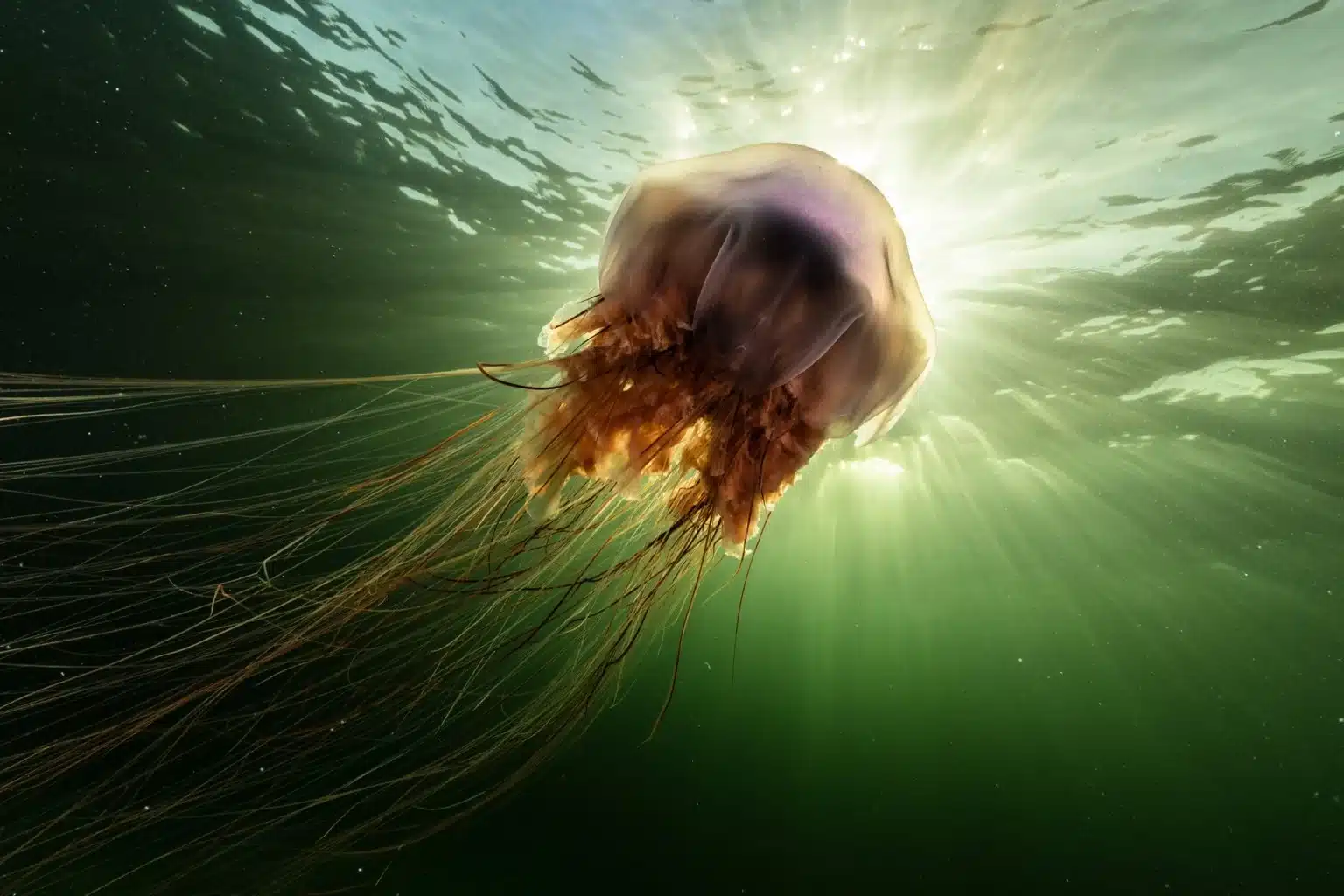
In the ocean’s depths, a creature evolves that defies all laws of nature. Picture an animal weighing as much as a small car, with its appendages extending to lengths rivaling a blue whale, yet it remains composed entirely of soft, gelatinous tissue. The lion’s mane jellyfish, regarded as the heaviest on Earth, resembles nothing we know on land, and yet it reigns supreme in the cold waters of our oceans. Its very existence challenges our preconceived ideas about what a sea giant can be, marrying hypnotic beauty with a daunting capacity for destruction.
A Gelatinous Titan with Vertiginous Dimensions
The lion’s mane jellyfish holds a record that leaves marine biologists speechless: with a weight capable of reaching a full metric ton, it far surpasses all of its kin. This impressive mass unfolds within an organic architecture that is as captivating as it is tailored for predation.
Its tentacles constitute its most striking feature. Extending over more than 30 meters in the largest specimens, they form a capture network of formidable efficiency. These deadly filaments are not laid out at random: they are meticulously organized into eight distinct clusters, each able to cradle up to 150 individual tentacles, for a total approaching 1,200 venomous appendages.
A Biological Weapon of Surgical Precision
Each tentacle functions as a highly specialized hunting device, packed with stinging cells loaded with powerful neurotoxins. This biochemical artillery enables the jellyfish to seize an impressive range of prey, from small fish to other jellyfish, creating a true floating trap in the currents of the sea.
The danger of this creature is not confined to marine legends. Arthur Conan Doyle himself drew inspiration from it for one of Sherlock Holmes’s stories, using the lion’s mane jellyfish as a tool of death in a crime plot. This literary reference testifies to the formidable reputation of the animal, whose stings can prove fatal to humans.
A Scientific Mystery Over a Century Old
The history of this jellyfish still holds fascinating shadows. In 1856, a geologist claimed to have discovered off the North American coast a specimen of astonishing proportions: a disk 2.3 meters in diameter and tentacles sprawling over more than 37 meters. This testimony, though spectacular, still divides the scientific community, with some researchers preferring to grant the title of “largest jellyfish” to Nomura’s jellyfish.
Nomura’s jellyfish, native to Asian seas, astonishes with its rapid growth. Capable of reaching 200 kilograms and two meters in diameter in just one year, it now poses serious ecological problems. Its recent spread in the Yellow Sea and the South China Sea upsets local ecosystems and greatly complicates the work of fishermen.
The Paradox of Size
The realm of jellyfish hides one final, particularly troubling surprise. The most formidable are not always the largest: the tiny Irukandji jellyfish, with a diameter of 5 centimeters and four diminutive tentacles, ranks among the planet’s most venomous creatures. This natural lesson reminds us that when it comes to marine danger, appearances are often deceiving.
