
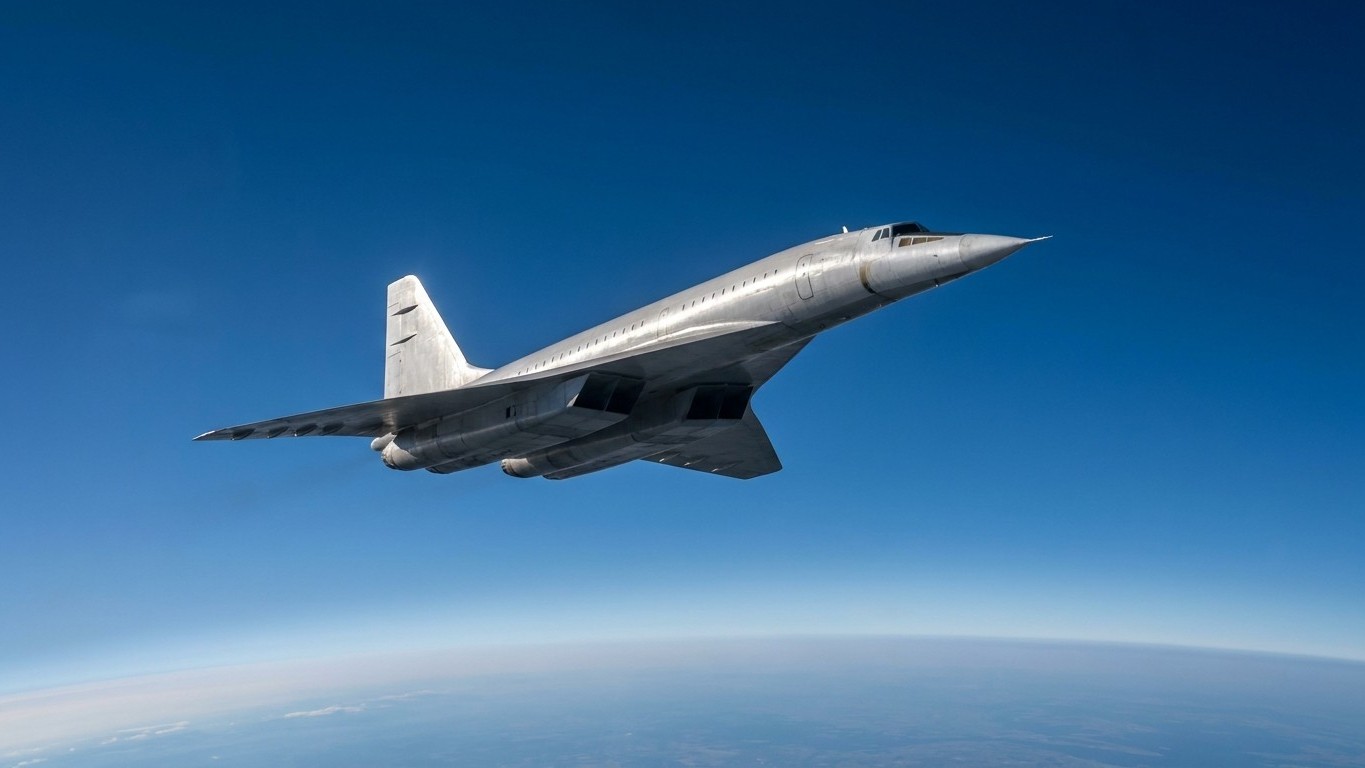
Eighty passengers, a roar so intense that you had to shout or scribble notes to exchange two sentences: that is the memory left by the Moscow–Alma‑Ata route, the only connection in the world ever operated with the Tupolev Tu-144, the first airliner to carry paying passengers at supersonic speeds. On November 1, 1977, a aircraft took off from the Soviet capital toward Kazakhstan with, aboard, the designer Alexei Tupolev and a delegation of foreign journalists. The venture would last only seven months.
To Note
- An aircraft twice as fast as its rivals, yet so loud that passengers had to write on notebooks to understand one another
- Only 55 commercial flights in seven months: why was this revolutionary supersonic so quickly abandoned?
- A test crash in May 1978 sealed the fate of the program, revealing the hidden fragilities of a Soviet propaganda marvel
A Flight at 2,000 km/h, but an Acoustic Nightmare
The route linked Moscow to Alma‑Ata over roughly 3,260 kilometers, cruising at an altitude of about 16,000 to 17,000 meters and at a speed approaching 2,000 km/h. The flight operated at an altitude of 16,000–17,000 meters over a distance of 3,260 kilometers, at a speed of 2,000 km/h, with the aircraft flying once a week carrying 80 passengers. On paper, the technical achievement was impressive: twice as fast as a conventional long‑range airliner of the time, a near‑orbital trajectory where passengers felt like astronauts during the flight.
Reality aboard, however, was far less glamorous. The Tu‑144’s engines, derived from military motors, produced vibrations and a cabin noise level that made normal conversation nearly impossible. Speaking in a low voice was an achievement; passengers had to raise their voices or lean within a few centimeters of each other to hope to understand one another. A paradox for a craft intended to embody Soviet luxury and modernity, conceived as the direct answer to the Franco‑British Concorde.
Fuel consumption, too, vastly exceeded the standards of conventional commercial aviation. The engines, designed for speed rather than efficiency, devoured kerosene disproportionately to the number of passengers carried—only 80 per flight. Add to that recurring failures in onboard systems—hydraulic, electrical, and pressurization—and it becomes clear that operating the aircraft commercially was more a political gamble than an economic calculation.
Only 55 Flights Before the Abrupt Stop
Between the line’s opening on November 1, 1977, and the service cessation on June 1, 1978, the Tu‑144’s commercial history boils down to a modest figure. Until regular commercial operations ended in May 1978, Aeroflot crews completed 55 Tu‑144 flights, carrying 3,284 passengers. It ran once a week, at most: only two of the sixteen Tu‑144s built, aircraft 77109 and 77110, flew on Moscow–Alma‑Ata passenger routes.
The ax fell after an accident that did not involve any commercial flight. On May 23, 1978, a Tu‑144D, a modified version equipped with new engines intended to improve range, conducted a test flight from Ramenskoe Airport near Moscow. The aircraft suffered a fuel leak that sparked an in‑flight fire in the right wing, forcing the shutdown of two of the four engines. Troubles cascaded: a third engine failed, making any return to the runway impossible. The crew had to belly‑land in a field near Iegorievsk; two flight engineers died in the crash, but the six other crew members survived.
That crash, occurring during a qualification flight rather than a commercial one, nonetheless sealed the fate of the passenger program. The accident led to a ban on Tu‑144 passenger flights, which was already plagued by numerous issues, provoking a loss of interest that would eventually lead to the cancellation of the Tu‑144 program. On June 1, 1978, Aeroflot announced the definitive end of passenger service. A decision made in a matter of days, revealing the fragility of the aircraft that Soviet authorities perhaps had been waiting to exploit as a pretext for stopping an operation that had become untenable.
A Supersonic Sacrificed on the Altar of Propaganda
What stands out in hindsight is the gap between the proclaimed ambition and the ground reality. The Tu‑144 first flew on December 31, 1968, two months before the Concorde, a feat Moscow loudly claimed during the Cold War. But the race for speed was pursued at the expense of reliability and comfort. Freight had even preceded passengers on this same route: as early as December 1975, the aircraft was already carrying mail between Moscow and Alma‑Ata, a burn‑in phase that evidently did not suffice to fix the aircraft’s structural faults.
Sixteen Tu‑144s would ultimately roll off Voronezh’s assembly lines. Today, most lie dormant in Russian museums, notably Monino or Ulyanovsk. A single aircraft left Russian soil: it sits in the Technikmuseum Sinsheim, in Germany, where it faces, in an almost ironic display, an Air France Concorde. Two competing supersonic dreams, two commercial failures, housed under the same roof to tell visitors of an era when speed alone was believed to seduce the masses, even if it blew out their eardrums.
Sources: avionslegendaires.net | aviation-safety.net
