
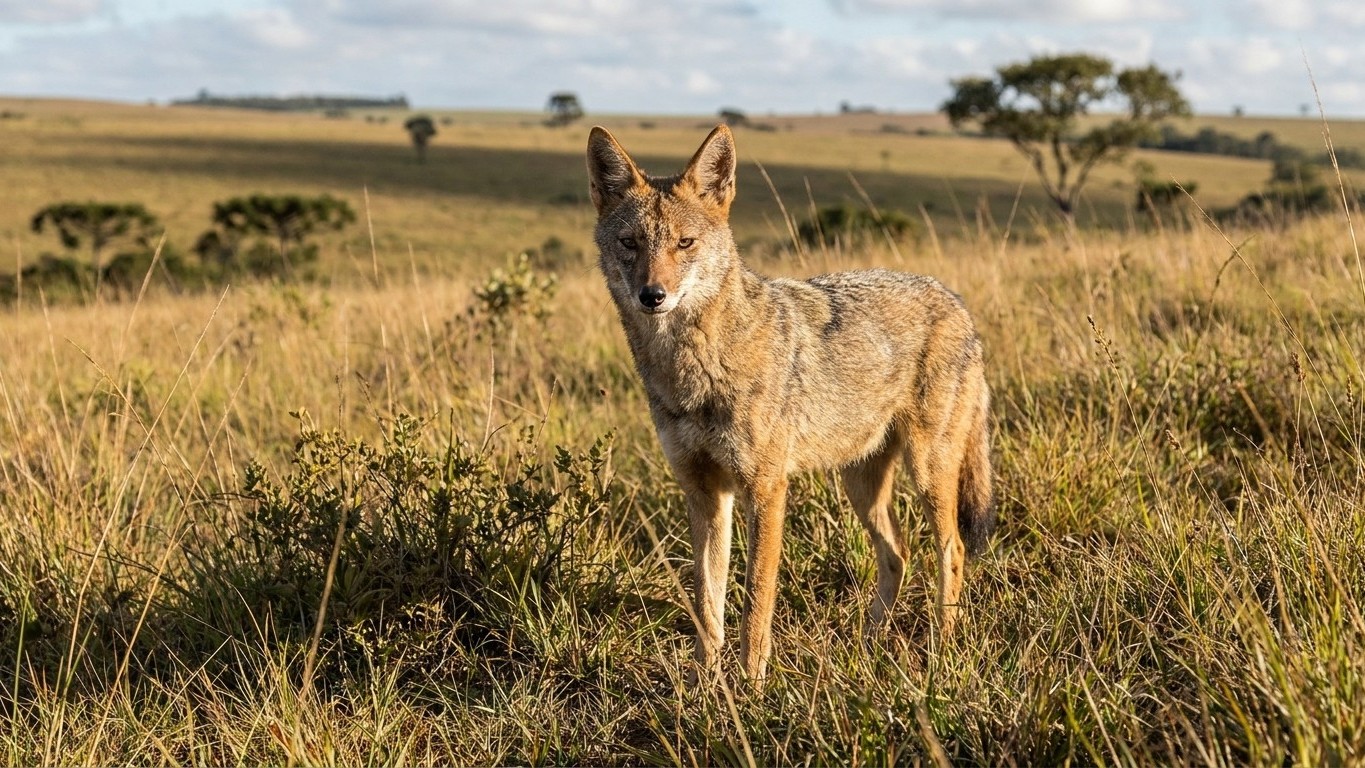
A female canid hit by a car on a southern Brazilian road delivered, in 2023, one of the most surprising genetic discoveries in South American zoology: she was the offspring of a cross between a domestic dog and a wild fox, two lineages long believed incapable of reproducing together for nearly seven million years.
Key takeaways
- Chromosomes that told a story: how a simple count revealed the unimaginable
- A fox mother, a stray dog father: the encounter that should never have produced viable offspring
- A behavior revealing its dual heritage: why Dogxim refused kibble
A roadside animal that looked unlike anything known
The story begins in 2021 near Vacaria, in the state of Rio Grande do Sul. A female canid had been taken in by the veterinary center of the Federal University of Rio Grande do Sul, Brazil, after being struck by a car. Her appearance immediately puzzled the caregivers: not quite a dog, not quite a fox, but a perplexing blend of both. The veterinarians initially considered several possibilities among the wild canids present in the region, before ruling out most for reasons of geographic distribution or morphology. This individual exhibited phenotypic characteristics that could not be linked to any known canid species in Brazil, and genetic and cytogenetic analyses suggested she was a first-generation hybrid between a dog and a pampas fox.
The animal eventually ended up at the Canela conservation center, where the research team would spend two years unraveling her mystery. This timeframe was not incidental: documenting such an improbable hybrid demanded solid evidence, and the scientists wanted to leave no room for doubt.
76 chromosomes: the proof that does not lie
The verdict came through a test as simple as it was decisive: counting the chromosomes. The genetic analysis confirmed she carried 76 chromosomes, precisely between the 78 of domestic dogs and the 74 of pampas foxes. This intermediate figure, nearly a perfect average between the two parental species, is the hallmark of a first-generation hybrid. There is no room for chance: such a chromosomal arrangement can only be explained by the fusion of one gamete from each species.
The researchers did not stop there. By studying the mitochondrial DNA, inherited exclusively from the mother, and then the nuclear DNA, inherited from both parents, they rebuilt the animal’s family tree. The mitochondrial DNA confirmed that her maternal line belonged to the pampas fox, while the nuclear DNA showed clear contributions from domestic dogs. A wild fox had been fertilized by an roaming dog somewhere in the pastures of Rio Grande do Sul.
What makes the finding so striking is the evolutionary distance between the two species. Although these species diverged about 6.7 million years ago and belong to different genera, they could still produce viable hybrids. Seven million years is roughly the span that separates humans from gorillas on the tree of life. That two lineages so distant could still yield a living individual upends part of what biology had long assumed about the barriers between species.
A behavior that betrayed its dual origins
Beyond the chromosomes, the animal behaved like a genuine bridge between two worlds. During its transfer to a rehabilitation center, caregivers noted atypical behaviors: although it barked like a dog and responded to human stimuli, it rejected processed foods and preferred to hunt rats. It was impossible to feed it with standard kibble: its predatory instinct would always take precedence, driving it to stalk live prey rather than accept a bowl. A telling detail, almost more revealing than any lab analysis, about the wild impulse still intact in her despite her canine lineage.
The scientists gave it a name that encapsulated its double identity. The name combines “dog” with “graxaim do campo,” the local term for the pampas fox. The Dogxim, as it is now referenced in the scientific literature, thus became the emblem of a phenomenon previously undocumented on the South American continent. Unfortunately, the story ends abruptly: the animal died in 2023, only months after the rehabilitation began, with the precise cause of death not clearly established in the available publications.
Why this discovery concerns conservation specialists
An isolated hybrid might seem like a curiosity with little consequence. The problem is that this case is probably not unique. The incidence of interspecific hybridization between wild and domestic species has increased, although cases involving species from different genera remain rare. Behind this scientific observation lies a more prosaic reality: the expansion of agricultural areas and livestock farming is gradually eroding the natural habitats of pampas foxes, forcing them to live in closer proximity to stray or domestic dogs.
If such crossings were to multiply, the consequences for wild populations could be serious. If these hybrids can reproduce, as genetic analyses suggest, they could alter the genetic makeup and behavior of native fox populations, potentially threatening their survival. This is precisely the issue researchers are now trying to resolve: the fertility of these hybrids. An infertile individual would remain a biological curiosity, but a fertile lineage capable of back-crossing with pure foxes would open the door to a genetic dilution that would be difficult to reverse for a species already weakened by habitat loss.
The Dogxim case is not a quirky exotic news item tucked away in a scientific journal. It serves as a near-clinical reminder of how urbanization and intensive farming redraw the biological boundaries once thought fixed for millions of years, and it invites Brazilian biologists to monitor closely for other suspects who might, unknowingly, carry traces of this unlikely encounter between dog and wild fox.
Sources : chatschiens.com | dailygeekshow.com
