
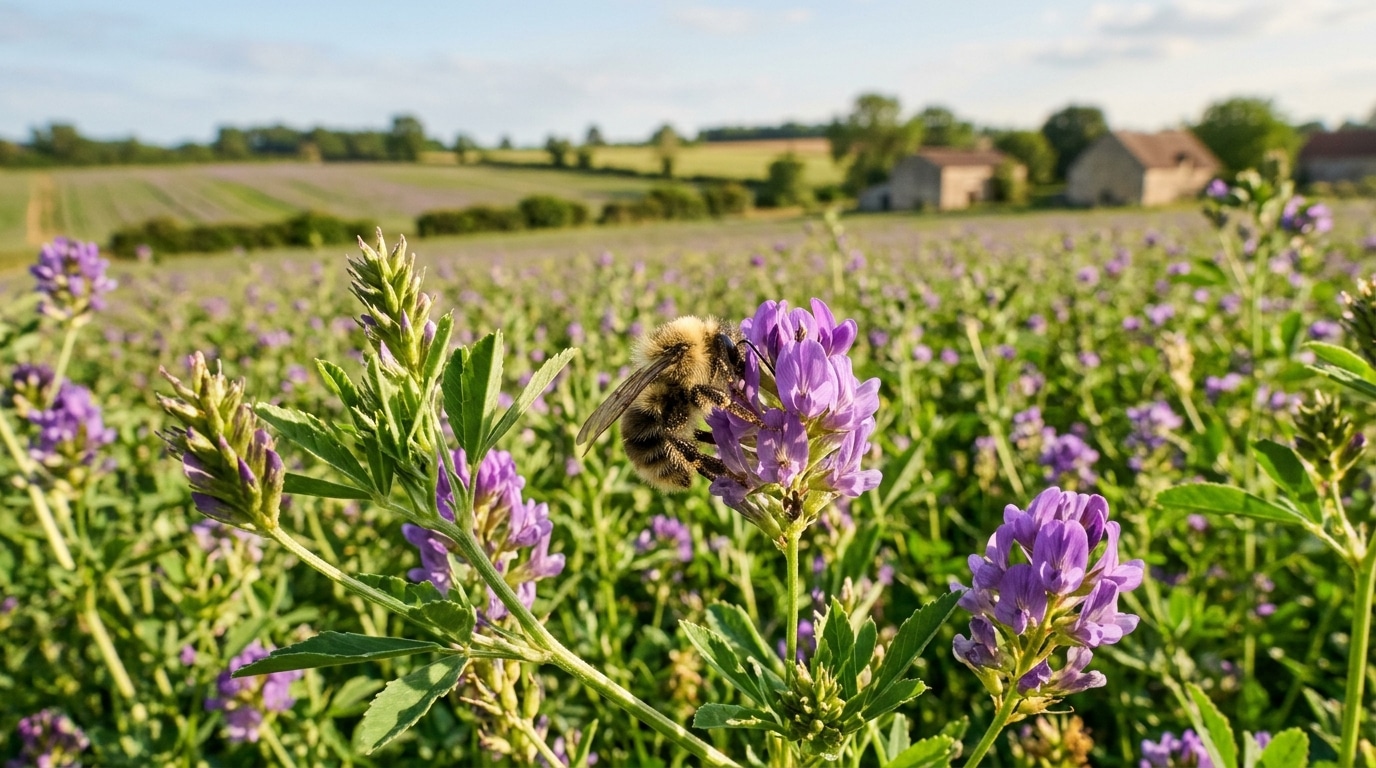
It only takes sitting a few minutes on the edge of an orchard, in the heart of summer, to notice them. Small solitary bees, often mistaken for flies or quiet passing insects, buzz tirelessly, alone, far from any hive. They are hardly noticed. Yet these tireless workers have just upended a stubborn preconception: that our harvests depend almost exclusively on the domestic bee, the one that produces our honey and lives in well-organized colonies. The reality is more nuanced, and above all more fascinating. For these lone pollinators play a largely underestimated role in filling our plates. A reason to question how we think about food security and the future of our crops.
These shadow workers our fields can no longer ignore
When we mention bees, the collective imagination immediately conjures the hive, its golden cells and its precisely orchestrated ballet. Yet the vast majority of bee species do not live in colonies. They are solitary bees, each building her own nest in a wall crack, a hollow stem, or a piece of dead wood. No queen, no workers, no honey: simply a female who lays eggs, protects her offspring, and forages to feed them.
These discreet insects often go unnoticed, precisely because they do not organize into spectacular swarms. Yet their discreteness has long masked their true importance. As they fly from flower to flower to feed, they carry pollen from one plant to another, ensuring pollination that yields fruits and seeds. In other words, without them a large portion of what we cultivate would simply never come to be. A crucial role, long attributed to their honey-bearing cousins.
When science dismantles the myth of the irreplaceable domestic honeybee
For decades, the domestic honeybee reigned supreme in the minds of farmers as well as the general public. Hives were placed near crops, convinced they were the key to yield. A logical, but partial conviction. A rigorous analysis now measures the real contribution of wild solitary bees to the pollination yields of several crops. And the verdict is surprising: their contribution often proves dominant, and above all independent of honey bee presence.
Concretely, this means that these solitary pollinators do not simply supplement honey bees’ work. They act on their own, with formidable efficiency. Some solitary species visit more flowers, venture out in cooler or windier weather, and deposit pollen with remarkable precision. Where we believed they were just a supplementary aid, science reveals a discreet yet essential pillar of our harvests.
A yield boosted without a single hive nearby
This may be the most puzzling takeaway: in many cases, crops show excellent yields without any hive nearby. Pollination is then largely provided by these wild bees living naturally in hedgerows, on embankments, in flowering meadows, and in the margins of fields left to themselves.
This discovery changes everything. It shows that relying solely on installing hives amounts to neglecting a substantial portion of the pollination work already performed for free by nature. The solitary bees, foraging according to their own rhythms, actually boost yields autonomously. An invaluable ecological service, provided by insects we hardly notice, and even less protect.
Saving the solitary bees, a decisive bet for our plates of tomorrow
If these bees weigh as heavily as they do on our harvests, their decline poses a direct threat to our food supply. Yet these pollinators suffer from the disappearance of natural habitats, the widespread use of pesticides, and the scarcity of wildflowers. Protecting the solitary bees thus becomes an issue as strategic as preserving hives, if not more so.
The good news is that everyone can act, at their own level. Here are some simple, concrete steps to lend them a hand:
- Leave a patch of the garden to run wild, with wildflowers and tall herbs.
- Install an insect hotel or preserve hollow stems and dead wood.
- Ban pesticides as much as possible and favor natural treatments.
- Plant a variety of nectar-rich species that bloom from spring to autumn.
These small arrangements, within reach of any gardener, offer shelter and food to these precious allies. A discreet but effective way to secure, year after year, a share of our future harvests.
By putting solitary bees back in the spotlight, science invites us to rethink pollination from the ground up. These insects we ignored yesterday appear today as unsuspected guarantors of our food security, capable of boosting our crops without any nearby hive. So, the next time you encounter one of these solitary foragers at the edge of the garden, will you still risk mistaking it for a simple wandering insect?
