
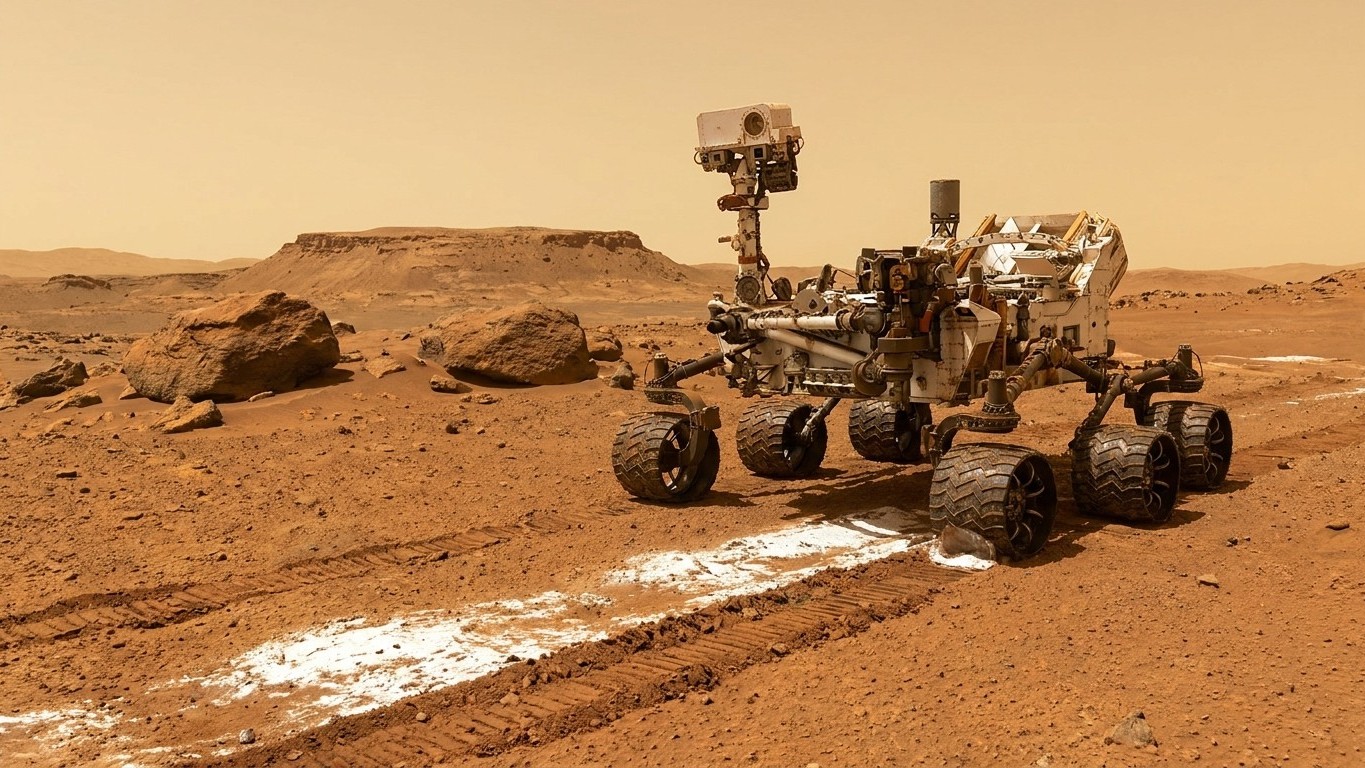
A breakdown that becomes a fortuitous tool for discovery. On Mars in 2007, this liability turned into the rover Spirit’s most valuable scientific instrument. Dragging its stuck front-right wheel like an improvised plow, NASA’s rover gouged into the Martian ground and uncovered a nearly pure silica deposit, the strongest evidence yet of an environment once suitable for life that the mission had ever found—six years before its quiet death in a dune of sand.
Key takeaways
- A mechanical failure becomes, inadvertently, a major instrument of scientific discovery
- A stuck wheel reveals clues hidden under Martian dust for millions of years
- This finding changes our understanding of Mars’ past habitability
A Breakdown That Becomes a Makeshift Tool for Discovery
On March 13, 2006, the Spirit rover’s front-right wheel motor failed. The front-right wheel stopped turning on March 13, 2006, more than two years after the rover landed on Mars, and engineers kept the vehicle moving by powering its five other wheels, mostly driving in reverse. On Earth, such a scenario would have signaled the end of a project. On Mars, 200 million kilometers from any repair shop, improvisation was required.
The solution chosen by the mission team was as simple as it was demanding: keep the robot moving backward at all times, the dead wheel dragging behind it like a dead weight. The compromise cost speed and made slopes harder to negotiate, but it also turned the immobile wheel into an unplanned excavation tool. No one at the time imagined that this technical constraint would become the key to a major discovery. This is often how space science works: you fix what you can, and sometimes improvisation reveals more than the original plan.
A White Ground That Should Never Have Been Visible
By late March 2007, as Spirit moved near the volcanic plateau dubbed Home Plate in the Columbia Hills, the blocked wheel carved a trench into ground that had previously been covered by only a thin layer of dust. As it scraped across the unusually bright soil, the wheel would later reveal that one of the targets analyzed contained about 90% silica. The figure immediately alerted the mission’s geologists.
The mechanism is clear once explained: the dead wheel did not create the silica; it peeled away the surface cover that kept certain deposits hidden and cracked fragile materials to expose fresh faces. The science team had to act quickly to avoid letting the anomaly slip by. Once the pale trace appeared, the team recognized an unusual spectrum and adjusted Spirit’s work program to study it up close. Steve Squyres, the mission’s principal scientist, summed up the scene with a line that has become famous, referring to “the first discovery of this silica, springing from the soil at the bottom of that trench.”
Why Pure Silica Changes Everything
Silica is not an exotic mineral in itself. What intrigues researchers is its degree of purity and the geological context in which it appears. On Earth, this type of deposit forms in very specific environments: hot springs or geysers, such as those found in Yellowstone National Park. Dragging the blocked wheel like an agricultural plow, the rover uncovered a rich deposit of nearly pure silica, surrounded by outcrops also rich in silica—a mineral commonly found in hot springs and geysers like those at Yellowstone.
The significance goes beyond mineralogical curiosity. Silica does not prove that a lake once filled the Gusev crater, nor that anything lived there, but it bears witness to an interaction between water and volcanic materials under hydrothermal conditions, an environment that can host microbes and preserve traces of them on Earth. Nine years later, researchers at Arizona State University reinforced this hypothesis by studying Chilean hot springs at El Tatio. Geoscientist Steve Ruff and astrobiologist Jack Farmer identified finger-like structures, formed with the help of microorganisms, whose appearance is striking: these biologically influenced silica structures observed at El Tatio resemble the silica structures found by Spirit at a Martian site almost identically. This terrestrial parallel even guided the choice of sites explored by later Martian missions.
A Three-Month Mission Becomes a Six-Year Adventure
This discovery would never have happened were Spirit to have followed its original spec. The rover was designed for a 90-day Martian mission, just over three Earth months. It lasted much longer, eventually becoming permanently stuck in a fine-sand trap in 2009, a position that prevented it from tilting its solar panels properly to recharge its batteries during the Martian austral winter. Despite repeated attempts by the landers to free it, Spirit never moved again and ceased all communication with Earth in March 2010, marking the end of nearly seven years of uninterrupted exploration.
The silica discovery remains a textbook example taught in astronautical engineering schools: sometimes the most constraining breakdown opens the way to the most valuable finding. No Spirit instrument had been programmed to search for this specific deposit, and the rover did not even have the tools to decisively answer the question of a biological origin. It took a broken wheel, a stroke of luck, and the stubbornness of a team of scientists unwilling to abandon a robot in a half-disabled state to turn a mechanical handicap into a clue about the Red Planet’s past habitability.
Sources: futura-sciences.com | pubs.usgs.gov
