
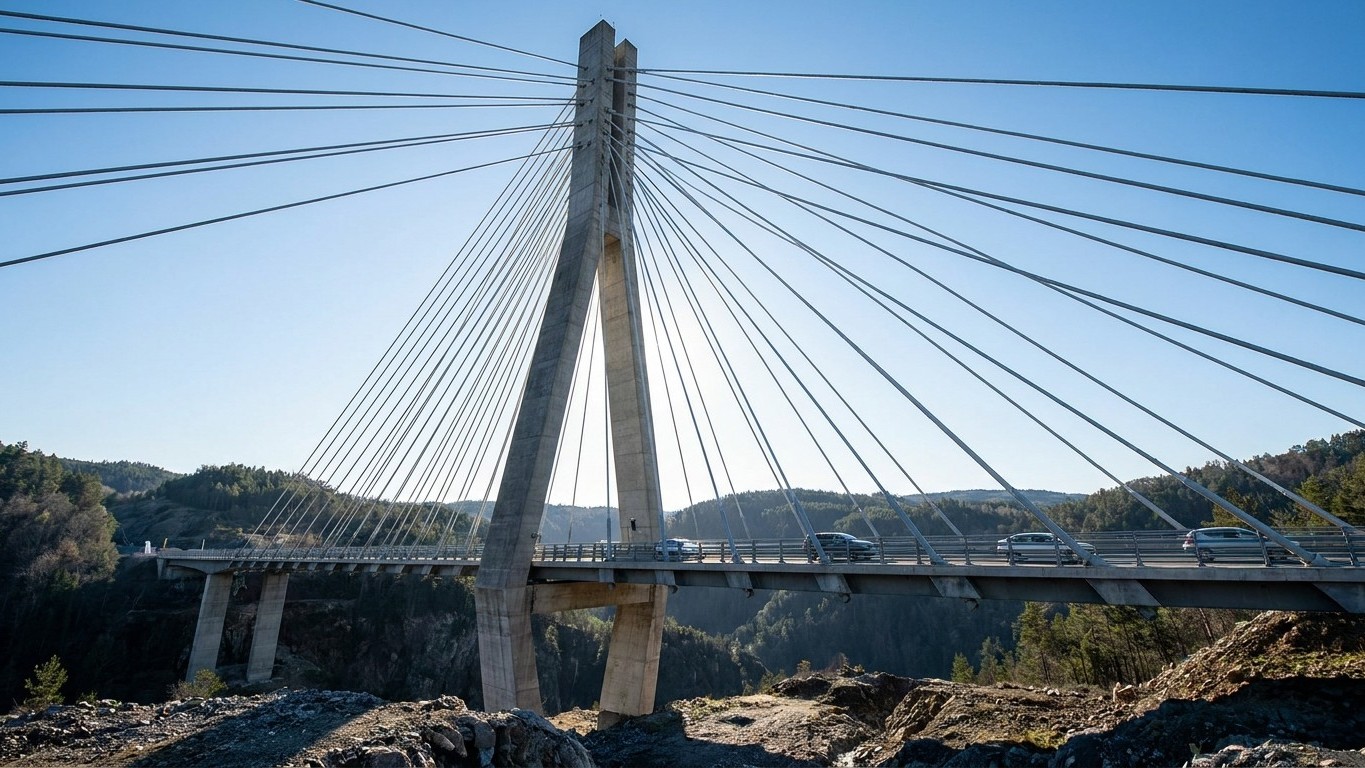
On December 14, 2004, Jacques Chirac inaugurated a bridge that cost the French nothing. The Millau Viaduct, a 400‑million‑euro feat spanning the Tarn valley, was financed entirely by a private group. No subsidy, no public guarantee, no emergency budgetary boost voted in a hurry in the Assembly. Twenty‑two years on, that arrangement remains an anomaly in the landscape of France’s major works, most of which are funded with public money and frequently singled out by the Court of Auditors.
Key takeaways
- A 343‑meter‑tall giant built in three years without a penny of public money
- Actual traffic exceeded optimistic forecasts from the very first year of operation
- Why this financial success stands in sharp contrast to the failure of other French PPPs
A record-breaking bridge funded without a euro of public money
The figures surrounding the viaduct are dizzying even before money is considered. Carrying the A75, it links the red limestone plateau to the Larzac plateau by crossing a gap of 2,460 meters in length and a depth of 343 meters at its highest point. The summit of the P2 support tower reaches exactly 343 meters above ground level, nearly twenty meters taller than the Eiffel Tower. The construction itself lasted just three years—a record time for a project of such magnitude, from the laying of the first stone to opening to traffic.
The total cost of the operation comes to around €400 million, covering the viaduct and the toll barrier. But who paid? The answer is clear: entirely the private concessionaire. The concessionaire funds the design, construction, operation, and maintenance at its own risk. Concretely, the Millau Viaduct Construction Company (CEVM), a 100% subsidiary of the Eiffage group, advanced all the funds, built the bridge, and has been reimbursed since then through toll revenue. The State remains the owner of the structure on paper, but never had to lay out money to build it.
A 78‑year concession, calibrated to the limit
This arrangement rests on a contract signed in 2001, unusually lengthy for this type of operation. The concession lasts 78 years: 3 years of construction and 75 years of operation. A remarkable duration compared with traditional highway concessions, but deemed necessary to amortize a substantial investment over a traffic level that was still uncertain at the time. The contract even includes an early termination clause: if cumulative revenues exceed a threshold, adjusted from 2045 onward, the State can end the concession without indemnifying the concessionaire. A way to cap profitability if the success were to surpass all forecasts.
Yet the bet was far from guaranteed. The two-year forecast before opening projected 10,000 vehicles per day with 10% trucks, 25,000 vehicles in the summer, and a 3% annual growth over fifteen years. Ambitious projections for a rural corridor through the Aveyron region. But reality surpassed the most optimistic financial assumptions. In 2005 and 2006, about 4.3 million vehicles traversed the viaduct, averaging just under 12,000 vehicles per day. Less than a year after opening, actual traffic already exceeded the two-year forecast. And during peak summers, the structure even hovered near capacity, recording more than 50,000 vehicles in a single day at the end of July 2005, far above the toll barrier’s initial capacity of 28,000 vehicles per day.
The PPP counterexample that weighs on public finances
This financial success stands in stark contrast to the verdict regularly issued by the Court of Audit on classic public‑private partnerships. In these schemes, a public entity grants a private firm the construction and management of a facility, in exchange for rent paid over twenty or thirty years. On paper, the concept resembles Millau. In practice, however, it often ends up as the public sector footing the bill when the traffic or usage fails to materialize.
The Court of Audit has denounced PPP prisons and court buildings as a “runaway escalation,” noting private firms that borrow at rates higher than what public authorities would face: 6.4% in the case of Paris’s TGI built by Bouygues, against a much lower borrowing cost for the State itself. The European Court of Auditors’ 2018 report was even harsher, stating that “public‑private partnerships (PPPs) cofinanced by the EU cannot be regarded as a financially viable option for delivering public infrastructure.” It cited a French project whose budget rose from €18 million to €31 million (a 73% increase) and another project in Meurthe‑et‑Moselle where actual revenues fell 50% short of expectations.
The difference with Millau comes down to one word: risk. In a typical PPP, the public entity often guarantees a minimum rent or compensation, regardless of actual traffic, thereby transferring the financial risk to taxpayers if the project fails commercially. The Eiffage contract, by contrast, contained no minimum traffic guarantee from the State. If no cars had come, the concessionaire would have taken the hit, not the public finances. A high‑risk bet, assumed entirely by a private player convinced of the market, and one that ultimately paid off.
A model difficult to reproduce as‑is
This success should not blind us to what makes it hard to copy. The Millau viaduct enjoyed a rare advantage: a mandatory route on the Paris–Mediterranean axis, with no credible free alternative, guaranteeing a captive clientele willing to pay the toll rather than waste half an hour detouring. Many PPP projects focus on public facilities—prisons, hospitals, courts—without any direct revenue stream from operation, forcing the community to fund the rent through taxes without a comparable return on investment. The private stakeholder’s gamble only makes sense when the use itself generates profitability; otherwise the taxpayer ends up bearing the bill, sooner or later.
Sources: legifrance.gouv.fr | finance-gestion.com | explore-millau.com
