
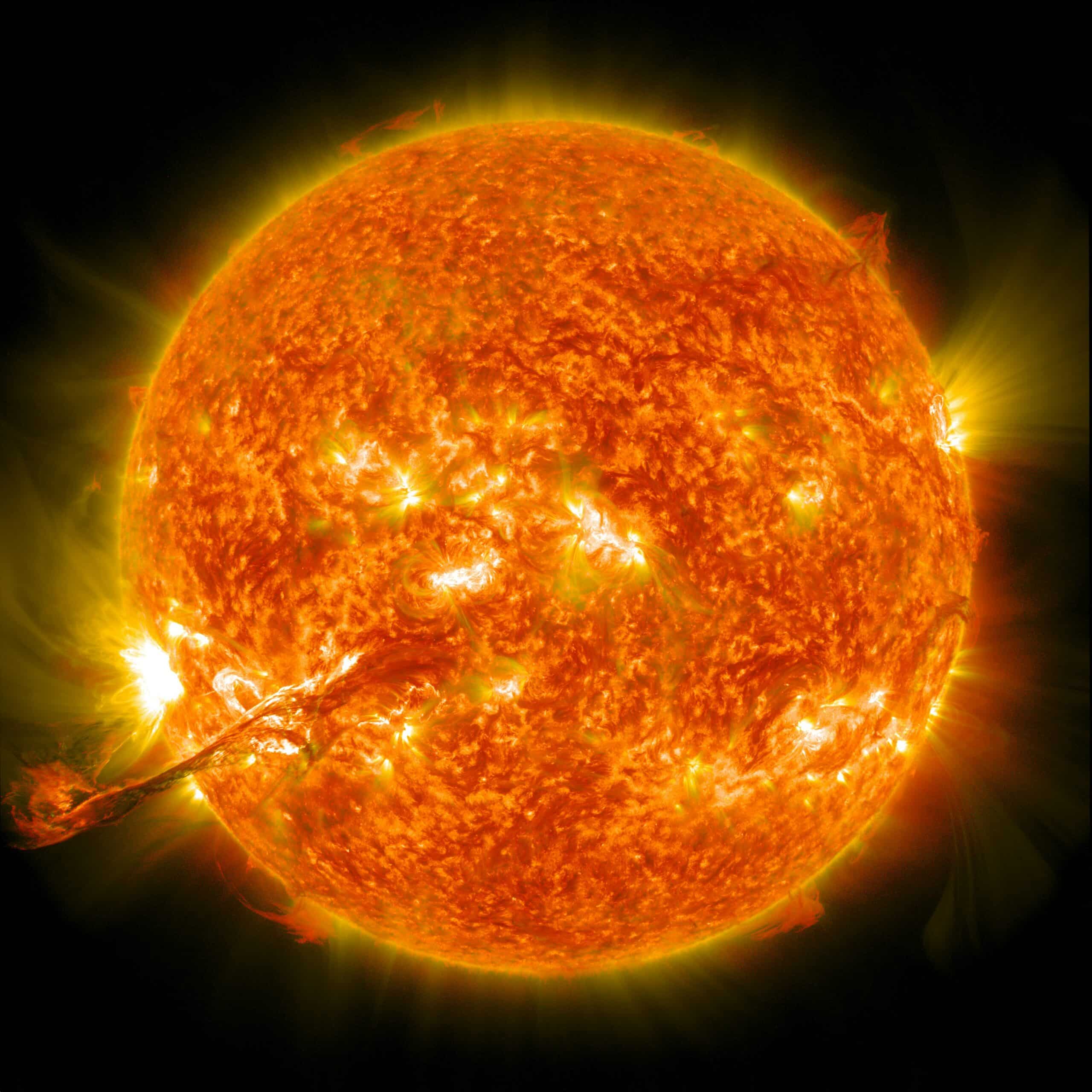
When the ISS is retired, why not simply send it into the Sun? This is the innocent question from a Reddit user — and the answer reveals something counterintuitive: reaching the Sun is far more difficult than escaping the solar system.
A Reddit question that deserves a real answer
An AskAstronomy subreddit user asked: “Why can’t we simply send the ISS into the Sun?” The logic is appealing — with a star about 1.4 million kilometers in diameter at the center of the solar system, it’s hard to miss. And yet, reaching the Sun is one of the most challenging orbital feats there are.
Earth moves very fast — laterally
The fundamental problem is that our planet is traveling at about 108,000 km/h, almost entirely in orbit around the Sun, not toward it. Any object launched from Earth inherits this velocity. Pointing a rocket toward the Sun and firing its engines doesn’t fundamentally change that trajectory.
“When a rocket moves away from the Earth, it travels faster around the Sun than toward it,” explains Michael Brown, astronomy professor at Monash University. The result: the rocket ends up in an elliptical orbit that avoids the Sun entirely — missing the target by nearly 100 million kilometers.
To go toward the Sun, one must cancel all the lateral velocity inherited from Earth’s orbit. That requires reaching roughly 7,000 km/s — a speed completely beyond what our current technologies can achieve.
The gravity assist technique, and why it isn’t enough
The Parker Solar Probe did manage to approach the Sun, but by using several Venus flybys to gradually slow down — a process that took years and only works because Parker weighs about 685 kg. The ISS, by contrast, weighs 419,725 kg. Adapting this approach to the ISS would be astronomically complex and costly — no pun intended.
What we will actually do: a controlled descent into the ocean
The ISS, initially designed for 15 years but still in service 26 years after its launch, is approaching its structural limits with repeated leaks. NASA has commissioned SpaceX to provide a deorbit vehicle that will guide the station into a controlled reentry above one of the planet’s most remote locations — Point Nemo in the South Pacific Ocean.
Less spectacular than burning up in the Sun, but far more realistic. And far less complicated than what the laws of physics would demand for the cosmological alternative.
