
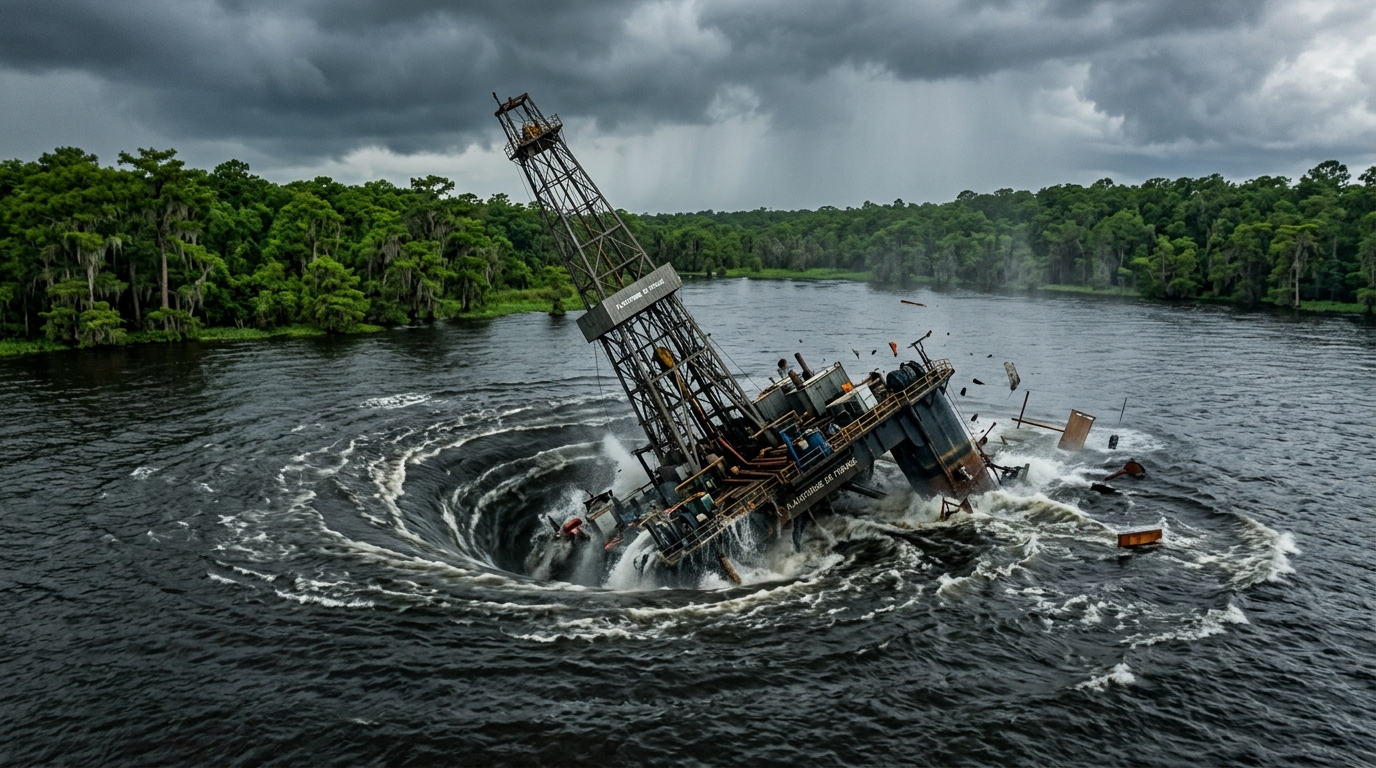
Imagine a tranquil lake where a few fishermen enjoy a calm morning, and where in the space of just three small hours, everything vanishes, as if drawn into a giant siphon. This catastrophe scenario, worthy of a disaster film, actually occurred on a November day in Louisiana. An entire lake, with its shores, its trees and part of its ecosystem, literally collapsed into itself, victim of an industrial miscalculation that would become one of the most fascinating case studies in modern geological history. A look back at this extraordinary disaster, where oil and salt ended up rewriting the map of an entire region.
An error in judgment 400 meters beneath the water
It all started with what looked like a routine drilling operation, carried out by an oil platform operated by Texaco, set right in the middle of Lake Peigneur. The goal was classic: to probe the subsurface in search of exploitable oil reserves. But no one at that moment anticipated that several hundred meters below the lake’s tranquil surface lay a complex network of underground tunnels, remnants of a salt mine active since 1919.
This mine, operated by the Diamond Crystal Salt Company, a subsidiary of Cargill, stretched across multiple levels, some plunging as deep as 460 meters. The platform’s drill bit, in carving its way downward, ultimately pierced a gallery belonging to the mine. The breach thus created measured only about 36 centimeters in diameter, barely the size of a trash can lid. Yet this seemingly insignificant technical detail would prove enough to trigger a devastating chain reaction, showing that in geology the size of a fault line does not predict the scale of the damage it can unleash.
The lake draining away like a giant bathtub
Once the breach opened, the lake’s water surged into the underground galleries with formidable force, as if sucked through an oversized kitchen drain. Salt, a material well known for its solubility, did not stand long in the face of this flood: the pillars supporting the mine’s ceiling gradually dissolved, triggering a total collapse of the structure. Lake Peigneur, once shallow with about 3 meters of water, was transformed into a genuine geological funnel.
The phenomenon quickly escalated: a gigantic whirlpool formed on the surface, swallowing the drilling platform itself, as well as eleven barges, several buildings, and more than 26 hectares of adjacent land. In total, around 5 billion liters of water disappeared into the earth’s depths in just three hours. To illustrate the scale of the event, the reversal of the Delcambre Canal’s flow, normally connected to the Gulf of Mexico, temporarily produced the highest waterfall ever observed in Louisiana, reaching about 50 meters in height. A waterfall that sprang from nowhere, fed by Gulf seawater moving upstream to fill the void left by the vanished lake.
Eleven miners trapped and a miraculous rescue
What makes this catastrophe even more astonishing is the complete absence of human casualties. At the moment of the collapse, workers were operating both on the oil platform and deep inside the salt mine’s galleries. The alert was issued in time to allow a general evacuation, on the surface and underground. The miners were able to reach the surface, guided by emergency exits, before the galleries were completely flooded and collapsed.
That rescue, still considered nearly miraculous today given how quickly the engulfment occurred, is documented in archival footage from the period: a landscape that was a tranquil lake only hours earlier had become a gaping crater, surrounded by collapsed terrain and partially submerged industrial structures. The absence of human losses remains one of the most striking elements of this disaster, which could have turned into tragedy if the timing had been different.
A submerged landscape, a lesson learned
The consequences of this accident were irreversible for the local ecosystem. Lake Peigneur, once a shallow freshwater body, filled with saltwater from the Gulf of Mexico, reached a record depth of about 60 meters, becoming the deepest lake in the entire state of Louisiana. This abrupt shift in salinity permanently disrupted local fauna and flora: freshwater species disappeared, replaced by a wholly different saline environment, as if nature itself had to start over from scratch.
Economically, the salt mine, in operation for more than six decades, never reopened. It permanently closed in 1986, a few years after the disaster. Texaco had to pay 32 million dollars in damages to the Diamond Crystal Salt Company to compensate for the total loss of its mining operation. Today, as summer wanes and enthusiasts of geological curiosities continue to study such phenomena, Lake Peigneur is cited as a quintessential case study in industrial geology textbooks. It perfectly illustrates how a seemingly harmless miscalculation, at first glance, can trigger a large-scale, irreversible catastrophe.
This story, as vertiginous as it is little known to the general public, reminds us how our subsoil remains a fragile and interconnected territory, where the slightest human intervention can have unforeseen repercussions. It also invites reflection on the importance of mapping and coordinating among different industries sharing the same subterranean space. So, the next time you gaze at a peaceful lake, remember that beneath its tranquil surface there can lie a delicate balance, ready to tilt in just a few hours.
