
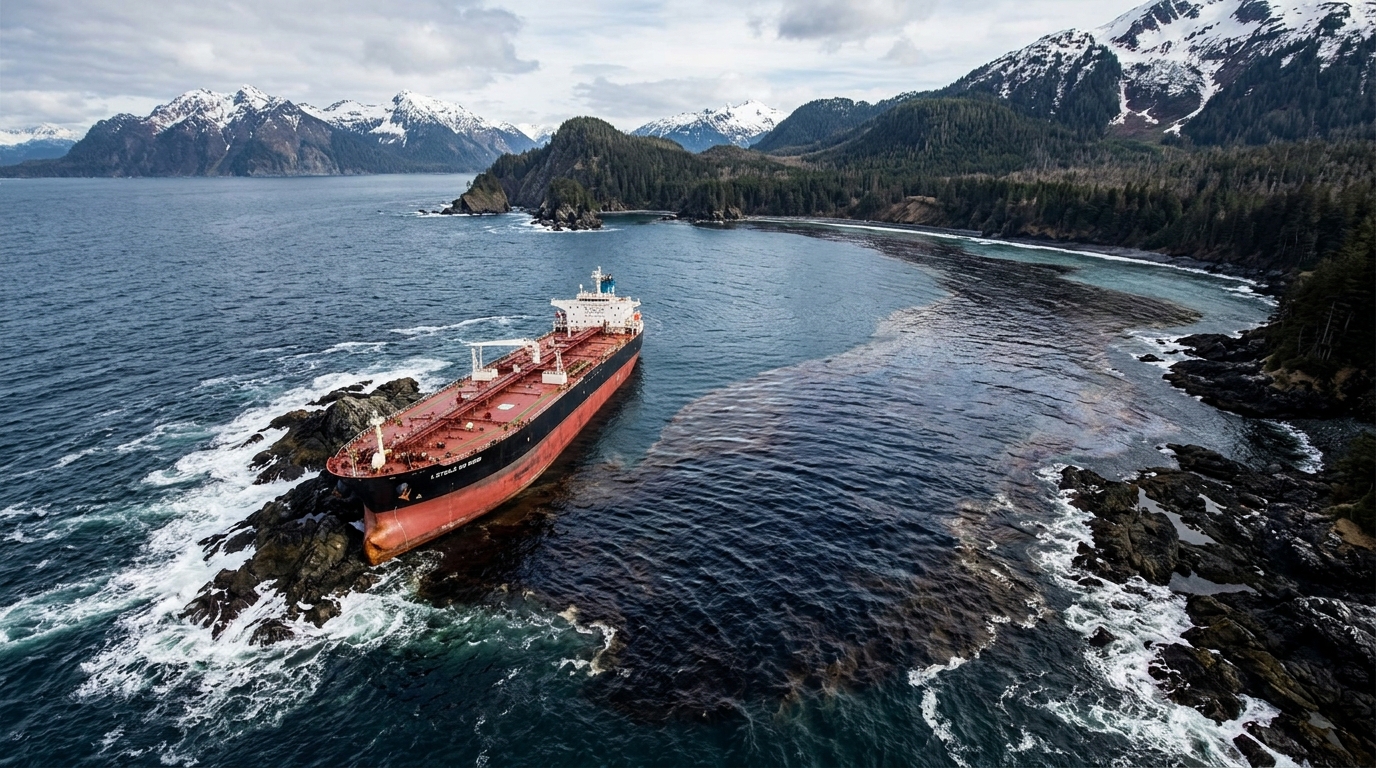
Two terms are often confused: shipwreck and grounding, while these two terms designate very different realities. A shipwreck implies the vessel sinks, disappears beneath the waves. A grounding, by contrast, means the boat remains stranded on an obstacle, hull torn but the silhouette still visible at the surface. It is precisely this second scenario that occurred in Prince William Sound, Alaska, when the Exxon Valdez struck a perfectly charted reef. The tanker never sank, but that did nothing to alter the scale of the disaster: in just a few hours, one of North America’s richest marine ecosystems was covered by a black, viscous carpet whose traces still linger today beneath the sands of Alaska’s beaches.
Eleven minutes that were enough to change everything
On the night of March 24, 1989, the Exxon Valdez was steering through Prince William Sound after departing the Valdez oil terminal. To avoid a drifting iceberg on its path, the vessel veered away from the usual shipping lane. A maneuver meant to be temporary, but it turned into tragedy when the ship struck Bligh Reef, an obstacle well known to the region’s nautical charts. The hull tore open and crude oil began to spill into the frigid water.
Following investigations would reveal a particularly troubling aggravating factor: the ship’s captain was in a state of heavy intoxication that night, leaving the vessel in the hands of an able crew ill-prepared to anticipate danger. In only a few hours, about 40,000 tonnes of crude oil, almost 42 million litres, poured into the sea. To visualize this quantity, one might imagine dozens of Olympic-sized pools filled with hydrocarbons, poured simultaneously into an exquisitely fragile marine environment.
A black carpet 2,000 kilometers long that swallowed wildlife
The oil spill does not stay confined near the reef. Carried by currents and winds, the slick rapidly spread over more than 15,000 square kilometres of sea, before fouling as much as 2,000 kilometres of coastline when accounting for the numerous islands and inlets along Alaska’s coast. This region was far from a mere wild backdrop: it housed orcas, sea lions, sea otters, and bald eagles, as well as a salmon nursery essential to the local food chain and a vital refuge for migratory birds.
The ecological tally of the disaster is staggering: more than 22,000 animal carcasses, of all species, were collected across the affected zone. That figure, considerable in itself, likely represents only a fraction of the true mortality, as many carcasses sank or were never recovered along this rugged coastline. The image etched in memory is of those sea otters and seabirds, their plumage and fur saturated with oil, unable to warm themselves or float normally in water already chilled by the cold.
The oil that refuses to disappear beneath the sand
What truly sets this disaster apart from other oil spills is its persistence. The hydrocarbons that settled into the beach sediments did not vanish over time, contrary to what one might hope. Field studies conducted in the following decades showed that buried oil only erodes naturally at a rate of approximately 4% per year, a pace so slow that full restoration in certain areas will take many more decades.
Twenty years after the wreck, harlequin ducks continued to show signs of oil exposure in the contaminated zones that had been affected in 1989, proof that nature does not erase the traces of such pollution easily. Beneath a layer of seemingly clean pebbles, it sometimes took only a few centimeters of digging to uncover this frozen oil—a stubborn reminder of that March 1989 night. This slow cleanup illustrates a reality often overlooked: an oil spill is not merely a dramatic visual impact, it engraves lasting pollution in soils and sediments for generations to come.
What Exxon Valdez changed forever in the oil industry
Beyond the ecological tragedy, this catastrophe deeply disrupted the local economy. The fishing sector, particularly harpoon and salmon fisheries, suffered a domino effect: contaminated stocks, consumer distrust, and temporary closures of certain fishing zones threatened entire communities whose livelihoods depended directly on this marine ecosystem. A socio-economic shock that extended well beyond the early years following the spill.
Judicially, the case also marked a turning point. In 1994, Exxon was ordered to pay 5 billion dollars in damages—a historic sanction aimed at repairing the harm inflicted on people and the environment. Yet after fifteen years of arduous legal battles, this sum was reduced to 500 million dollars in 2008, ten times less than the initial amount. This dramatic reduction fed much debate about the real ability of large oil companies to bear the financial consequences of their mistakes. At the same time, the disaster spurred stronger maritime safety standards, notably the progressive requirement that oil tankers be equipped with double hulls to reduce the risk of a massive spill in the event of a collision.
More than thirty years after that March night in 1989, the Exxon Valdez remains a defining reference when discussing the great environmental disasters of the twentieth century. It reminds us that a mere deviation in course, combined with human negligence, can permanently and profoundly disrupt an entire ecosystem and the lives that depend on it. In an era when global maritime traffic continues to grow and oil extraction reaches ever more remote areas, this Alaskan tale asks a timely question: are we truly better prepared today to prevent such a scenario from happening again?
