
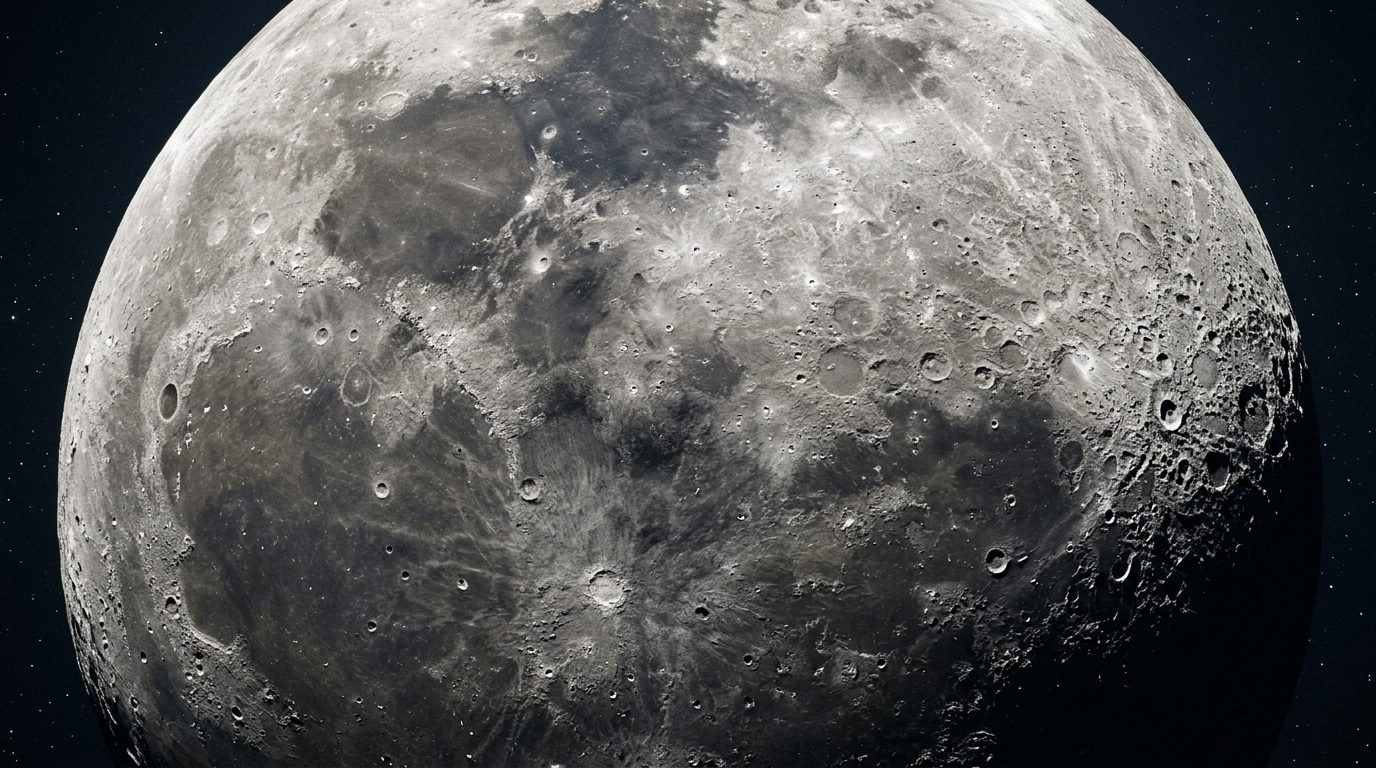
Every night, a familiar star watches over our sleep, seemingly unchanging. Yet the Moon we gaze at tonight isn’t quite in the same place as the one that lit our distant ancestors. Slowly, imperceptibly, it is drifting away from us at a rate of 3.8 centimeters per year, roughly the speed at which your nails grow. Behold the fascinating paradox: an object in the billions upon billions of tons drifts at the pace of a nail growth. But the most astonishing part is the culprit behind this silent drift. It isn’t hiding in the void of space, nor in some cosmic mystery beyond reach. No, the culprit is right beneath our feet, on the beaches where we walk in summer: it is our oceans, and the grand ballet of tides.
Mirrors on the Moon to track an ever-growing distance
How can we measure such a tiny displacement, at nearly 384,400 kilometers away? The answer lies in an exquisitely elegant device. During the Apollo missions, astronauts left on the lunar surface laser reflectors, special kinds of mirrors capable of bouncing a beam back exactly in the direction from which it came. The Soviet Lunokhod rovers also added some of their own. These small panels turned our satellite into a precision target.
The principle is as simple as it is ingenious. From a terrestrial observatory, a laser beam is aimed at these reflectors, and one measures the light’s round-trip time. Since the speed of light is known with extreme precision, this delay yields the distance to the millimeter. By repeating the operation year after year, scientists have been able to observe this steady drift. The Moon does not merely stay closest at about 362,600 kilometers and farthest at 405,400 kilometers: its average distance keeps increasing.
When the oceans become the hidden engine of this drift
Here is where the story takes an unexpected turn. The Moon’s gravitational pull does not simply raise and lower the sea along our Breton or Norman coasts. It literally deforms the oceans and the Earth’s crust, creating two bulges aligned along the axis that links Earth to its satellite. Imagine a soft ball being gently stretched on both sides.
But Earth spins on its axis much faster than the Moon travels along its orbit. As a result, this water bulge is carried by Earth’s rotation and ends up slightly ahead of the Moon’s position. This displaced mass of water then exerts a small pull on our satellite, like an invisible hand softly nudging it forward. This slight surplus of energy speeds up the Moon on its trajectory, and a faster orbit corresponds precisely to a more distant one. The Sun, despite its colossal distance, also participates in this mechanism: its massive presence generates a tidal force roughly half as strong as that of the Moon.
Angular momentum, the invisible currency exchanged between Earth and the Moon
To grasp the heart of the phenomenon, one must invoke a somewhat abstract yet essential physical quantity: angular momentum. Let’s say it’s the total “amount of rotation” of the Earth–Moon system. This quantity cannot disappear: it is conserved, it can be transferred, but it never vanishes. It’s a true invisible currency of exchange between the two celestial bodies.
Tidal friction dissipates energy as heat and gradually slows Earth’s rotation, by about two milliseconds per century. Our days lengthen, thus, imperceptibly. But since the total must remain constant, what the Earth loses in rotation, the Moon gains in orbital angular momentum. And this gain manifests as an increasing distance. In short, Earth pays for its growing slowness by giving the Moon a one-way ticket toward the open sea.
In billions of years, a very different sky awaits us
What does this slow breakup hold for the very long term? Physics offers a dizzying scenario. As Earth slows and the Moon moves farther away, the two bodies tend toward a synchronous rotation (tidal locking). In other words, the length of a day on Earth would eventually lengthen to coincide with the Moon’s orbital period. Our planet would then forever present the same face to its satellite, just as the Moon already does to us today.
Rest assured, this future lies on the scale of billions of years, and many other cosmic upheavals will occur by then. Yet the idea is striking: the rhythmic lapping of waves on our shores, this ordinary spectacle, truly shapes celestial mechanics on the scale of the cosmos.
Thus, behind the Moon’s discreet drift hides a story of rare beauty, where the oceans’ tides, Earth’s rotation, and the Moon’s orbit converse in a delicate balance. The next time you watch the sea retreat, consider that this familiar motion participates, on its modest scale, in nudging the Moon a little farther into the heavens. Isn’t it fascinating to think that the distant celestial bodies remain tied to the most everyday gestures of our world?
