
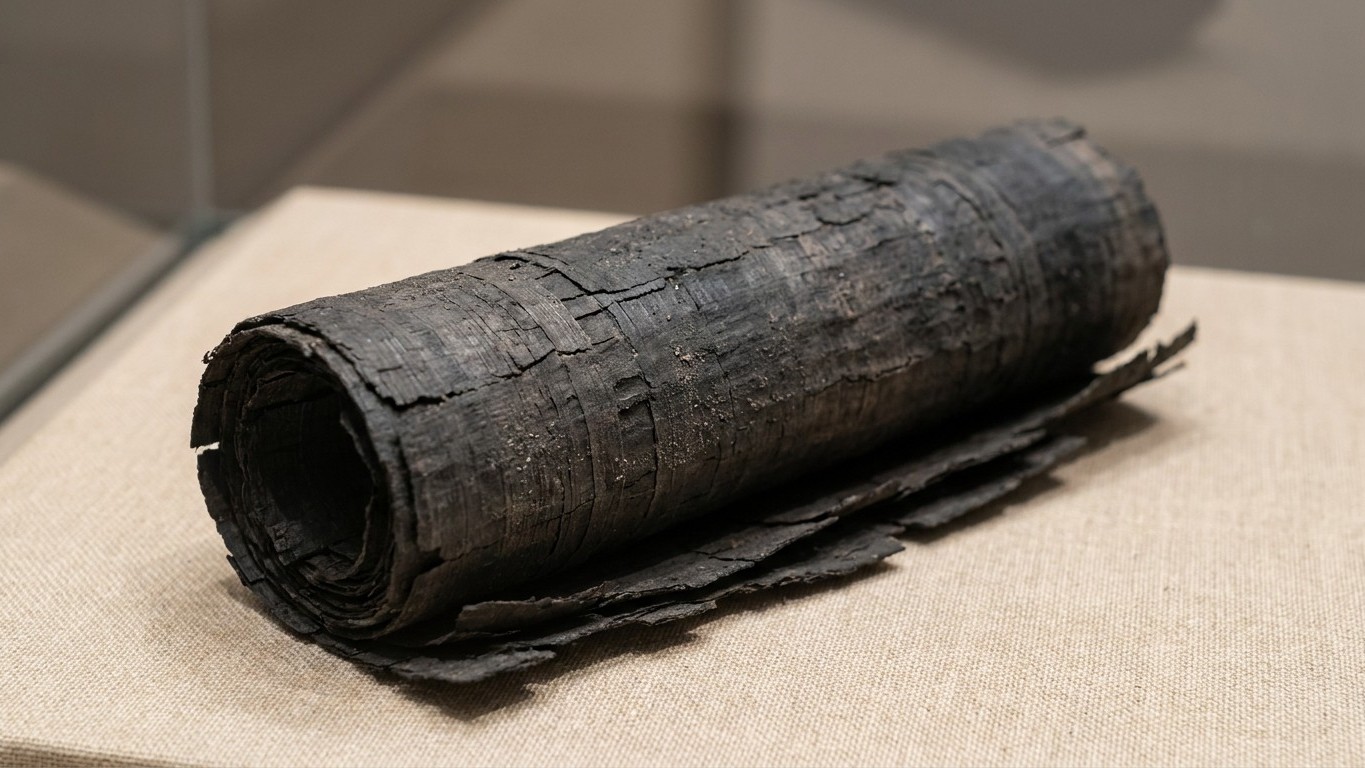
Two thousand Greek characters, extracted from a cylinder of charred plant matter that no one dared touch. That is the result achieved in February 2024 by a team of researchers who managed to read the inside of a scroll from Herculaneum without ever unrolling it, thanks to X-ray tomography and artificial intelligence.
The scroll in question carries a rather unpoetic code name: PHerc. 1, also known as “Scroll 1.” A cylinder of charred plant matter, barely larger than a soda can, capable of crumbling at the lightest touch. Since its discovery in the eighteenth century, no one had been able to open it without destroying it. Early scholars’ attempts, with scalpels or threads stretched by weights, had reduced many of its cousins to powder. This one had escaped the mass slaughter, but at the cost of two millennia of silence.
Key takeaways
- A 2,000-year-old papyrus scroll kept its secrets for twenty centuries: how did researchers pierce this mystery?
- Roman ink and carbonized papyrus became indistinguishable to tomography: what revolutionary technique changed the game?
- 95% of the scroll remains unread: what other secrets might Herculanum reveal?
An entire library frozen by the ashes
The story begins in 79 AD, when the eruption of Vesuvius swallowed Herculaneum under a torrent of mud and scalding ash. In a sumptuous villa, probably the residence of Julius Caesar’s father-in-law, an entire library was carbonized on the spot. Nearly 1,800 papyrus scrolls, the Roman Empire’s only complete collection ever found, were transformed into blocks of dense charcoal. The heat baked them, the absence of oxygen preserved them. A paradox that would take twenty centuries to bear fruit.
Conventional tomography scanners could reveal the internal geometry of the scroll—the spirals, the folds, the layered structure. But the ink used at the time, carbon-based, left no discernible difference from the papyrus itself, also carbonized. Searching for text meant chasing a black letter on a black background. In other words, a mission impossible for the human eye, and even for the most sophisticated sensors.
A million-dollar contest to train algorithms
That is where Brent Seales, a computer scientist at the University of Kentucky, enters the scene, a researcher on the project since the early 2000s. His idea: stop looking for the ink directly and instead train an artificial intelligence to detect the micro-reliefs that the ink has left on the papyrus fibers, a technique known as “crackle pattern.” In March 2023, he published his work and, with entrepreneurs Nat Friedman and Daniel Gross, launched a competition inviting anyone capable of teaching an AI to identify the micro-reliefs etched by ink onto the papyrus fibers. The Vesuvius Challenge drew more than 1,000 teams from around the world, each attempting their luck on ultra-high-resolution scans made openly accessible.
The prize pool totaled one million dollars, with an ambitious target: decipher at least 15 columns of legible text to claim the grand prize. At the outset, organizers estimated less than a 30% chance that anyone would reach that benchmark. A first encouraging sign arrived in October 2023 when student Luke Farritor detected the very first Greek word concealed within the carbonized fibers: πορφύραc, meaning “purple.” A proof of concept that rekindled the race.
The day the scroll spoke
On February 5, 2024, the verdict arrived. A team managed to detect not 15 but 26 columns of text, exceeding 2,000 characters. The group comprised three students from Nebraska, Egypt, and Switzerland: Luke Farritor, Youssef Nader, and Julian Schilliger. The Vesuvius Challenge announced the winners of its grand prize in the global AI competition, to decipher virtually a still-rolled carbonized scroll, with Youssef Nader, a biorobotics student in Berlin, at the helm of the winning team. The prize: $700,000 for succeeding in what had appeared an insoluble challenge.
And the content, then? Papyrologists now working on a full translation lean toward a precise attribution. The author would likely be the Epicurean philosopher Philodemus of Gadara, who wrote about food, music, and savoring life, this disciple of Epicurus presumably serving as the villa’s resident philosopher. A passage even hints at a surprisingly modern meditation on rarity and abundance: “We do not immediately believe that the rare things are absolutely more agreeable than those that are abundant,” the ancient author writes. Two thousand years before modern debates on overconsumption, a Greek philosopher was already asking questions about pleasure in the face of excess.
What remains to be read
The picture is far from complete. Roughly 95% of the scroll remains to be deciphered, underscoring both the progress made and the work still ahead for the teams of the Vesuvius Challenge. The competition continued beyond 2024: in 2025, a new advance revealed, for the first time, the full title of a scroll still closed, a Philodemus treatise titled “On Vices,” preserved at the Bodleian Library in Oxford. A non-invasive method confirms that the technique works beyond the pioneer scroll.
What strikes in retrospect is the speed of the pivot. Two millennia of waiting, then a few months of global competition to crack the first lock. Of the roughly 300 Herculaneum scrolls never opened, the vast majority still awaits its turn before scanners. Some researchers even speak of the possibility that other buried libraries lie beneath the site’s ash layers, still unreached for lack of sufficient funding. Vesuvius may still be ready to yield more of what it swallowed.
Sources: trustmyscience.com | dailygeekshow.com
