
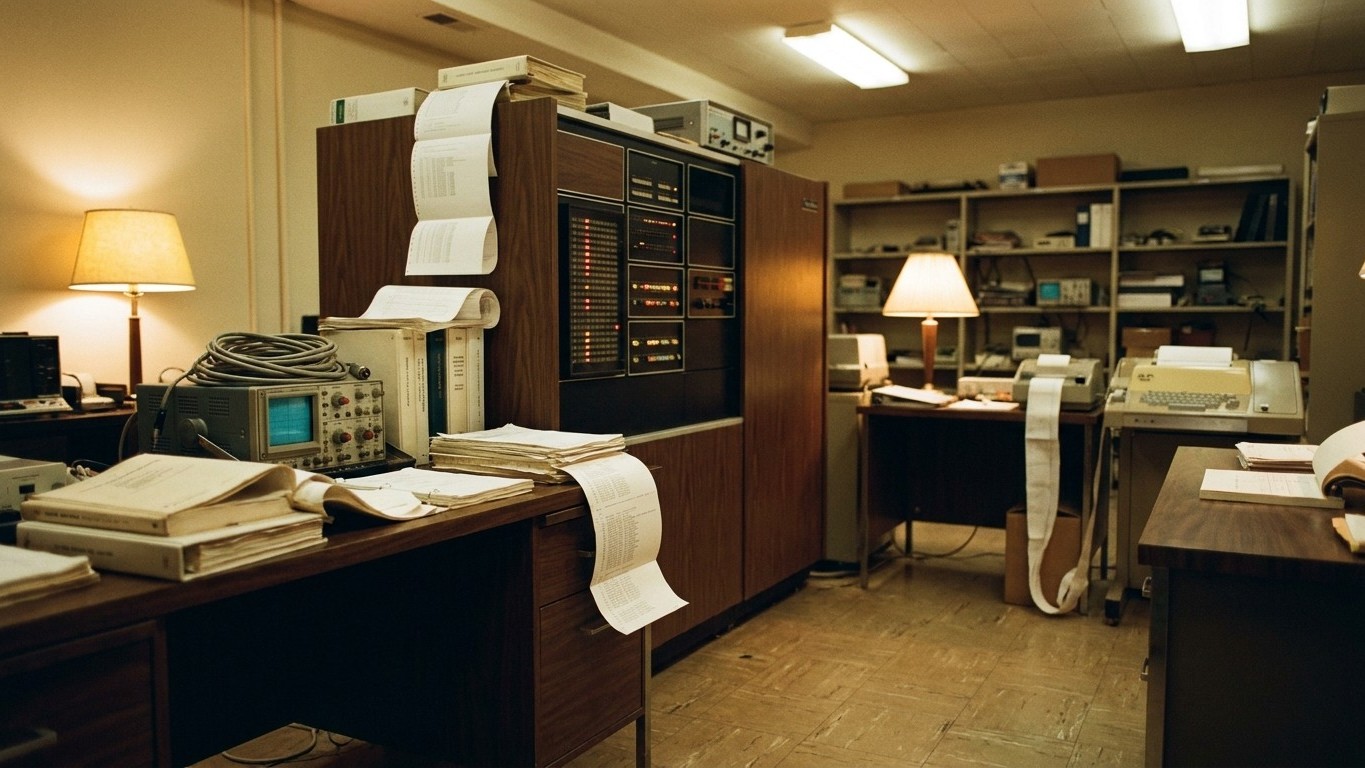
Two months before ARPANET arrived on the world stage, a small laboratory in the Paris suburbs was already building a network capable of moving data packets without relying on traditional telephone lines. That network was called Cyclades. It was designed and steered by engineer Louis Pouzin at IRIA, the institute that would later become Inria, as part of an experimental network created in 1972. A few years later, two Americans took up its ideas to construct what would become Internet. France, for its part, pulled the plug.
Key takeaways
- A French network preceded ARPANET with superior datagram-based technology
- Two American scholars directly copied French innovations to create TCP/IP
- The French administration thwarted the project to protect its own Transpac network
A laboratory that invents the datagram before anyone else
Cyclades was a pilot project of IRIA, the predecessor of Inria, designed and led by Louis Pouzin. The team started modestly: a small group that began around 1972 with about six people, including collaborators such as Jean-Louis Grangé, Hubert Zimmermann, Jean-Pierre Touchard, Michel Elie, Jean Le Bihan, and Gérard Le Lann. Pouzin set up in Rocquencourt, in IRIA facilities that had never before hosted any network project. The network’s name itself tells a flavorful story: initially called Mitranet in reference to the Mitra 15 computer, the project was renamed after someone at the Ministry of Finance deemed that it wasn’t a French name.
The real technical breakthrough was the datagram. Unlike ARPANET, which operated on a principle close to a telephone network with circuits established in advance, Cyclades broke information into independent packets that each traveled on its own and were reassembled upon arrival. Because datagrams are routed independently, they can take different routes, arrive out of order, and you must verify on arrival that all are present and reassemble them in the correct sequence. A handful of French research sites were connected at speeds that would make any modern teenager laugh—the equivalent of a few tens of kilobits per second, just enough to load a compressed photo in a few seconds. The network even crossed borders: it was symbolically deployed in Italy, at the European Space Agency, with demonstrations of interconnections to networks in the United Kingdom and Canada.
Cerf and Kahn take a close look at Paris
That is where the story pivots to the United States. As early as 1972–1973, Vinton Cerf, working on the design of TCP/IP with Robert Kahn, grasped the value of the work done on Cyclades and drew inspiration from it. This was not mere distant influence: Gérard Le Lann had directly collaborated with Vint Cerf and Bob Kahn to integrate concepts from the Cyclades project into the original Transmission Control Protocol design. The famous “catenet,” the idea of interconnecting several heterogeneous networks, sprang straight from the French team’s papers. This term appears unchanged in a 1978 technical document by Vint Cerf, which cites Louis Pouzin in the introduction. The datagram and the sliding window, the mechanism that adapts the sending rate to the network’s real capacity, would be incorporated into the specifications that would give birth to Internet as we know it.
When you type an address into a browser today, you are unknowingly using an architecture that was partly conceived in Rocquencourt, in a building lent almost by chance to a team that initially had neither a substantial budget nor a clear roadmap.
The French Touch cut off by its own administration
The cruel paradox is that Cyclades was not killed by a foreign competitor but by the French administration itself. The PTT were developing in parallel their own solution, based on virtual circuits rather than on datagrams, which would become Transpac. Data transmission remained a state monopoly in France, and IRIA needed a special exemption to operate Cyclades; the PTT did not accept the state funding a competitor to their Transpac network and demanded that authorization and funding be canceled. The political context did not help: France shifted policy in 1974 with the rise of Giscard d’Estaing to power, IRIA became INRIA, and the industrial consortium Unidata was dissolved.
The public Transpac network, for its part, was opened in December 1978 by the semi-public company Transpac and operated until June 2012. The budgetary axe therefore fell on Cyclades in the late 1970s, and the experimental network finally faded away in 1981, as several histories of the network recount: by 1981, Cyclades had to close. A former head of IRIA’s computing center, Bernard Nivelet, summed up the misfortune in a blunt formula: the attitude of the DGT caused us to lose about 15 years of industrial mastery. Fifteen years is roughly the time that would separate Cyclades’ shutdown from the commercial opening of Internet in France in the early 1990s.
An inheritance that eventually triumphed, too late for France
The irony of history is that the standard finally beaten by Paris ended up taking hold everywhere else. The datagram mode would become that of Internet, whose public opening began in 1991, and its TCP/IP standard would gradually supersede CCITT’s until Transpac was closed in 2012. The old Cyclades team members did not vanish: Louis Pouzin and the Cyclades alumni launched several follow-up projects at IRIA to experiment with local networks, satellite networks, the Unix system, and the Chorus message-passing operating system. Louis Pouzin himself continued his career to become one of the recognized voices in Internet governance, often cited as one of the “forgotten fathers” of the network of networks, a paternity that American history books long tended to downplay.
There remains an almost comic trace of this story: according to a testimony collected on the subject, in the early 2000s there was still an X.25 link used for the Minitel server of the Mines-Ponts competition results, the last vestige of a French technology that the world eventually abandoned in favor of the one that Paris, indeed, chose to smother at birth.
Sources: pixees.fr | david.fayon.free.fr
