
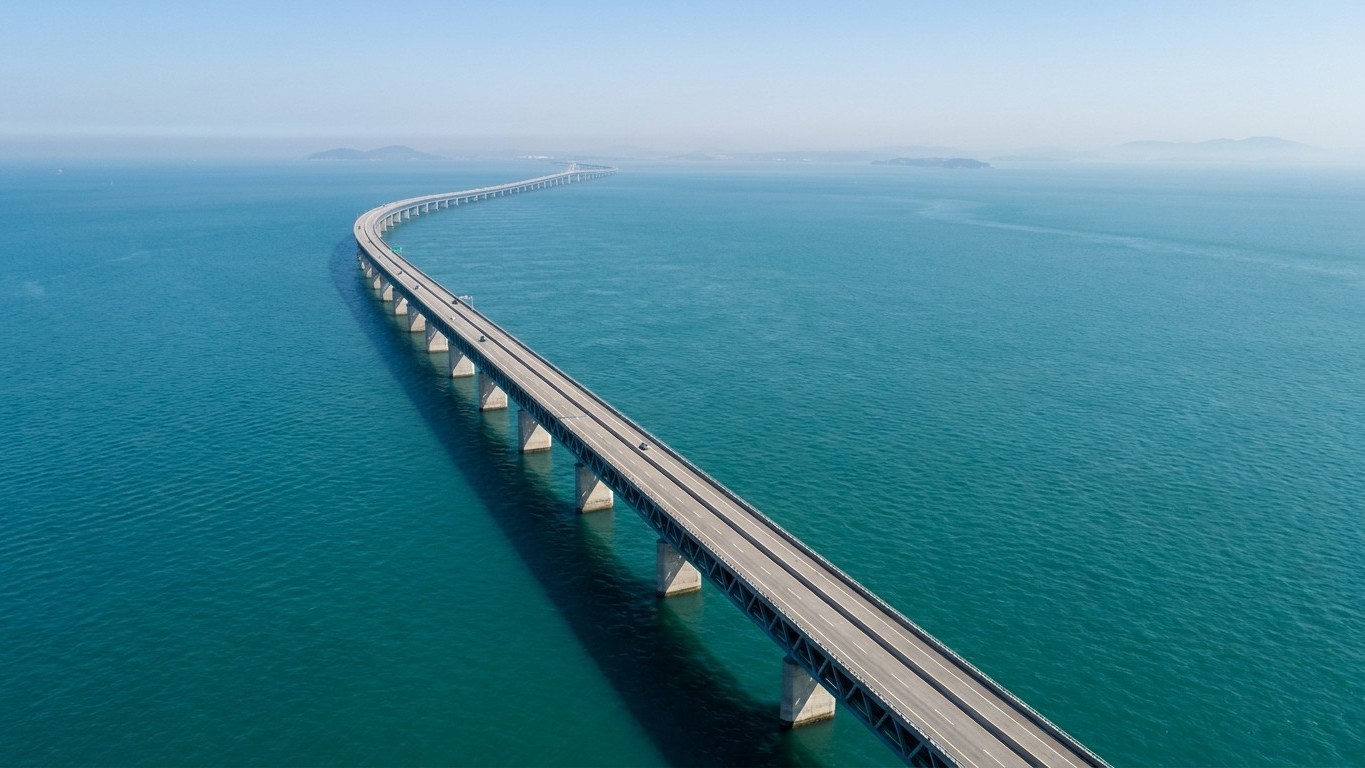
Nine years of construction, 55 kilometers of concrete and steel above the South China Sea, and a promise repeatedly hammered out by Beijing: this bridge would carry about 9,200 vehicles per day once it came into service. A year after its inauguration in 2018, the Hong Kong–Zhuhai–Macau Bridge only welcomed 4,167 on average per day, just under half of the target. This gap speaks volumes about the challenge of aligning pharaonic infrastructure ambitions with the realities on the ground.
Key takeaways
- A 55-kilometer bridge promised 9,200 vehicles per day, but accommodated fewer than 4,200 in the first year
- Strict administrative constraints and a $20 billion price tag slowed immediate uptake
- It took six years before the bridge finally met traffic goals, prompting questions about economic viability
A monumental project for an XXL promise
The bridge, costing up to $20 billion, required nearly a decade of construction, with significant delays and budget overruns. It includes an underwater tunnel allowing ships to continue traversing the Pearl River Delta, the industrial heart of South China. The numbers are staggering: the structure was built with enough steel to erect 60 Eiffel Towers, capable of withstanding earthquakes of magnitude 8 and the fiercest typhoons.
On October 23, 2018, Chinese President Xi Jinping officially inaugurated the world’s longest sea-crossing bridge linking Hong Kong, Macao and mainland China, dramatically shortening travel time between the three zones from about three hours to just 30 minutes. An undeniable technical feat: this journey that previously took several hours by ferry or by road via the mainland now completes in half an hour. On paper, everything suggested immediate success. Beijing had made it a symbol of the region’s economic integration, a totem of the “Greater Bay” intended to connect eleven cities and 68 million inhabitants.
The early disappointment: less than half the expected traffic
On opening day, October 24, 2018, reality dashed the official ambitions. Traffic was light from day one, with officials noting they did not expect many vehicles to use the route immediately and that it would take time. A prudence that proved well founded: a year later, the bridge was only moving 4,167 vehicles per day, far, far from the 9,200 promised. The project was operating at less than 45% of its announced capacity.
Several bottlenecks explain this sluggish start. First, a major administrative constraint: private car owners in Hong Kong cannot cross the bridge without a special permit, and most drivers must park at the Hong Kong port and take a shuttle or rental vehicle after immigration. It is therefore impossible to simply hop in your car and drive to Zhuhai as one would cross the Normandie Bridge. This system of quotas and permits, designed for security and customs management between different legal systems (Hong Kong drives on the left, mainland China on the right), slowed ordinary motorists from taking up the bridge.
The financial aspect of the operation already worried observers before opening. The bridge and its access roads and artificial islands cost a total of $20 billion, including $6.92 billion for the main bridge, while a Chinese-language BBC estimate pegged toll revenues at only $86 million per year. A return that, on paper, would have required more than two centuries to recoup the main bridge alone. This was enough to temper the enthusiasm of official communicators, who, on their side, offered far more flattering figures: Chinese authorities argued the project would generate up to 10 trillion yuan for the economy, a figure challenged by Hong Kong lawmakers.
The bridge eventually found its audience, but years later
The first-anniversary tally, in October 2019, remained respectable in aggregate: the bridge had welcomed more than 14 million passengers and 1.5 million vehicles since opening. Yet when broken down to a daily basis, the car traffic clearly lagged behind early ambitions. The number of vehicles entering and leaving the Zhuhai port rose from 860,000 in 2019 to 3.26 million in 2023, almost quadrupling in four years, pushing the daily average well beyond the 2019 threshold.
The real takeoff came from the gradual lifting of restrictions and a more favorable regional context. In 2024, more than 3 million trips by vehicles registered in Hong Kong or Macao were recorded at the port, representing 55% of total traffic, a sign that residents of both territories had finally embraced the infrastructure. Peak usage during Chinese holidays illustrates the progress: by early 2026, traffic on the bridge surpassed 27,000 vehicles in a single day, beating the opening-day record, with an average of around 21,000 vehicles per day during the first five days of the Spring Festival holidays. This figure, this time, far exceeded the initial target of 9,200 daily vehicles.
The story of the Hong Kong–Zhuhai–Macao Bridge illustrates a reality that major Chinese infrastructure projects often struggle to acknowledge: technical excess does not guarantee immediate usage. It took nearly six years, the loosening of cross-border circulation rules, and the rise of regional tourism for this $20 billion project to find traffic commensurate with its scale. A useful reminder as other megaprojects—in China as elsewhere—promises attendance figures that sometimes resemble political objectives more than realistic forecasts.
Sources: newsgd.com | french.news.cn | obo.fr
