
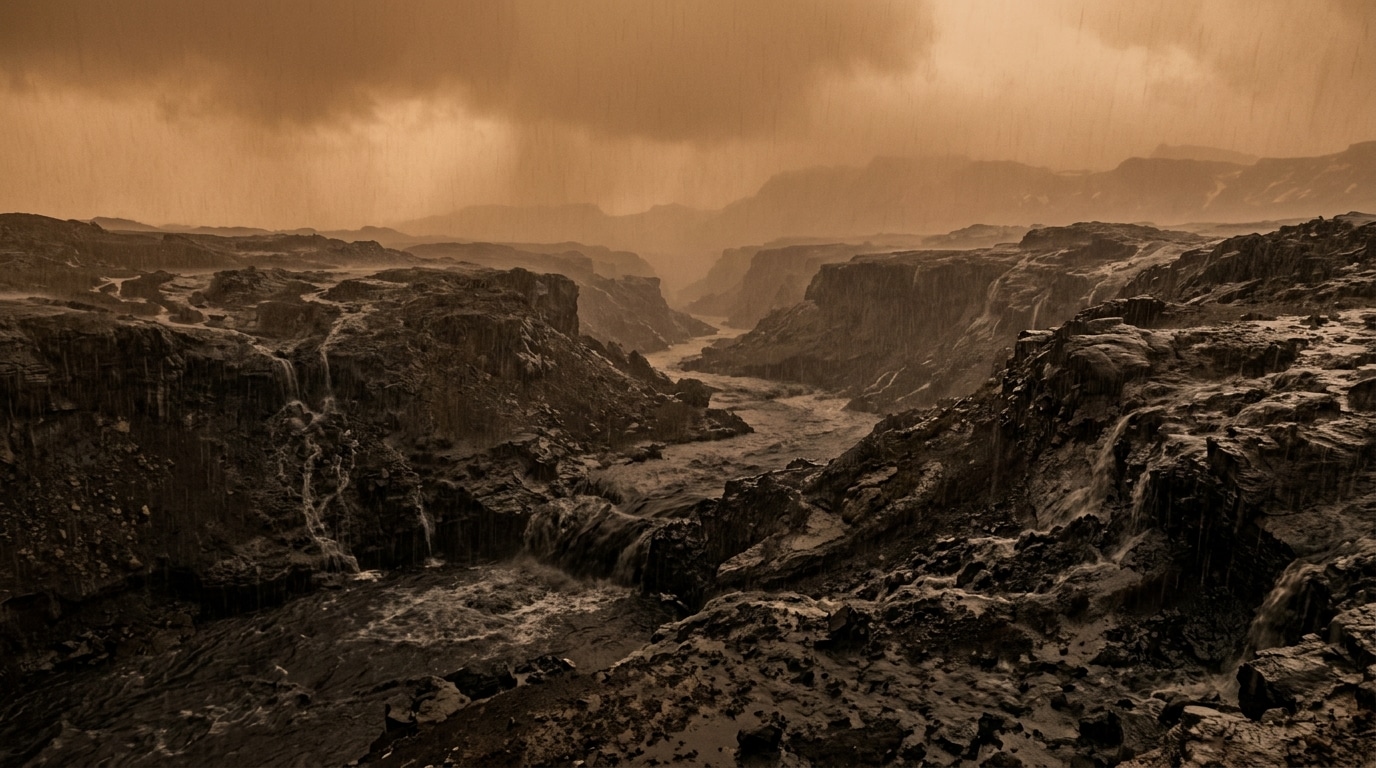
Imagine a world where the sky pours a tepid rain that isn’t refreshing, where sluggish rivers coil between frozen hills, where lakes glimmer under a mandarin-colored dome. This landscape isn’t from a science-fiction novel: it truly exists, more than a billion kilometers away from us. Titan, the largest moon of Saturn, bears a striking resemblance to Earth in its geography, yet everything here operates under rules that defy our intuition. For the liquid that flows there, the one that carves valleys and fills lakes, it isn’t water. It’s methane, kept fluid at a chilling -180 degrees. And soon, a craft of an entirely unprecedented kind will observe this spectacle up close.
A world where rain falls, but it isn’t water
On Titan, weather exists. There are clouds, showers, seasons that stretch across Earth years. But the cycle driving this little world is not the water cycle we know here. On the surface, it is so cold that water there is as hard as rock. The role played by our precious liquid on Earth is here filled by hydrocarbons, primarily methane and ethane, which remain liquid at these extreme temperatures.
The principle, however, remains surprisingly familiar. Methane evaporates from the surface, rises into the atmosphere, forms clouds, then falls again as rain. It’s a true meteorological cycle, comparable to Earth’s water cycle, with the difference that it runs on methane. This uncanny kinship makes Titan one of the few places in the Solar System where atmospheric dynamics are so close to ours. A distorted mirror of our own planet, in a sense.
Rivers and lakes that reshape an alien landscape
For millennia, these patient rains have sculpted Titan’s surface. The methane rivers carve networks of valleys, carry sediments, sculpt reliefs. Near the poles, vast expanses of liquid spread out: true hydrocarbon lakes and seas, some reaching dimensions comparable to Earth’s great lakes. Under the orange sky, constant, they shimmer like jewels frozen in the cold.
What makes Titan fascinating is this active geology shaped not by water, but by exotic chemistry. There are giant dunes made of organic grains, jagged coasts, deltas where rivers pour into lakes. All these landscapes recall Earth in form, while resting on radically different ingredients. It’s like visiting a distant country whose architecture looks strangely familiar, even though nothing is made from the same material.
Dragonfly, the drone that will soar over the impossible
To explore this extraordinary world, a machine of equal caliber was needed. NASA is preparing a bold mission named Dragonfly, scheduled to launch in 2028. It isn’t a simple wheel-driven rover like those that roam Mars, but a flying drone, a large multi-rotor helicopter capable of moving from site to site by soaring over the landscapes.
This choice is far from trivial. Titan’s atmosphere is dense, much thicker than ours, and gravity is low. These conditions make flight unusually efficient, almost easier than on Earth. Dragonfly will thus cover long distances, touch down near the methane lakes and the rains of liquid methane, collect samples, and analyze surface chemistry. The objective: understand how the building blocks of life form in such an alien environment, and perhaps answer questions that have haunted us for ages.
What Titan already reveals about our place in the universe
Titan is much more than a curiosity of astronomy. It is a natural laboratory where a complex organic chemistry unfolds, the very chemistry that on young Earth may have prepared the ground for life. By studying this moon, we effectively trace the thread of time back to a past our planet has long erased.
Studying this methane world also measures how life, or at least the conditions that precede it, could take forms we can’t imagine. Titan reminds us that the universe does not merely copy Earth’s recipe: it improvises, it invents, it composes with different elements and different temperatures.
As Dragonfly prepares to take to the skies toward this enigmatic moon, one question remains suspended in Titan’s orange sky: what if life elsewhere simply didn’t need water to exist? The answer could well upend how we contemplate the cosmos, and our own reflection in the mirror of the universe.
