
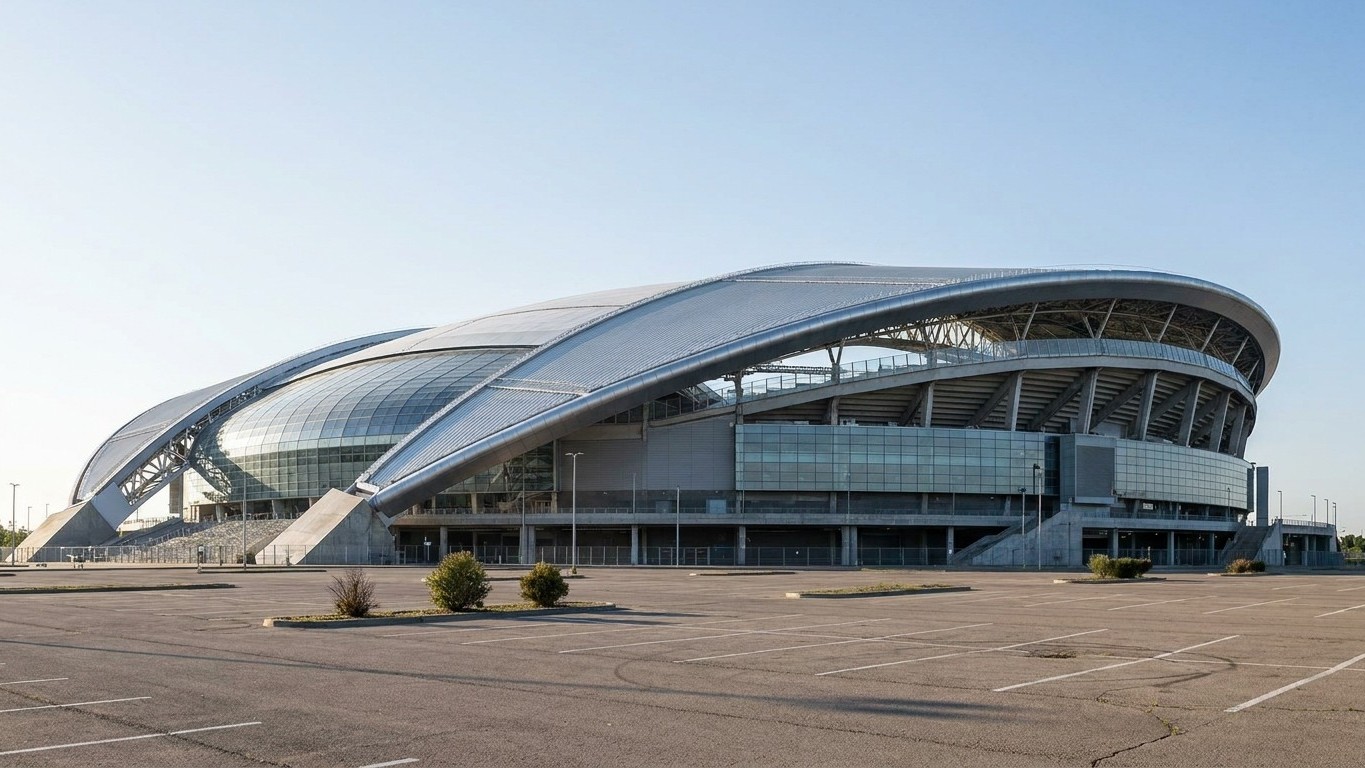
Since its opening in 2012, the Métropole Européenne de Lille has paid about 15 million euros each year to the Eiffage group to finance the Villeneuve-d’Ascq sports complex. A fixed, contractual sum that applies whether the stadium hosts fifty matches a season or sits half empty. Over more than thirty years of commitment, the bill far exceeds the 324 million euros that the building cost to construct. A budgetary paradox that, ten years after the inauguration, continues to fuel critical reports from the regional audit chamber.
Key takeaways
- Since 2012, Lille pays for its stadium in rents at twice the cost of its construction
- The contract has never ceased to be renegotiated in court, adding tens of millions more
- Alternative revenues (concerts, events) never took off, leaving taxpayers to pay alone
A Rent That Runs Until 2043
The mechanism dates back to the partnership agreement signed in October 2008 between the local authority and Elisa, a 100% Eiffage subsidiary created specially for the operation. The LMCU is in charge of reimbursing over 31 years, through this public-private partnership, the private contractor responsible for the construction and operation of the stadium, the Eiffage group, with an amount that amounts to 24.7 million euros through 2043, the concession’s end date. This figure corresponds to the contract’s theoretical ceiling; in practice, the metropolis’s net contribution has long hovered around 15 million euros per year, once revenues generated by the site’s commercial exploitation are deducted.
The mechanism is sensitive to the sports performance of LOSC, the stadium’s tenant. A report from the Court of Audits cited by regional press recalled that in the event of the club being relegated to Ligue 2, the lease contract set at 4.7 million euros excluding tax per year would fall to 1 million, which would raise the metropolis’s charges from 11 to 15 million euros per year. The Lille taxpayer pays more when the football team performs less well. A peculiarity that speaks volumes about the financial architecture of the arrangement.
324 Million in Concrete, Over 450 Million in Rents
The calculation is simple, almost brutal. The stadium cost 324 million euros in total, of which 282 million was spent on constructing the stadium itself, and 42 million on ancillary equipment around the stadium. By multiplying an annual fee of around 15 million euros by the thirty-one years of the contract, the metropolis committed to a total that approaches or surpasses 450 million euros, not counting revisions and disputes that have further swelled the bill over the years.
Because the file did not end with the initial signing. In August 2023, the Lille Administrative Court ruled on a dispute that had dragged on for years between the metropolis and Elisa. The court partially granted the requests of the company Eiffage Lille Stadium Arena, ordering the Métropole Européenne de Lille to pay it a supplementary sum of 49,937,275.85 euros for damages suffered during the construction and commissioning of the stadium. Part of this litigation centered on the calculation of the royalty: a method of calculation contrary to the contract’s stipulations was sanctioned by the court, which ordered the metropolis to pay, for the period from August 12, 2012 to December 31, 2022, the sum of 9,506,186.15 euros, corresponding to a methodological gap in the yield rate used. Each year, or almost, adds its share of financial disputes to the already heavy bill.
The PPP Principle: Build Fast, Pay Long
The public-private partnership rests on a seemingly simple logic. The community does not directly finance the construction; it entrusts to a private operator the design, financing, construction, and operation of the facility, in exchange for a rent spread over several decades. This arrangement theoretically allows transferring part of the financial risk to the private partner, expected to better manage construction and operating costs. In the Lille case, the Court of Auditors highlighted the opposite: the Lille metropolis would shoulder a large portion of the economic risk in the event of LOSC’s failure. The sports risk — relegation or a drop in attendance — thus falls on public finances rather than on the private operator expected to bear it.
The operation itself did not meet its promises. The stadium was to host concerts, cultural events, and international sporting events to diversify its revenues. In practice, the stadium’s activity has remained centered on LOSC matches and a few sporting events such as the Davis Cup or the Handball World Championship, while few concerts have been organized since 2012. As a result, the operating revenues intended to ease the metropolitan bill remained well below the initial projections of the arrangement.
What the Regional Court of Auditors Says
The final observations report from the Court of Auditors on the management of the Pierre-Mauroy stadium offers a nuanced but stern assessment on several points of the contract. The magistrates note that the overruns, according to the authorizing officer, were largely due to the stadium’s innovative nature, which combines a 50,000-seat multi-sport venue with a 25,000-seat concert hall, which justified the use of a public-private partnership, and that the metropolis left these costs to the private partner, which is the subject of ongoing litigation before the administrative court. An ambitious urban planning choice, turned into a nest of lawsuits.
On substance, the chamber also highlights governance flaws in the contract. Beyond the imperfections of the PPP contract, Elisa’s requests regarding the calculation of the various royalties can be interpreted as attempts to renegotiate the contract, even if the company disputes this reading. One could say that the 2008 contract has never ceased to be reinterpreted, adjusted, and challenged before the courts, with each revision translating into millions of euros more charged to the public authorities.
A conventional financing, where the metropolis would have directly borrowed the 324 million euros for construction on the bond markets, would likely have avoided this margin captured by the private operator over the life of the contract. The PPP offered a stadium delivered quickly, without mobilizing the public debt at the moment of construction. But thirteen years after the doors opened, the bill continues to run, year after year, until 2043. At this pace, Lille residents will have paid for their stadium almost twice before becoming fully owners.
Sources: lille.tribunal-administratif.fr | ccomptes.fr | butfootballclub.fr
