
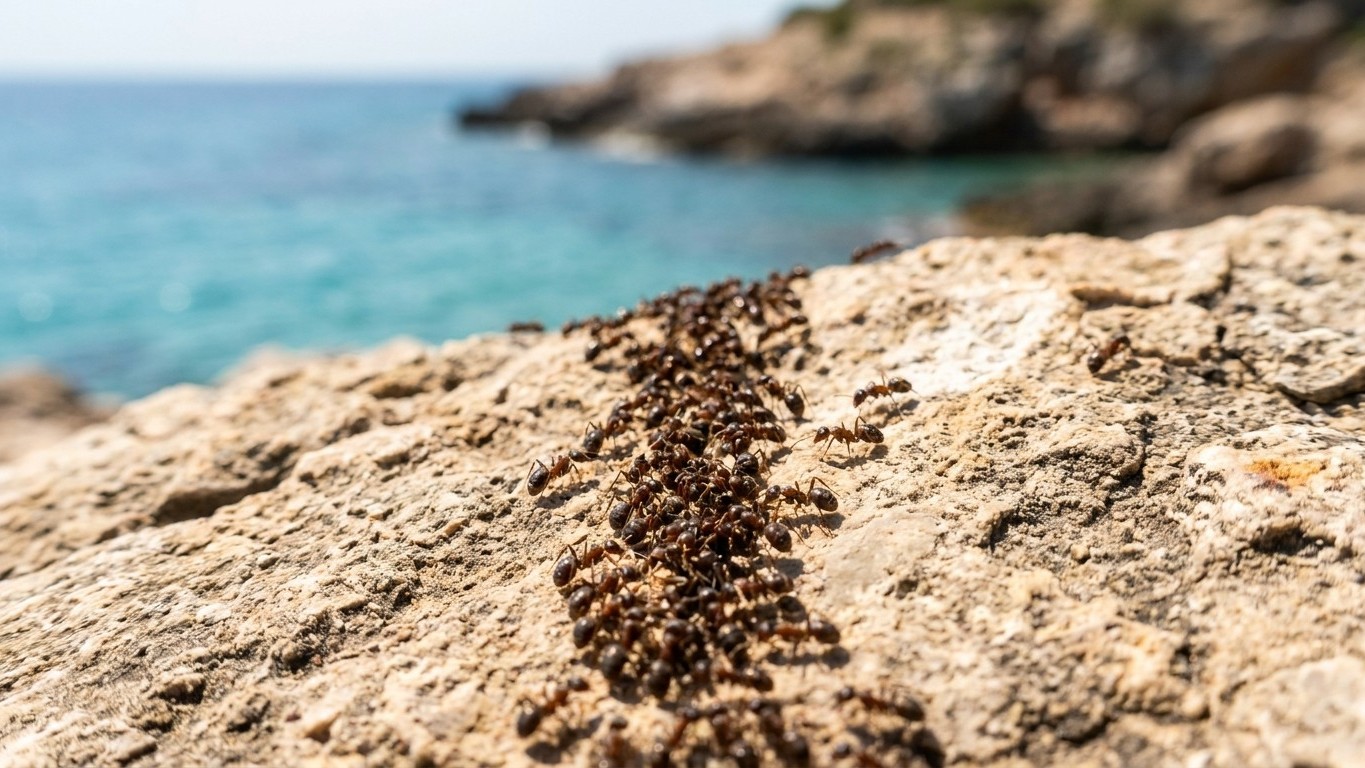
6,004 kilometers of coastline, a single, unified colony. That was the result obtained in 2002 by a team from the University of Lausanne, led by Laurent Keller, when testing the aggressiveness of Argentine ants collected along the Mediterranean and Atlantic coasts. The main supercolony, which stretches 6,000 kilometers from Italy to the Atlantic coast of Spain, constitutes the largest cooperative assemblage ever recorded. A figure that would hardly shock anyone if it involved a migratory species. But this concerns a three-millimeter ant, incapable of traversing more than a few meters in its entire life.
Key takeaways
- A colony of ants barely three millimeters long extends over more than 6,000 kilometers without ever fighting
- A revolutionary experiment showed that ants separated by Italy behave like sisters
- A genetic bottleneck has rendered these ants unable to recognize one another as enemies
A Simple Experiment That Changed Everything
The researchers’ protocol was a straightforward idea: put two ants face to face and observe what happens. In most species, two workers from different nests sniff each other, identify as strangers, and fight, sometimes to the death. The aggression never occurred between individuals belonging to the same supercolony, even when they came from nests far apart, while it was systematically intense between supercolonies. Two workers collected hundreds of kilometers apart, without any recent common ancestor, behave like perfect roommates. They groom each other, exchange food, cohabit without a trace of hostility.
The detail that intrigued the Swiss team was the discovery of two distinct and gigantic supercolonies in Southern Europe, the Catalan supercolony and the main supercolony. It was as if two peaceful nations coexisted on the same continent without ever mixing, each closed to the other but completely open internally. The chemical boundary between the two is as clear as a geopolitical border, except that it operates at the molecular scale.
The Chemical Deception That Makes War Impossible
Among ants, identity is not read on a face: it is expressed in molecules. Each individual bears on its exoskeleton a cocktail of cuticular hydrocarbons, a kind of olfactory identity card that normally allows distinguishing a nest member from an intruder. These cuticular hydrocarbons are waxy signals on the exoskeleton, used for recognition between colonies.
The problem for the Argentine ant introduced in Europe is that this identity card has become unreadable due to a lack of variety. When a colony starts with only a handful of queens and workers, their common ancestry reduces chemical differences to the point that all daughter colonies eventually carry the same signature. Recent work estimates that these European populations arose from barely a few dozen founding reproductive individuals, revealing a pronounced founder effect. A genetic bottleneck explains why ants separated by the length of Italy no longer distinguish themselves: they smell, chemically, like sisters.
The situation sharply contrasts with what happens in the species’ original range. In the South American homeland, Linepithema humile populations show a more fragmented structure, and workers from different colonies can be aggressive toward one another. There, a colony stays modest, confined to a few meters or at most a few kilometers. In Europe, the species has shed this defensive reflex and gained a colossal advantage.
An Army Without Internal Borders
Not fighting changes everything at the scale of an ecosystem. Each skirmish between colonies costs energy, injures workers, and wastes foraging time. By removing this cost, the Argentine ant can devote all its resources to exploiting the territory. The loss of aggressiveness among a vast number of nests has eliminated a large portion of the costs associated with defending territories, allowing very high densities and concentrating energy on resource gathering and competition with other species. Result: local ants, which still fight between rival colonies, simply lack the means to resist a unified army.
The species arrived on the continent in the early 20th century, accidentally introduced to Europe a little over a century ago via the holds of merchant ships loaded with plants from the Paraná River region. The Mediterranean climate, very close to that of its native range, provided an almost perfect playing field. Today, these ants are familiar to anyone who has lived along the coast between Spain and Italy: they are the ones that invade jars of jam left open in tight columns on a kitchen counter.
The phenomenon does not stop at European borders. Comparative analyses have shown that these populations share chemical profiles with supercolonies identified elsewhere in the world, notably in California and Japan, suggesting a single global cooperative network. Nothing comparable existed before among social insects: until this discovery, the largest known ensemble was a Japanese colony comprising about 306 million workers spread across 45,000 nests, but confined to less than three square kilometers. The Mediterranean supercolony shatters this reference by changing the very scale of geography.
What makes the story almost vertigo-inducing is that none of these billions of workers will ever see the entire territory they occupy. An ant born near Barcelona and another born in Tuscany belong to the same society without ever meeting during their lifetimes. The colony exists nonetheless, like a nation without a capital or visible borders, held together by a single waxy molecule deposited on each exoskeleton.
Sources: letemps.ch | link.springer.com | researchgate.net
